
Science Highlights
Discovery of PSR J1227-4853: Transitioning from Low-mass X-Ray Binary to Redback Millisecond Pulsar
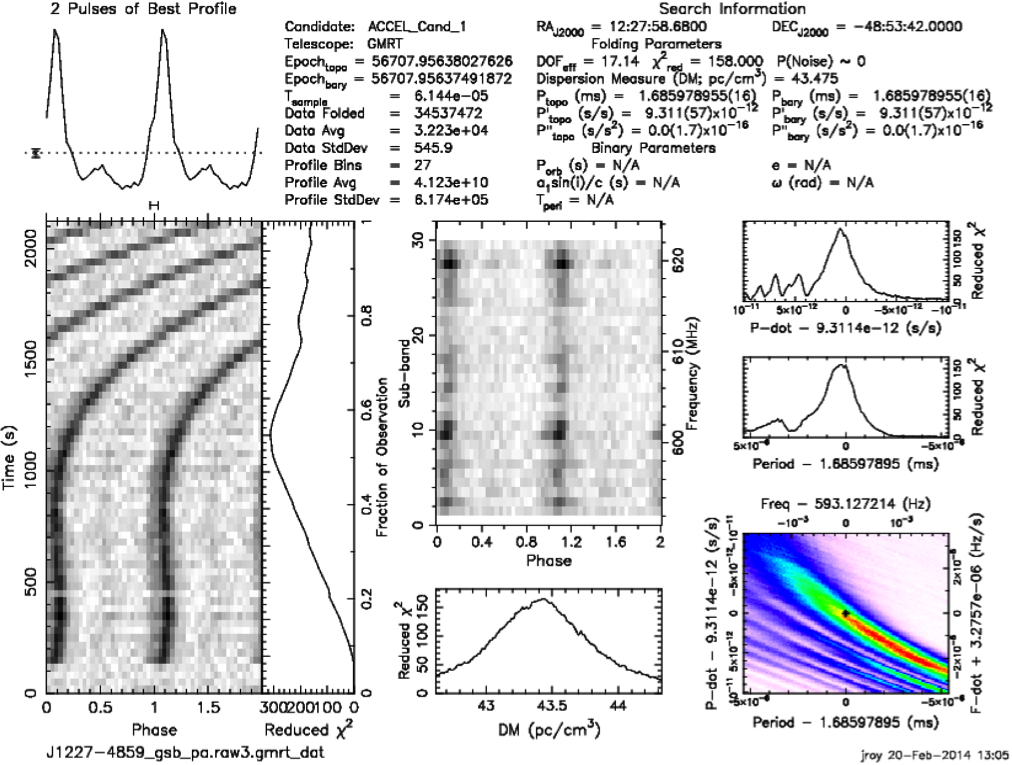
Low-mass X-ray binaries (LMXB s) and radio millisecond pulsars (MSP s) are linked through stellar and binary evolution, where MSP s are the end products of an episode of accretion of matter and angular momentum from the binary companion during the LMXB state. Over the last decade, the discovery of three transitional millisecond pulsars (tMSP s) has allowed a detailed study of the recycling process. Recent studies of PSR J1824−2452I and PSR J1023+0038 have observationally demonstrated the LMXB – MSP evolutionary link. These systems show direct evidence of back-and-forth state switching between radio MSP and accreting X-ray millisecond pulsar regimes and opened a new avenue of research in pulsar astrophysics. The third such tMSP system, J1227-4853, was discovered by us using the GMRT. PSR J1227-4853 is a 1.69 millisecond pulsar at a dispersion measure of 43.4 pc/cm^3. It transited into the active radio-MSP phase associated with a sudden drop of its X-ray and optical luminosity in 2012 December. Extreme orbital perturbations as well as the signature of proper motion are revealed from our GMRT timing campaign. This pulsar, an "recentResults"eclipsing redback , is the only transitioning system currently in an active rotation-powered state. Simultaneous imaging and timing observations with the GMRT were used to directly show that eclipses are caused by absorption rather than dispersion smearing or scattering. A long-term timing study of PSR J1227-4853 is currently under way, which will help to determine whether these transitional systems will eventually be canonical radio MSP s or whether they form a new sub-class of MSP s that continue to transition between the two states. Also, such studies will result in better understanding of the spin evolution of the systems and the dynamics of accretion during the accretion-powered, propeller stage and the rotation-powered stage. The figure shows the pulsar search output for PSR J1227-4853 showing rapid evolution of period and period-derivative in a compact binary system.
Coherently dedispersed gated imaging of millisecond pulsars
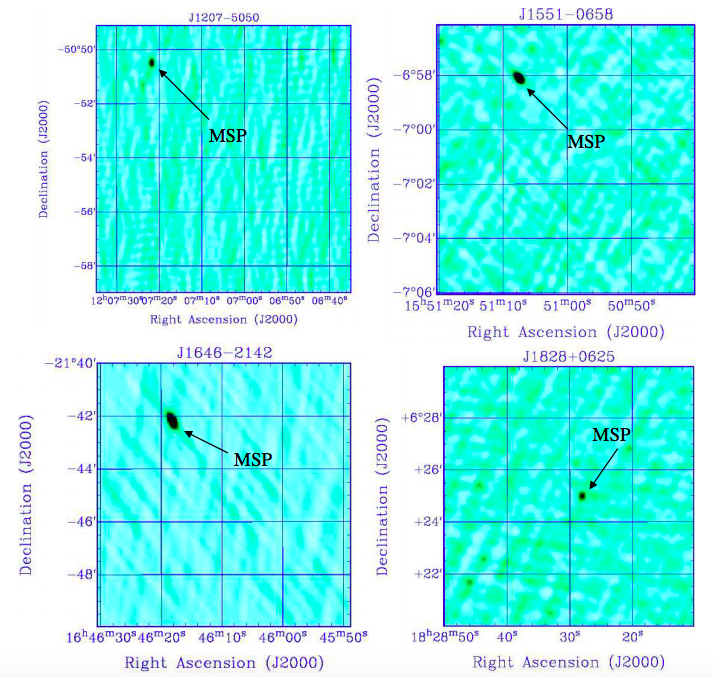
The discovery of millisecond pulsars (MSP s) and their precise localisation using existing methods is hindered by their intrinsic fainter nature. This leads to significant delays between the discovery of MSP s and their further identification using conventional imaging methods. Motivated by the need for rapid localization of newly-discovered faint MSP s, we have developed a coherently dedispersed gating correlator for the GMRT. This gating correlator accounts for the orbital motions of MSP s in binary systems, while folding the visibilities with a best-fit topocentric rotational model derived from a periodicity search using simultaneously generated beamformer output. With this technique, the signal-to-noise ratio of the detection of an MSP in the image domain can be dramatically improved (by a factor of as much as 5). We have also incorporated a superior approach of dispersion correction, called coherent dedispersion, in our imaging technique to reconstruct the intrinsic pulse shape of such MSP s. We could unambiguously localize newly discovered Fermi MSP s in the on–off gated image plane with an accuracy of ±1â€. Immediate knowledge of such a precise position enables the use of sensitive coherent beams of array telescopes for follow-up timing observations, which substantially reduces the use of telescope time (by a factor of 20 for the GMRT!). In addition, a precise a priori astrometric position reduces the effect of large covariance in timing fit, which in turn accelerates the convergence to an initial timing model. Moreover, such accurate positions allow for rapid identification of pulsar counterparts in optical and X-ray wavelengths. Figure caption: On–off gated images for newly discovered Fermi MSP s. All the MSP s are marked in the respective 10’ × 10’ facet images.
Coherently dedispersed gated imaging of millisecond pulsars
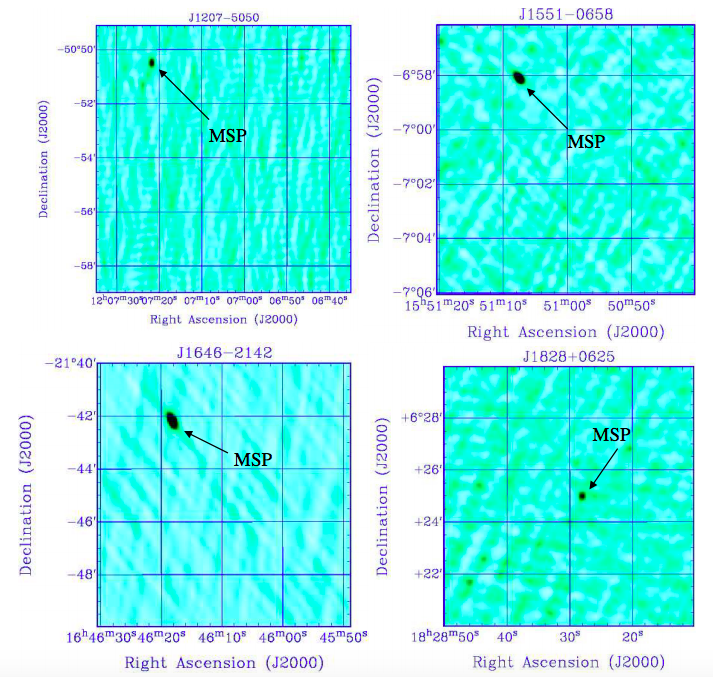
The discovery of millisecond pulsars (MSP s) and their precise localisation using existing methods is hindered by their intrinsic fainter nature. This leads to significant delays between the discovery of MSP s and their further identification using conventional imaging methods. Motivated by the need for rapid localization of newly-discovered faint MSP s, we have developed a coherently dedispersed gating correlator for the GMRT. This gating correlator accounts for the orbital motions of MSP s in binary systems, while folding the visibilities with a best-fit topocentric rotational model derived from a periodicity search using simultaneously generated beamformer output. With this technique, the signal-to-noise ratio of the detection of an MSP in the image domain can be dramatically improved (by a factor of as much as 5). We have also incorporated a superior approach of dispersion correction, called coherent dedispersion, in our imaging technique to reconstruct the intrinsic pulse shape of such MSP s. We could unambiguously localize newly discovered Fermi MSP s in the on–off gated image plane with an accuracy of ±1â€. Immediate knowledge of such a precise position enables the use of sensitive coherent beams of array telescopes for follow-up timing observations, which substantially reduces the use of telescope time (by a factor of 20 for the GMRT!). In addition, a precise a priori astrometric position reduces the effect of large covariance in timing fit, which in turn accelerates the convergence to an initial timing model. Moreover, such accurate positions allow for rapid identification of pulsar counterparts in optical and X-ray wavelengths. Figure caption: On–off gated images for newly discovered Fermi MSP s. All the MSP s are marked in the respective 10’ × 10’ facet images.
The GMRT High Resolution Southern Sky (GHRSS) survey
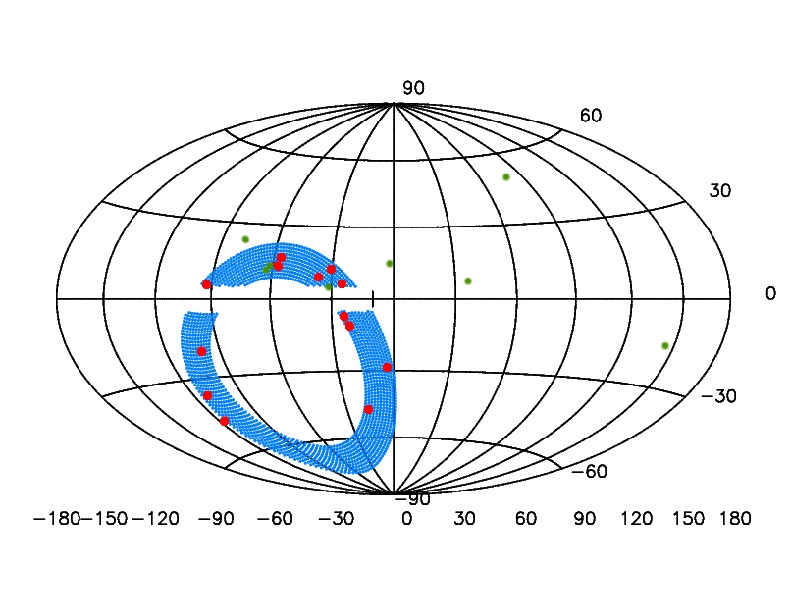
Bhattacharyya et al. used the outstanding GMRT potential for low-frequency pulsar surveys in the GMRT High Resolution Southern Sky (GHRSS) survey, a low-frequency survey for pulsars and transients away from the Milky Way s plane. The GHRSS survey covers Galactic latitudes |b|>5 degrees, scanning the southern sky, with declination -40 degrees to -54 degrees. This declination coverage is complementary to the coverage of other ongoing low-frequency sky surveys around the world. The first phase of the GHRSS survey was carried out using the narrow bandwidths of the GMRT Software Backend, at 322 MHz, and has already resulted in the discovery of bunch of new pulsars with exciting properties. Bhattacharyya et al. discovered 13 pulsars in the GHRSS survey in a surveyed area of 1800 square degrees, i.e. 0.007 pulsars per square degree, which is one of the highest among pulsar surveys away from the Milky Way’s plane. GHRSS survey discoveries include a millisecond pulsar (in a ~10 hour orbit around a ~0.18 solar mass companion star), a pulsar for which gamma-ray pulsations have been discovered using the Fermi Large Area Telescope, and two mildly recycled pulsars. The second phase, using the GMRT Wideband Backend and the 250-500 MHz receivers of the upgraded GMRT is now under way. Deatils: http://www.ncra.tifr.res.in/ncra/research/research-at-ncra-tifr/research-areas/pulsarSurveys/GHRSS
Ionized carbon and dust emission from high-redshift galaxies
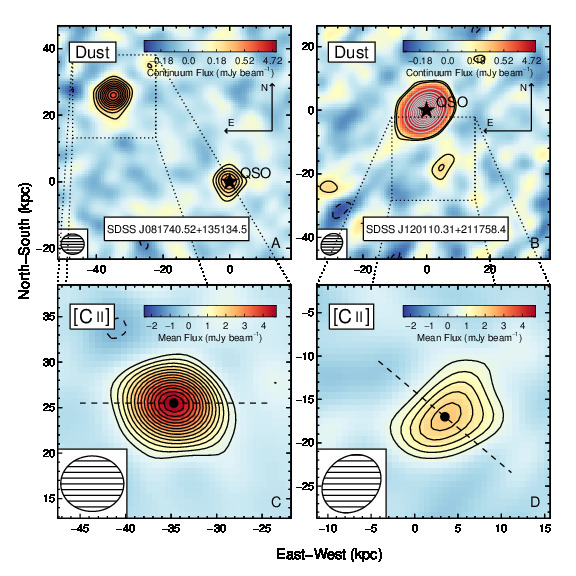
Gas surrounding high-redshift galaxies has been studied through observations of damped Lyman-alpha absorbers toward background quasars for decades. However, it has proven difficult to identify and characterize the galaxies associated with these absorbers due to the intrinsic faintness (at optical wavelengths) of the foreground galaxies compared with the background quasars. Neeleman et al. used the Atacama Large Millimeter/Submillimeter Array to obtain the first detections of ionized carbon ([CII]) 158-micron line and dust-continuum emission from two galaxies associated with damped Lyman-alpha absorbers at very high redshifts, z~4. The two upper panels of the figure show the dust continuum emission from the galaxies, while the lower panels show the [CII] 158-micron line emission. The results indicate that the host galaxies of the two absorbers are massive, dusty and rapidly star-forming systems. The hosts appear to be embedded in enriched neutral hydrogen gas reservoirs that extend well beyond the star-forming interstellar medium of the galaxies. The figure shows the two detections of ionized carbon (bottom panels) and dust continuum emission (top panels) from the two DLAs at z~4.
The spin temperature of high-redshift damped Lyman-alpha systems
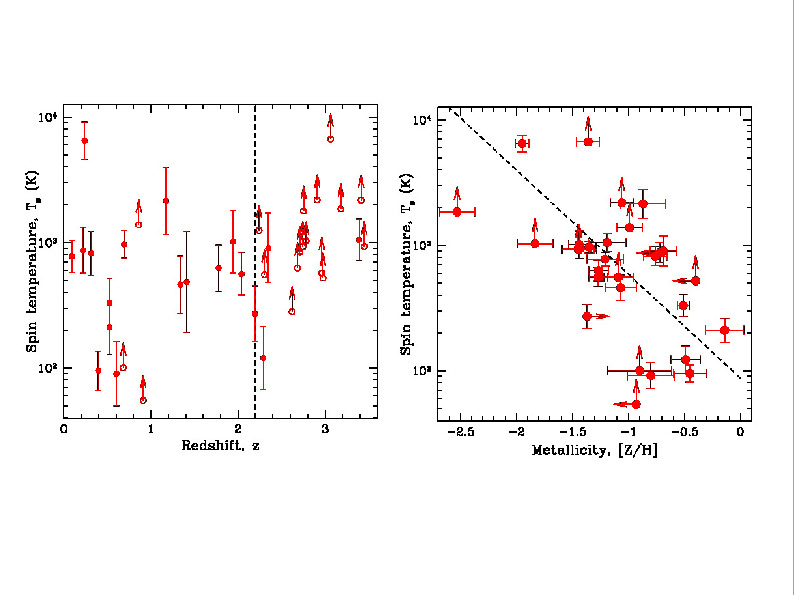
Kanekar et al. report results from a large programme aimed at investigating the temperature of neutral gas in high-redshift damped Lyman-alpha absorbers (DLAs). This involved (1) HI 21cm absorption studies of a large sample of DLAs towards radio-loud quasars, to measure the spin temperature (2) very long baseline interferometric studies to measure the low-frequency quasar core fractions, and (3) optical/ultraviolet spectroscopy to determine DLA metallicities and the velocity widths of low-ionization metal lines. Kanekar et al. found a statistically significant difference between the spin temperature distributions in the high-redshift (z > 2.4) and low-redshift (z < 2.4) DLA samples: the high-z sample contains more DLAs with high spin temperature, >~ 1000 K. The high DLA spin temperatures arise due to low fractions of the cold neutral medium (CNM): only two of 23 DLAs at z > 1.7 have CNM fractions > 20%, comparable to the median value (~ 27%) in the Milky Way. Kanekar et al. robustly confirmed the presence of an anti-correlation between spin temperature and metallicity [Z/H], via a non-parametric Kendall-tau test. The data thus appear to indicate that high-redshift DLAs have significantly larger fractions of the warm phase of neutral hydrogen than is present in the Milky Way and local spiral galaxies, probably because the paucity of metals in the absorbers implies a lack of cooling routes in the absorber host galaxies. The figure shows the spin temperature of the DLAs of the sample plotted versus redshift (left panel) and metallicity (right panel). The left panel shows that there is a higher fraction of DLAs with high spin temperatures at high redshifts, z>1.7. The anti-correlation between spin temperature and metallicity is clearly visible in the right panel.
GMRT detections of HI 21cm absorption in two damped Lyman-alpha absorbers at z~2
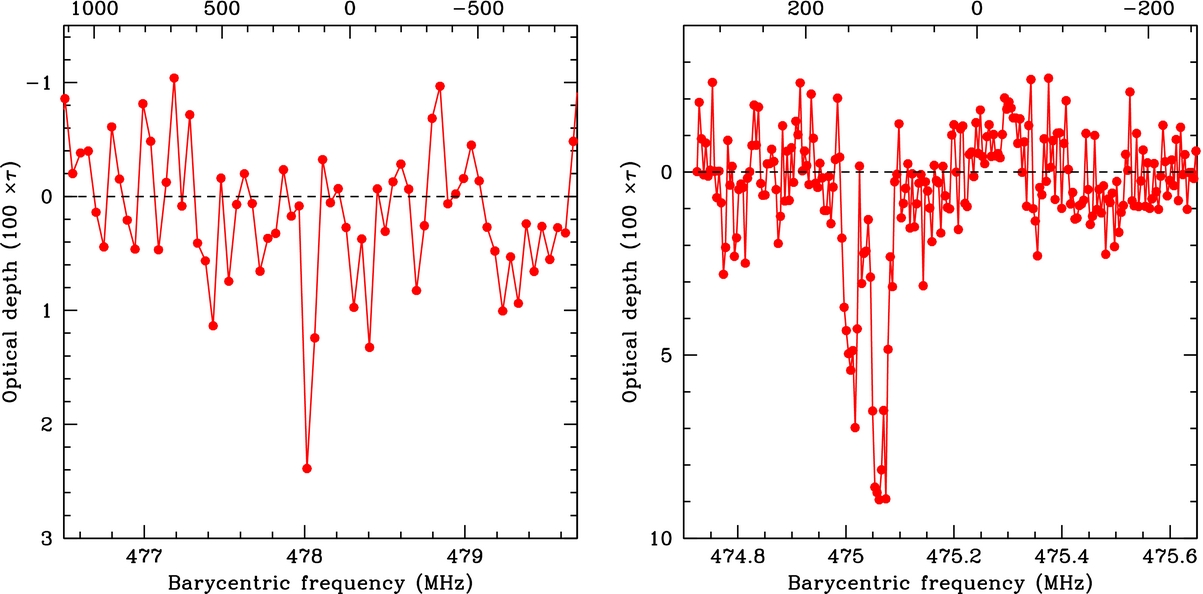
Kanekar used the new 250-500 MHz receivers of the upgraded GMRT to detect redshifted HI 21cm absorption in two high column density damped Lyα absorbers (DLAs) at z ~ 2. Both absorbers have high inferred integrated HI 21cm optical depths, and hence low spin temperatures. However, for the z=1.9698 DLA toward TXS1755+578, the difference in HI 21cm and C I profiles and the weakness of the radio core suggest that the HI 21cm absorption arises toward radio components in the jet, and that the optical and radio sightlines are not the same; this precludes an estimate of the DLA spin temperature. For the z=1.9888 DLA toward TXS1850+402, the HI 21cm absorption yields a DLA spin temperature ~ 372 K, lower than typical spin temperature values in high-z DLAs. This low spin temperature and the relatively high metallicity of the z=1.9888 DLA are consistent with the anti-correlation between metallicity and spin temperature that has been found earlier in damped Lyα systems. The figure shows the two new GMRT HI 21cm absorption detections.
The temperature of the warm neutral medium in the Milky Way
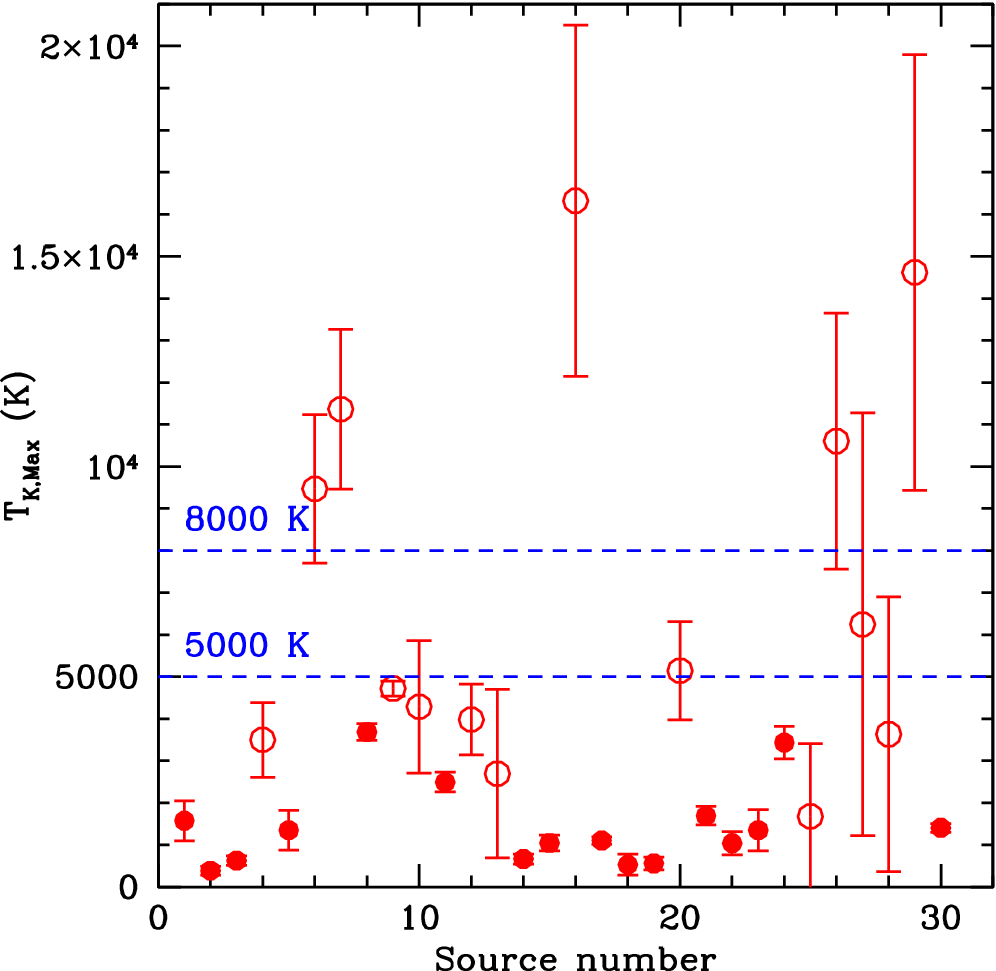
Roy et al. used deep, high velocity resolution HI 21cm absorption spectra towards 32 sources, obtained with the Giant Metrewave Radio Telescope (GMRT) and the Westerbork Synthesis Radio Telescope (WSRT) to probe physical conditions in the Galactic neutral hydrogen (HI). The HI 21cm absorption spectra are sufficiently sensitive to detect HI 21cm absorption by the warm neutral medium (WNM). Comparing these spectra with HI 21 cm emission spectra from the Leiden-Argentine-Bonn (LAB) survey, Roy et al. show that some of the absorption detected on most sightlines must arise in gas with temperatures higher than that in the stable cold neutral medium (CNM). A multi-Gaussian decomposition of 30 of the HI 21cm absorption spectra yielded very few components with linewidths in the temperature range of stable WNM, with no such WNM components detected for 16 of the 30 sightlines. Some of the detected HI 21cm absorption along 13 of these sightlines must arise in gas with spin temperatures larger than the CNM range. For these sightlines, the authors use very conservative estimates of the CNM spin temperature and the non-thermal broadening to derive strict upper limits to the gas column densities in the CNM and WNM phases. Comparing these upper limits to the total HI column density, at least 28 per cent of the neutral hydrogen must have temperatures in the thermally unstable range (200-5000 K). The GMRT and WSRT data hence robustly indicate that a significant fraction of the gas in the Galactic interstellar medium has temperatures outside the ranges expected for thermally stable gas in two-phase models. The figure shows the maximum kinetic temperature of the different components on each of the 30 sightlines, from the multi-Gaussian fits. The stable WNM temperature range (5000–8000 K) is indicated by the horizontal dashed lines. Components with temperatures consistent with stable WNM are indicated by open circles, while those definitely outside the above range (at >= 3 sigma significance) are shown as filled circles.
The temperature of the diffuse HI in the Milky Way - I. High resolution HI 21 cm absorption studies
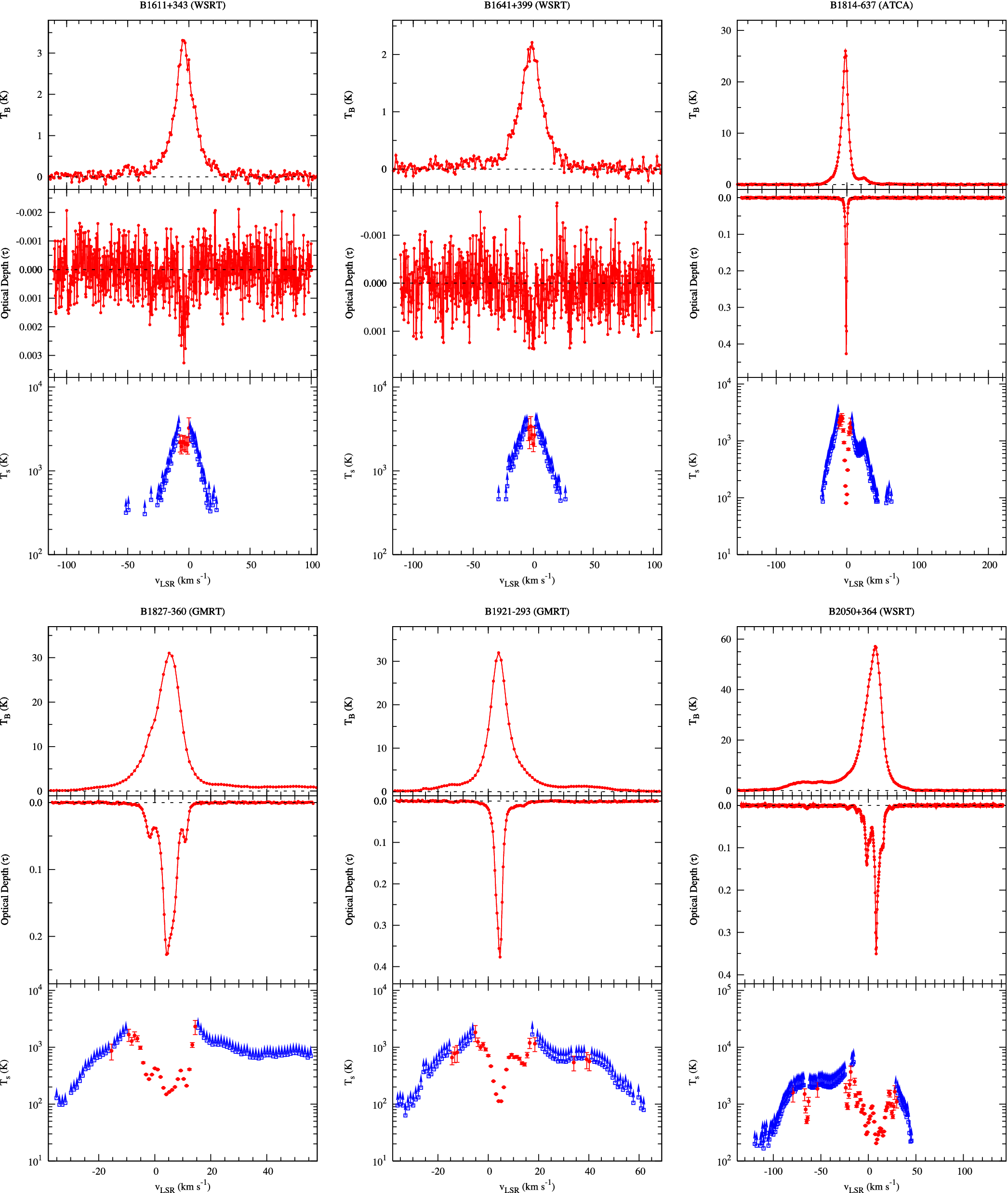
Roy et al. used the Giant Metrewave Radio Telescope (GMRT) and the Westerbork Synthesis Radio Telescope (WSRT) spectra to obtain deep, high velocity resolution HI 21cm absorption spectra of 32 compact extra-galactic sources. These are amongst the deepest HI 21cm absorption spectra ever obtained, with optical depth root-mean-square noise < 0.001 per 1 km/s velocity channel, sufficiently sensitive to detect HI 21cm absorption from the warm neutral medium along all sightlines. HI 21cm absorption was detected against all background sources but one, B0438-436. Roy et al. used the detected HI 21cm spectra to infer the spin temperature as a function of velocity along each sightline. On every sightline, the maximum spin temperature detected (at >= 3 sigma significance) is >= 1000 K, indicating that the warm neutral medium is being detected along most sightlines. This is by far the largest sample of Galactic HI 21 cm absorption spectra of this quality, providing a sensitive probe of physical conditions in the neutral atomic interstellar medium. The figure shows the HI 21cm emission spectrum (top), the HI 21cm absorption spectrum (middle), and the spin temperature spectrum (bottom) for six of the 32 targets. HI 21cm absorption is clearly detected against all sources.
GMRT Discovery of PSR J1544+4937: An Eclipsing Black-widow Pulsar Identified with a Fermi-LAT Source
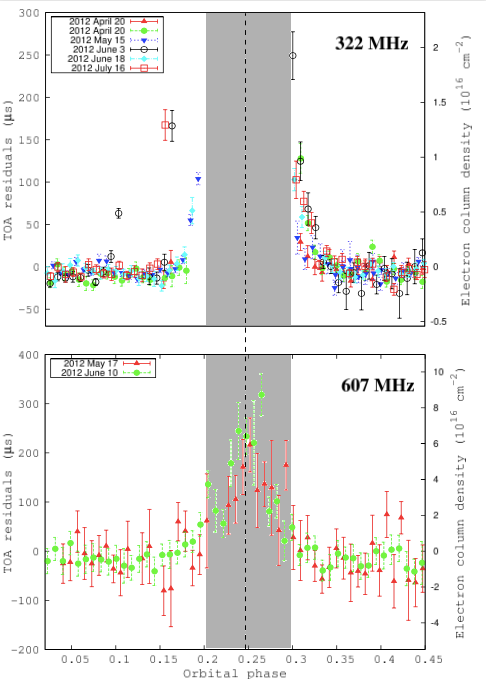
Bhattacharyya et al. used the GMRT to perform deep observations to search for radio pulsations in the directions of unidentified Fermi Large Area Telescope (LAT) gamma-ray sources, resulting in the discovery of a new milli-second pulsar (MSP), PSR J1544+4947, an eclipsing MSP in a special evolutionary state. PSR J1544+4937 is a 2.16 ms pulsar in a 2.9-hour compact circular orbit with a very low-mass companion star (mass > 0.017 solar masses). At 322 MHz, the pulsar is found to be eclipsing for 13% of its orbit, whereas at 607 MHz the pulsar is detected throughout the low-frequency eclipse phase. Variations in the eclipse ingress phase are observed, indicating a clumpy and variable eclipsing medium. Moreover, additional short-duration absorption events are observed around the eclipse boundaries. The authors used the radio timing solutions to detect gamma-ray pulsation from the pulsar, confirming it as the source powering the gamma-ray emission. The figure shows the frequency-dependent eclipsing detected with the GMRT in PSR J1544+4937. The pulsar radiation is seen to be eclipsed by the companion star at 322 MHz, but not at 607 MHz. The figure plots the variation of the timing residuals and the electron column density around the eclipse phase (which is indicated by the shaded region) at 322 MHz (top) and 607 MHz (bottom).