
Science Highlights
High-resolution Giant Metrewave Radio Telescope HI 21 cm Imaging of the Host Galaxy of FRB 20250316A
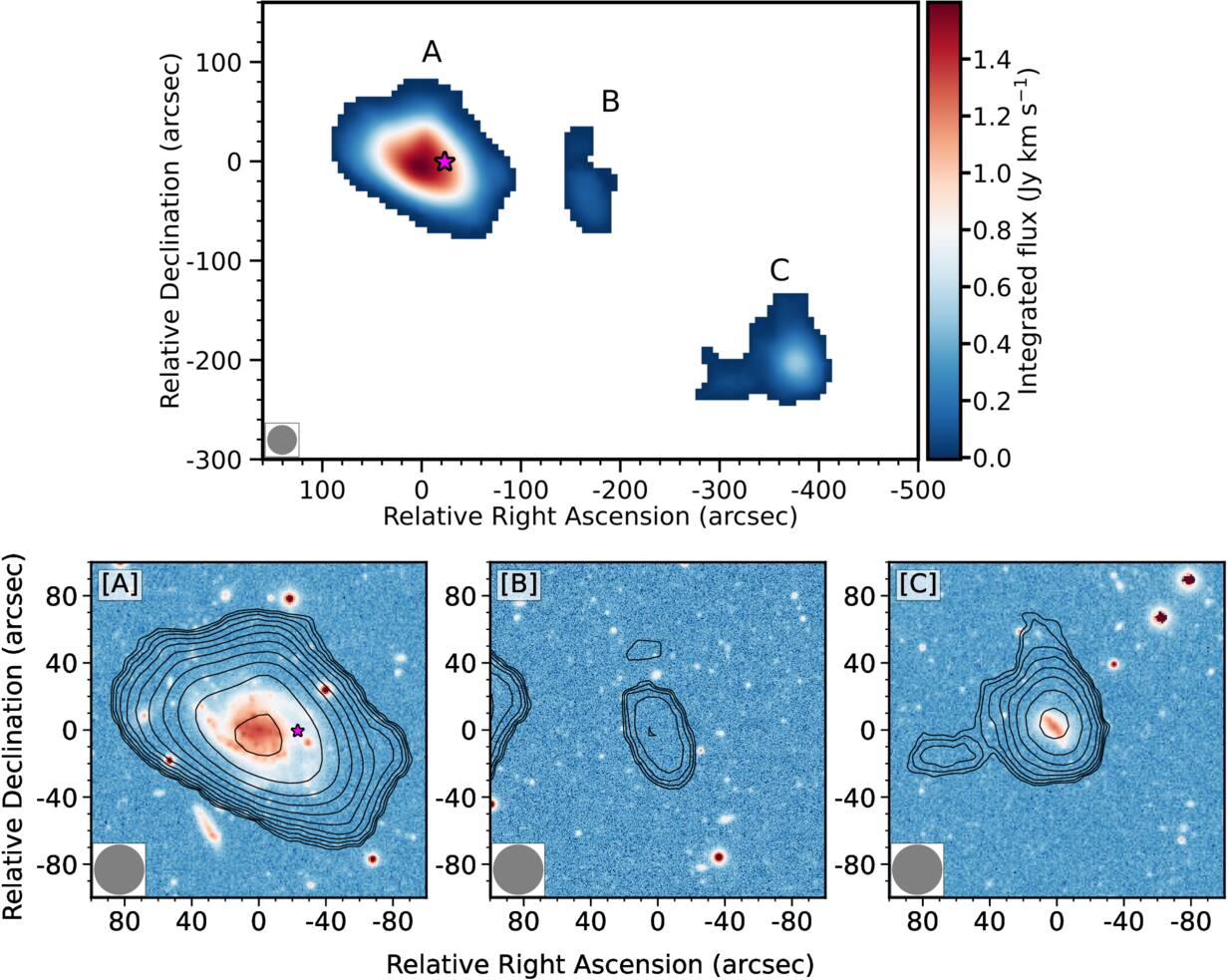
Kaur et al. report Giant Metrewave Radio Telescope (GMRT) HI 21 cm imaging of NGC 4141, the host galaxy of FRB 20250316A at z=0.0063. The GMRT HI 21 cm images have spatial resolutions, at z=0.0063, of approximately 0.48-8.0 kpc, and provide evidence for (i) a companion galaxy, LEDA 2582852, to the southwest, (ii) a nearby (27 kpc distant) HI cloud to the southwest, (iii) disturbances in the HI distributions of both NGC 4141 and LEDA 2582852, and (iv) high HI column densities in the southwestern outskirts of NGC 4141. A Sloan Digital Sky Survey spectrum yields a low metallicity and a high star formation rate (SFR) surface density in the southwestern disk of NGC 4141, and an H-alpha-based SFR estimate that is significantly higher than that at the same location from the Galaxy Evolution Explorer near-ultraviolet image, indicating a recent burst of star formation. The total SFR of NGC 4141 is also found to be higher via the H-alpha line than from the 1.4 GHz radio continuum. The above evidence indicates that NGC 4141 has recently (within the last roughly 3 Myr) acquired metal-poor gas, via either a merger or accretion, that resulted in the southwestern starburst and that may also have triggered large-scale star-formation activity in NGC 4141, resulting in the formation of the stellar progenitor of FRB 20250316A and the other transients. The highest-resolution (480 pc) GMRT HI 21 cm image finds no HI 21 cm emission from the location of FRB 20250316A or the nearby star-forming region, suggesting that most of the HI here has been either ionized or converted into the molecular phase. The non-detection of continuum emission at the location of FRB 20250316A yields one of the strongest current constraints on the radio luminosity of a persistent radio source associated with the fast radio burst. The figure shows the 30-arcsecond resolution GMRT HI image of the field of NGC 4141: three sources are clearly visible in the top image, marked as A (NGC 4141), B (a neighboring HI cloud), and C (LEDA 2582852); the lower panels show zoom-ins on the three sources. The position of FRB 20250316A is indicated by the magenta star.
Detection of Giant Pulses from the Transitional Millisecond Pulsar J1227-4853
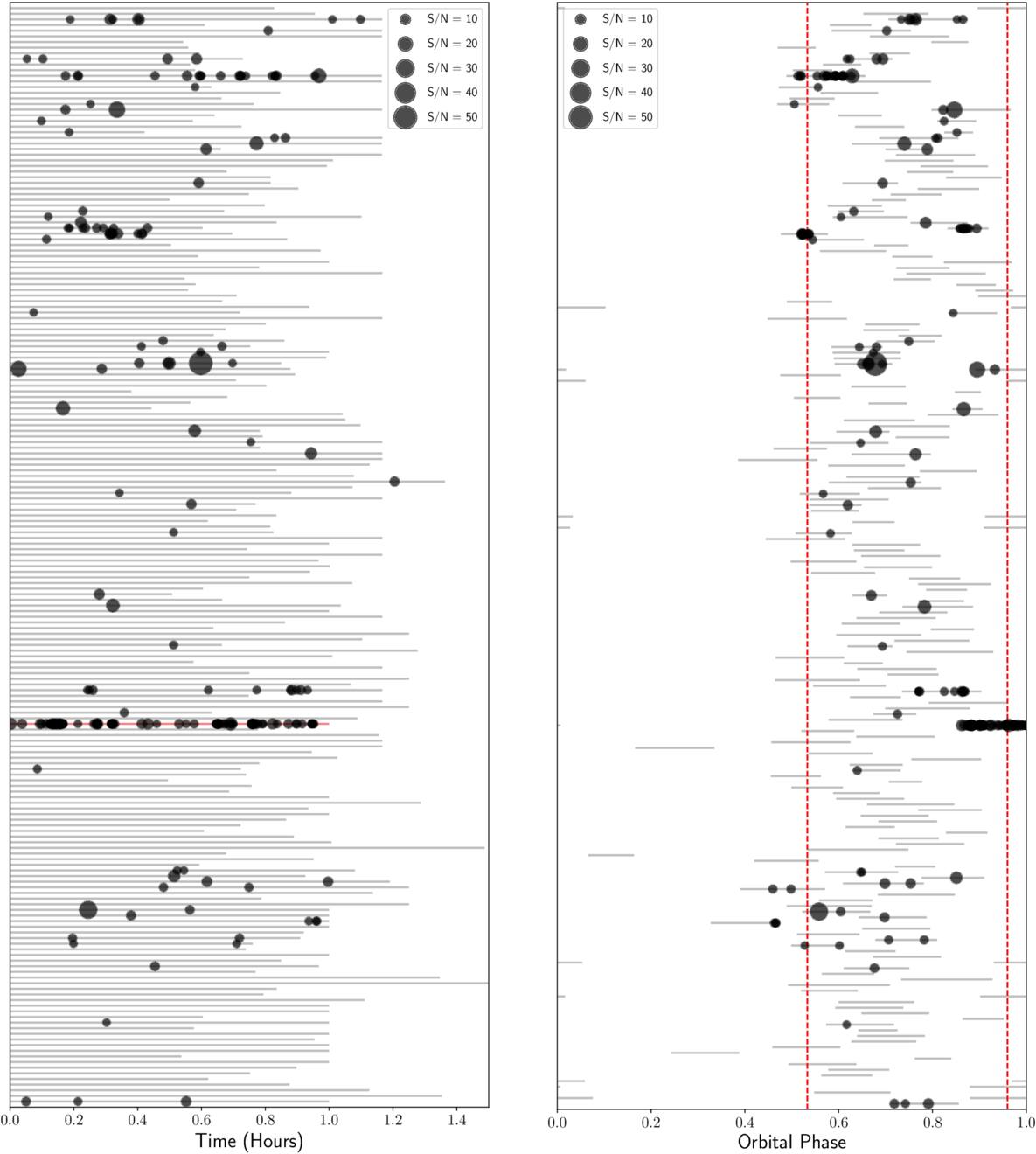
Millisecond pulsars are rapidly rotating neutron stars that emit regular pulses of radio waves, but a small number are also known to produce extremely bright and short-duration bursts known as giant pulses. Transitional millisecond pulsars are particularly interesting systems that can switch between accretion-powered and rotation-powered states. Using 174 hours of observations with the upgraded Giant Metrewave Radio Telescope (uGMRT) at 550-750 MHz, Sarkar et al. report the first detection of giant pulses from a transitional millisecond pulsar, PSR J1227-4853. A total of 235 giant pulses were detected, with pulse widths as narrow as 1.28 microseconds and flux densities reaching nearly 10,000 times the pulsar's average emission. The giant pulses are concentrated in specific components of the pulsar's main pulse and are absent from the inter-pulse region, indicating that their emission originates from a localized region of the pulsar's magnetosphere. The figure shows the long-term observation history of the pulsar, with grey lines marking the observation intervals and symbols indicating the detected giant pulses; the exceptionally active observation on 6 December 2020, during which 114 giant pulses were detected in one hour, is highlighted. The right
panel shows the same detections as a function of orbital phase and reveals no significant dependence of giant-pulse activity on the pulsar's position in its orbit. The arrival times of the giant pulses also show strong temporal clustering, with statistical properties intriguingly similar to those observed during burst activity from some repeating fast radio bursts. This discovery adds PSR J1227-4853 to the small population of giant-pulse-emitting pulsars and provides a new laboratory for investigating the extreme radio-emission processes operating in neutron-star magnetospheres.
The GMRT CATz1-COSMOS Survey: HI 21 cm emission from star-forming galaxies at z~1 in the COSMOS field
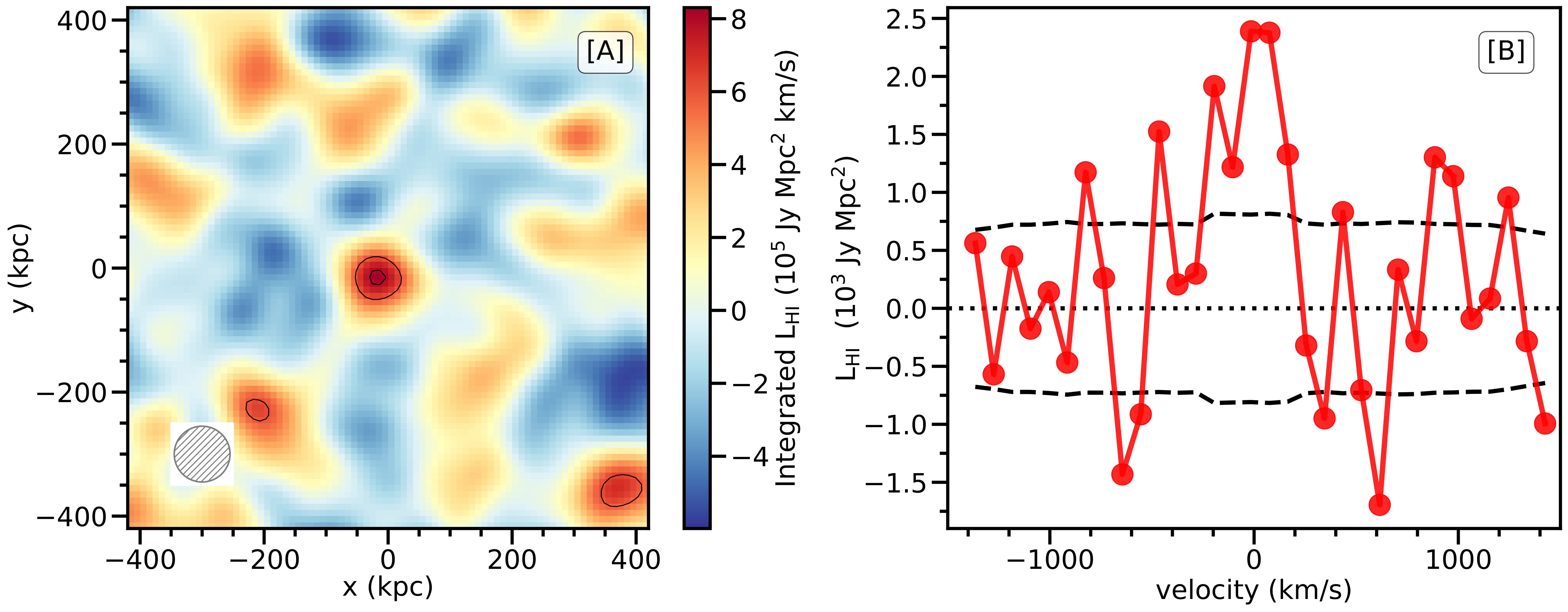
An important open question in galaxy evolution concerns the evolution of the neutral atomic hydrogen (HI) content of galaxies with time. The intrinsic weakness of the HI 21 cm line, the main tracer of the HI mass of galaxies, makes it extremely challenging to detect emission from neutral atomic hydrogen gas in galaxies at cosmological distances with today's radio telescopes. It has been shown that averaging the HI 21 cm emission signals from a large number of galaxies with accurately known redshifts (``HI 21 cm stacking'') can be used to measure the average HI mass of the population. Results from such HI stacking experiments are now pushing the frontiers of our understanding of the HI content of galaxies to higher redshifts. In this Letter, Kaur et al. report results from the upgraded Giant Metrewave Radio Telescope (GMRT) Cold-HI AT z~1 (CATz1)-COSMOS HI 21 cm survey, a deep GMRT Band-4 observation of the COSMOS field, aimed at characterizing the HI properties of star-forming galaxies at z~1. The authors used a 7-pointing strategy to cover a 2.4 sq. degree region in COSMOS, along with a deeper observation of the central COSMOS-Web region; the total observing time was 216 hrs. They stacked the HI 21 cm emission signals of 8,122 star-forming galaxies at z=0.875-1.50, at a spatial resolution of 90 kpc, to obtain a detection of the stacked HI 21 cm signal at 4.2 sigma significance. The figure shows [A] the velocity-integrated stacked HI 21 cm image and [B] the stacked HI 21 cm spectrum from the 8,122 star-forming galaxies at z~1. This is only the second detection of the stacked HI 21 cm emission signal from galaxies at z~1, after the detection from the GMRT-CATz1 survey in the DEEP2 fields (e.g., A. Chowdhury et al. 2020, Nature, 586, 369). The stacked HI 21 cm signal from the COSMOS field yields an average HI mass of M_HI = (15.5 +/- 3.7) billion solar masses for the 8,122 galaxies. The authors also measured the stacked rest-frame 1.4 GHz continuum emission of the same galaxies, and used this to infer an average star-formation rate (SFR) of (8.90 +/- 0.92) solar masses per year. The ratio of the average HI mass to the average SFR implies an HI depletion timescale of approximately 1.7 Gyr, far shorter than the corresponding HI depletion timescale of galaxies in the local Universe. The authors thus found that star-forming galaxies at z~1 are gas-rich, but have a very short HI consumption timescale. The lack of replenishment of the HI reservoir of star-forming galaxies provides an explanation for the decline in the cosmic star formation activity at z<1.
Solar observations with MeerKAT
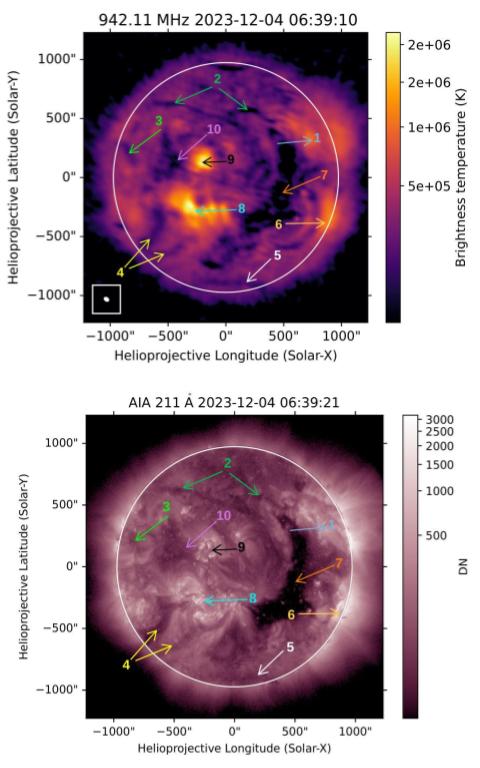
Solar radio emission offers powerful diagnostics of the solar corona, yet its highly dynamic, multiscale emission and extreme intensity contrasts pose substantial technical challenges. At gigahertz frequencies, MeerKAT provides a uniquely capable platform for high-fidelity, spectroscopic snapshot imaging of the Sun, enabled by its dense core, exceptional sensitivity, and broad instantaneous frequency coverage. As MeerKAT was originally optimized for faint galactic and extragalactic targets, observations with the Sun in the primary beam require specialized observing strategies and calibration approaches. Here, we demonstrate the technical readiness of MeerKAT for solar observations primarily in the UHF (580–1015 MHz) and L-band (900–1670 MHz) frequency ranges. This is achieved through optimized observing modes, a dedicated solar calibration framework, and a fully automated end-to-end calibration and imaging pipeline. The fidelity of the resulting solar radio image (top panel of the adjacent figure) is validated through detailed morphological comparisons with contemporaneous extreme-ultraviolet observations (bottom panel), in which corresponding coronal structures are indicated by numbered arrows. Early science results illustrate the diagnostic power of this new capability, including spectro-temporal imaging of coronal plasma potentially originating in the transition region, the identification of coronal hole–associated emission, and the tracking of the evolution of an erupting coronal mass ejection. Together, these results demonstrate that MeerKAT can probe coronal structure and dynamics across a wide range of spatial, spectral, and temporal scales. This development significantly expands MeerKAT’s scientific portfolio and establishes a robust foundation for solar observations with SKA-Mid, for which MeerKAT serves as the precursor.
Globular Clusters GMRT Pulsar Search (GCGPS). II. Discovery of Five Millisecond Pulsars in M69 and M70
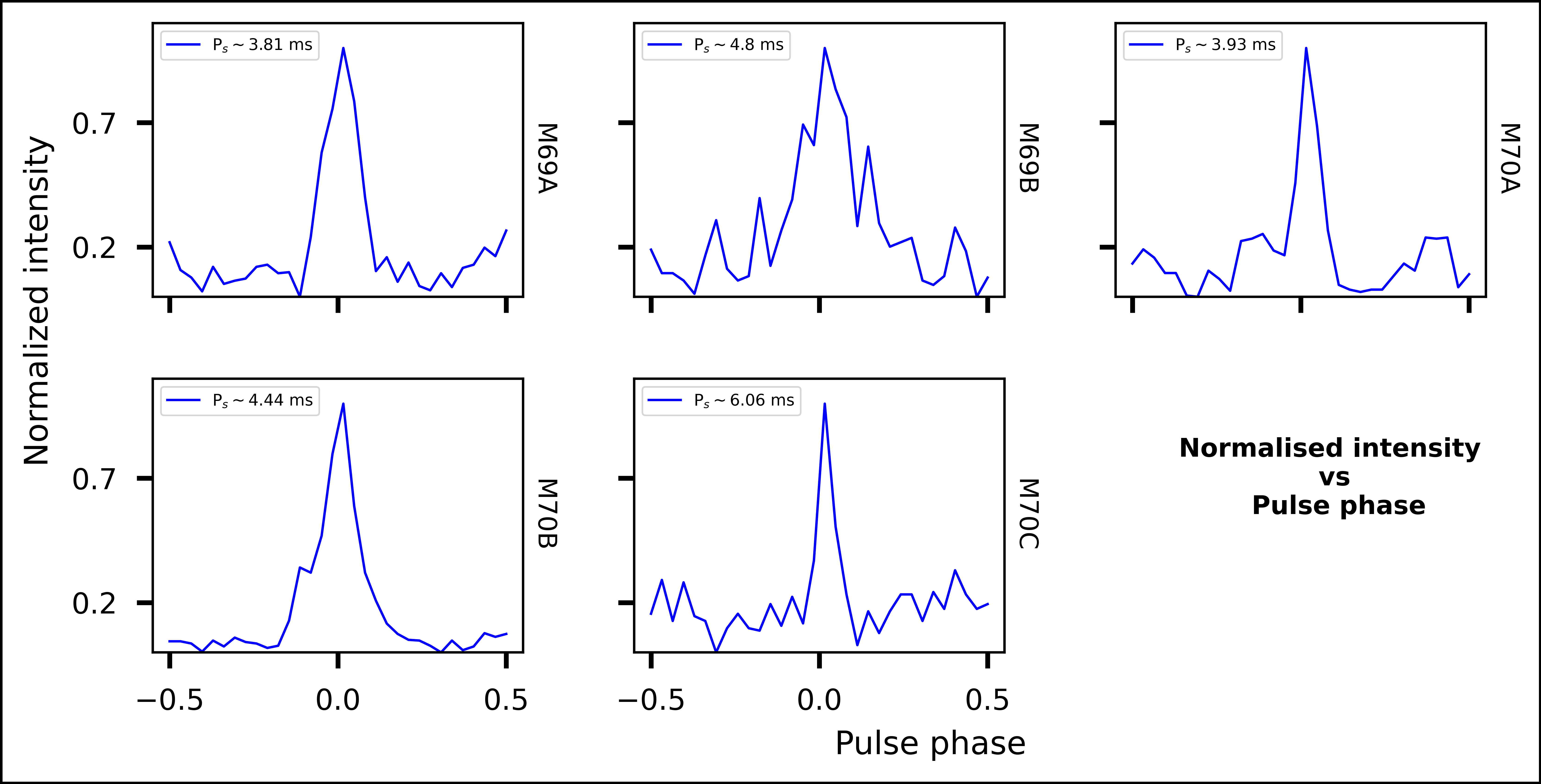
Globular clusters are among the oldest and most compact stellar systems in the Galaxy, where high stellar densities drive frequent dynamical interactions that efficiently form exotic compact binaries, including millisecond pulsars (MSPs). In this work, Das et al. report the discovery of five new MSPs from the Globular Clusters GMRT Pulsar Search (GCGPS) survey in two globular clusters, M69 and M70, both of which previously had no known pulsars. The attached figure shows the pulse profiles for the five new MSPs, with the names indicated to the right of each panel. The two MSPs in M69 have spin periods of 3.81 ms and 4.80 ms, with one showing clear orbital acceleration, indicating a compact binary system, while the other is likely isolated or in a wide binary. In M70, the three new MSPs have spin periods ranging from 3.93 to 6.06 ms, all consistent with typical recycled pulsars found in dense cluster environments. The discoveries were enabled by combining phased-array beamforming with interferometric imaging with the GMRT, allowing both high-sensitivity searches and positional constraints. The authors were able to localize PSR J1830-3220A (M69A) with arcsecond precision using the imaging and targeted beamforming technique, and also obtained positional constraints on the other four MSPs using imaging and beam simulation data; these can now be accurately localised via dedicated timing observations. The imaging analysis also reveals several faint, compact radio sources within the cluster fields that may represent additional, yet-undetected MSPs. The results demonstrate the strong capability of the GMRT and the GCGPS survey in probing globular clusters and expanding the known MSP population. The work also highlights the strong potential offered by the significant improvements in sensitivity and sky coverage in Phase II of the GCGPS survey, enabled by the SPOTLIGHT multibeam targeted mode with 160/320 beams. In Phase II, GCGPS is expected to uncover many more such systems and provide deeper insights into pulsar formation and cluster dynamics.
An automated, self-calibration-based pipeline for high-fidelity solar imaging with LOFAR: SIMPL
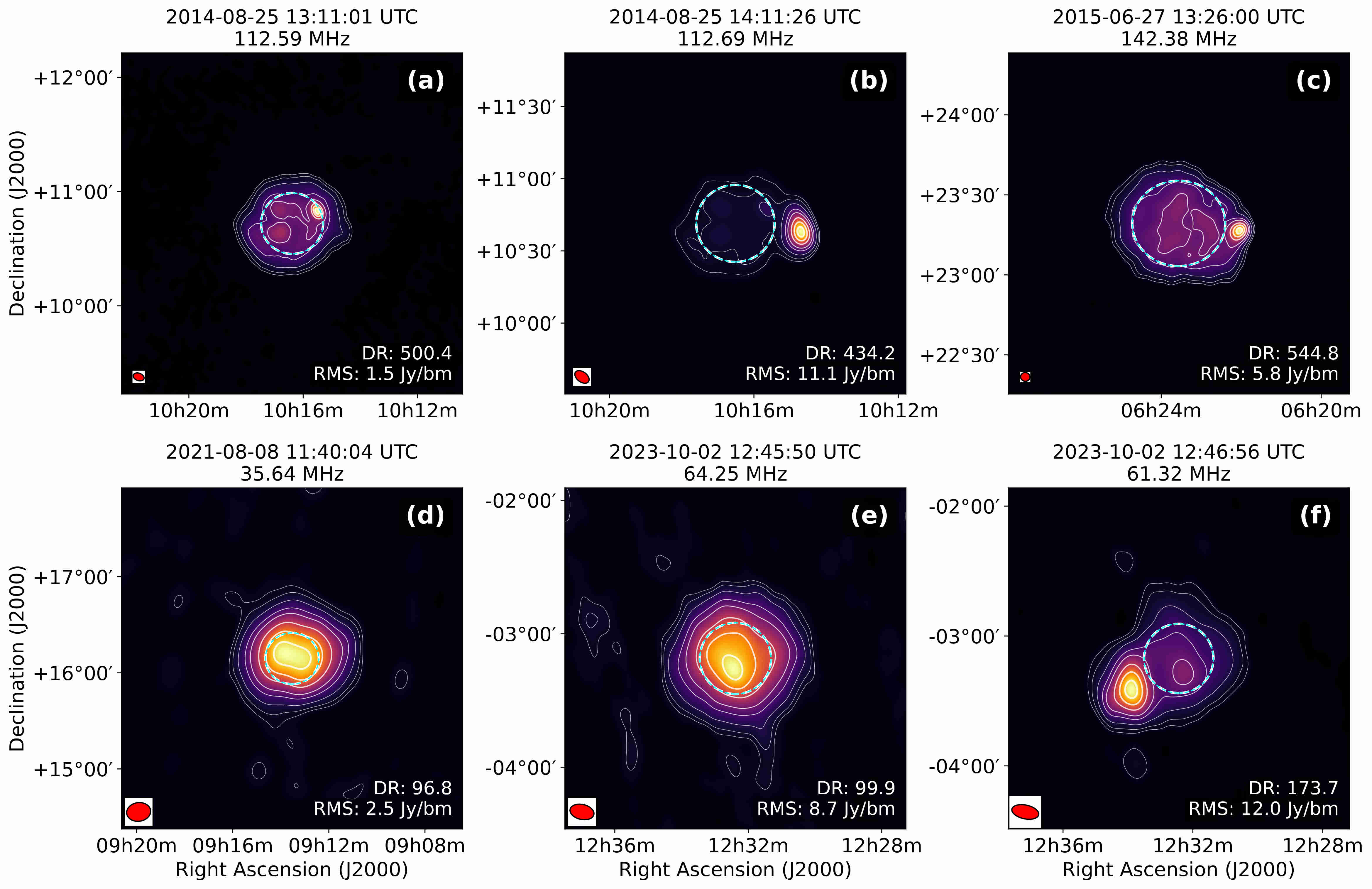
The LOw Frequency ARray (LOFAR) is capable of imaging spectroscopy of the Sun in the 10─240 MHz frequency range, with high spectral, temporal, and spatial resolution. However, the complex and rapidly varying nature of solar radio emission ─ spanning several orders of magnitude in brightness and further exacerbated by the strong ionospheric phase distortions during daytime observations, poses major challenges for calibration, imaging, and automation. In this work, Dey et al. (2025) present a fully automated, high-fidelity imaging pipeline optimised for LOFAR solar observations, capable of handling the intrinsic variability of solar emission and producing science-ready images with minimal human intervention. This pipeline, christened “Solar Imaging Pipeline for LOFAR” (SIMPL), integrates excision of radio-frequency interference (RFI) for the solar-specific scenarios, calibration strategies, and self-calibration. Currently, SIMPL can process data from the LOFAR core stations and produces total-intensity solar images. It is designed to enable scalable and uniform processing of large archival datasets. SIMPL has been tested across a wide variety of solar conditions and has been shown to reliably produce high-quality spectroscopic snapshot images providing an improvement of more than an order of magnitude in the imaging dynamic range when compared to previous efforts. The figure shows examples of spectroscopic snapshot images produced by SIMPL in its default mode (typically averaged over 1 s and 195 kHz). The dashed line marks the optical solar limb, the ellipse at the bottom-left marks the restoring beam, and the contours are at 3%, 5%, 10%, 20%, 30%, 50%, 70%, and 90% of the maximum intensity. SIMPL is currently being employed to process a decade of LOFAR solar observations, providing science-ready images for the community and enabling both comprehensive and novel studies of solar radio phenomena.
The Atomic Gas Properties of Green Pea Galaxies: Connections to Lyman Continuum Leakage
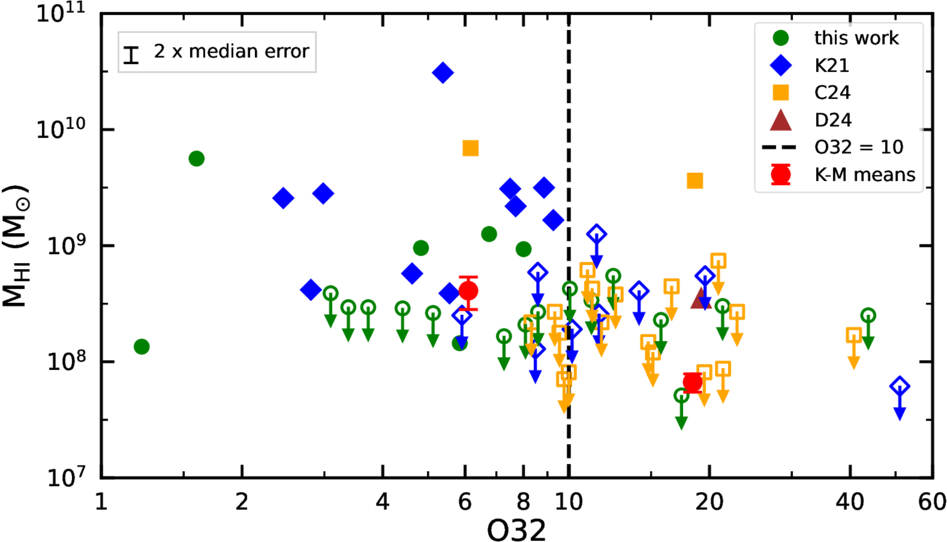
Green Pea galaxies (GPs) are local analogs of the dwarf starburst galaxies that reionized the Universe at early times via their Lyman-continuum (LyC) photons, and thus provide the opportunity to probe the processes by which such LyC photons might escape the early galaxies. Khasnovis et al. report a Green Bank Telescope (GBT) search for HI 21 cm emission from 30 low-redshift Green Pea galaxies (GPs), obtaining 7 detections of HI 21 cm emission and 17 upper limits on the HI mass. Including GPs from the literature, they compile a sample of 60 GPs at z<0.05, with 19 detections and 41 nondetections of HI 21 cm emission and with stellar masses in the range 0.001-1 million solar masses. They use the line luminosity ratio O32 = [O III]λ5007 + λ4959/[O II]λ3727,3729 as an indicator of LyC leakage and examine the dependence of the HI properties of the 60 GPs on the O32 ratio. They obtain a far higher HI 21 cm detection rate for the 32 GPs with O32<10 than that for the 28 GPs with O32>10. They also find statistically significant evidence that the HI mass, the HI-to-stellar mass ratio, and the HI gas depletion timescale of GPs with O32>10 are lower than the corresponding values for GPs with O32<10. Earlier studies have shown that galaxies with O32>10 tend to show significant LyC leakage. The new results indicate that this LyC leakage is due to the paucity of HI in such galaxies, with most of the HI consumed in the starburst. The results further suggest that HI 21 cm studies of the galaxies that reionized the Universe at early times are likely to find an anticorrelation between the HI 21 cm and Lyα emission signals, due to the paucity of HI in the strongest LyC and Lyα leakers. The figure shows the HI mass, or the 3-sigma upper limits to the HI mass, plotted against the O32 ratio for the 60 GPs of the sample. The dashed vertical line indicates the value O32=10, above which galaxies are expected to show significant LyC leakage. The filled and open symbols indicate, respectively, detections and nondetections of HI 21 cm emission. The green circles indicate GPs from the study of Khasnovis et al., and the other symbols indicate GPs from the literature. It is clear from the figure that GPs with O32<10 show both more detections of HI 21 cm emission and higher HI masses than GPs with O32>10.
Exploring Unusual High-frequency Eclipses in MSP J1908+2105
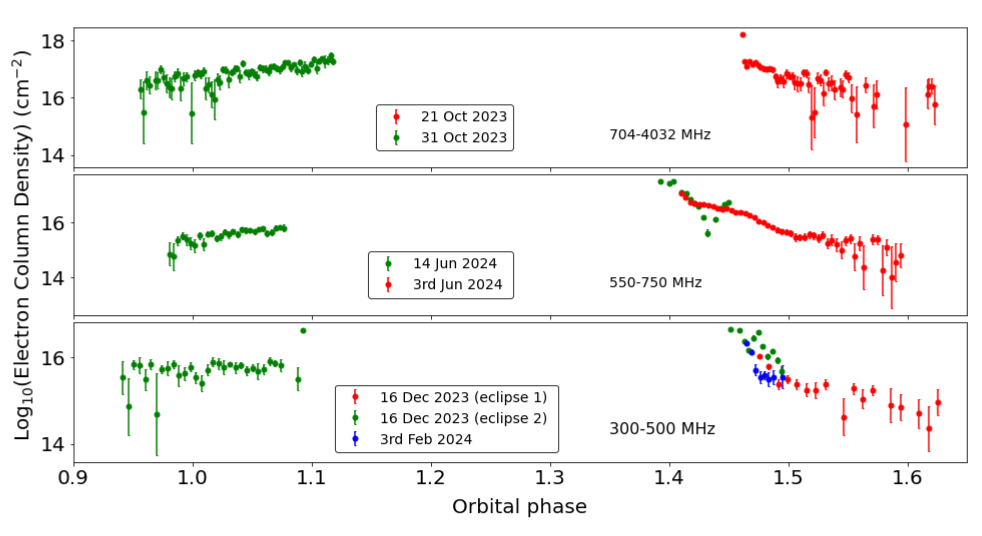
Spider millisecond pulsars (MSPs) are compact binaries in which the energetic pulsar wind ablates the companion; eclipses occur when this ablated material blocks the pulsar’s radio beam. These eclipses are frequency-dependent, and typically vanish above a characteristic eclipse cutoff frequency (around 1.4 GHz). Using wide-band uGMRT Band-3 (300–500 MHz) and Band-4 (550–850 MHz) observations, together with Parkes UWL (704–4032 MHz) observations, Ghosh et al. show that PSR J1908+2105 remains eclipsed up to 4 GHz for >30% of the orbit, making it one of only three MSPs known to eclipse at such high frequencies. Orbital-phase–resolved dispersion and polarization measurements imply a dense, magnetized eclipse medium with excess line-of-sight dispersion measure of ~4 pc per cc and electron column density of ~10^{19} per sq. cm; rotation-measure (RM) variations indicate stronger line-of-sight magnetic fields toward the eclipse boundaries, with a characteristic field of ~16 G near the eclipse center. Ghosh et al. show that only synchrotron absorption can account for such high-frequency eclipses. They report the first evidence of temporary magnification of the pulsed flux density (about four times higher than in the non-eclipse phase) near eclipse edges, attributing the magnification to plasma lensing by irregular, strongly structured circumstellar plasma around the companion, where steep electron-density gradients refract and focus the pulsar’s radio emission. Numerous single bright pulses were found immediately before and after the eclipse, especially during egress, while none were seen outside the eclipse region. Combining with literature cases, the authors note that eclipse cutoffs above ~1 GHz are consistently linked to electron column densities greater than around 10^{17} per sq. cm, offering a physical handle on the eclipse medium across spider MSPs. The figure shows electron density variation near the eclipse boundary at different epochs observed with uGMRT at 400 MHz and 650 MHz, and with Parkes UWL at 2368 MHz. A sharp dip around orbital phase ∼ 1.42 on 14 June 2024 suggests a localized gap in the ionized gas, probably caused by turbulence in the plume. The absence of this dip in data from 11 days earlier indicates variability in timescales of days to weeks, showing the turbulent eclipse medium.
Deciphering Profile Stability in Millisecond Pulsars: Timescales, Frequency Evolution, and Implications for Emission Mechanisms
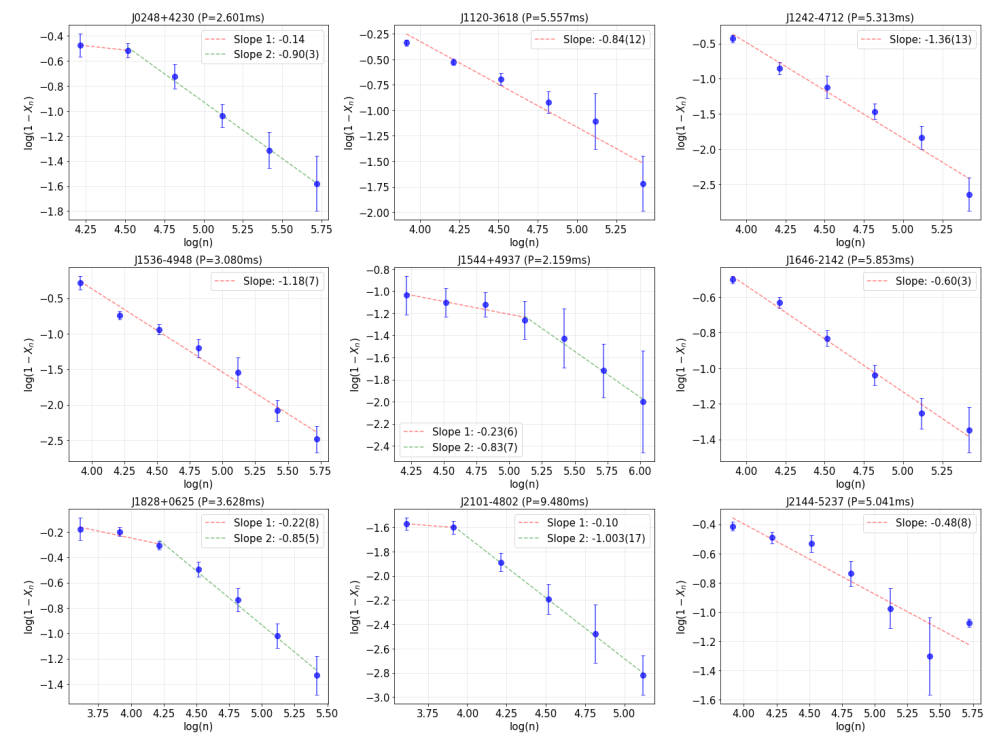
Millisecond pulsars (MSPs) enable precision timing, but their individual pulses show jitter -- random pulse-to-pulse changes in shape and phase that introduce a source-intrinsic white-noise term in timing. The jitter parameter is a dimensionless measure of how strong this effect is (a smaller value of the jitter parameter indicates steadier pulses). This study introduces a direct pulse-stacking method to measure how quickly the mean profile becomes stable. Using long-term, multi-epoch uGMRT observations at 300-750 MHz for nine MSPs, and complementary Parkes UWL data (704-4032 MHz) for a few of them, Ghosh et al. found that profiles typically require averaging a million pulses to stabilize. This stabilization rate depends on signal-to-noise ratio and pulse morphology, and shows a moderate link with surface magnetic field strength. Estimation of the jitter parameter is feasible for relatively bright sources with sufficiently high single-pulse signal-to-noise ratio. In this context, Ghosh et al. also found that the measured profile-stability slope correlates with this parameter, providing a practical proxy for intrinsic pulse-shape variability in faint MSPs and helping set integration times for Pulsar Timing Array experiments. The figure summarises the long-term profile stability for nine GMRT-discovered MSPs from multi-year observations. The plot shows the mean correlation between sub-averaged and global profiles versus pulse number, demonstrating that MSP profiles stabilise after averaging around a million pulses. Here, n denotes the number of individual pulses that have been averaged to form a subaveraged pulse profile. For each value of n, we compute the Pearson correlation coefficient Xn between the sub-averaged profile and the global profile. The quantity plotted is log(1 − Xn) as a function of log(n), capturing the stabilization behavior of pulse profiles with increasing averaging. The vertical error bars represent the standard error of the mean of Xn at each n, propagated through the logarithmic transformation. The slope of the fitted line shows the profile stability rate.
Observation and Modeling of Small Spatial Structures of Solar Radio Noise Storms Using the uGMRT
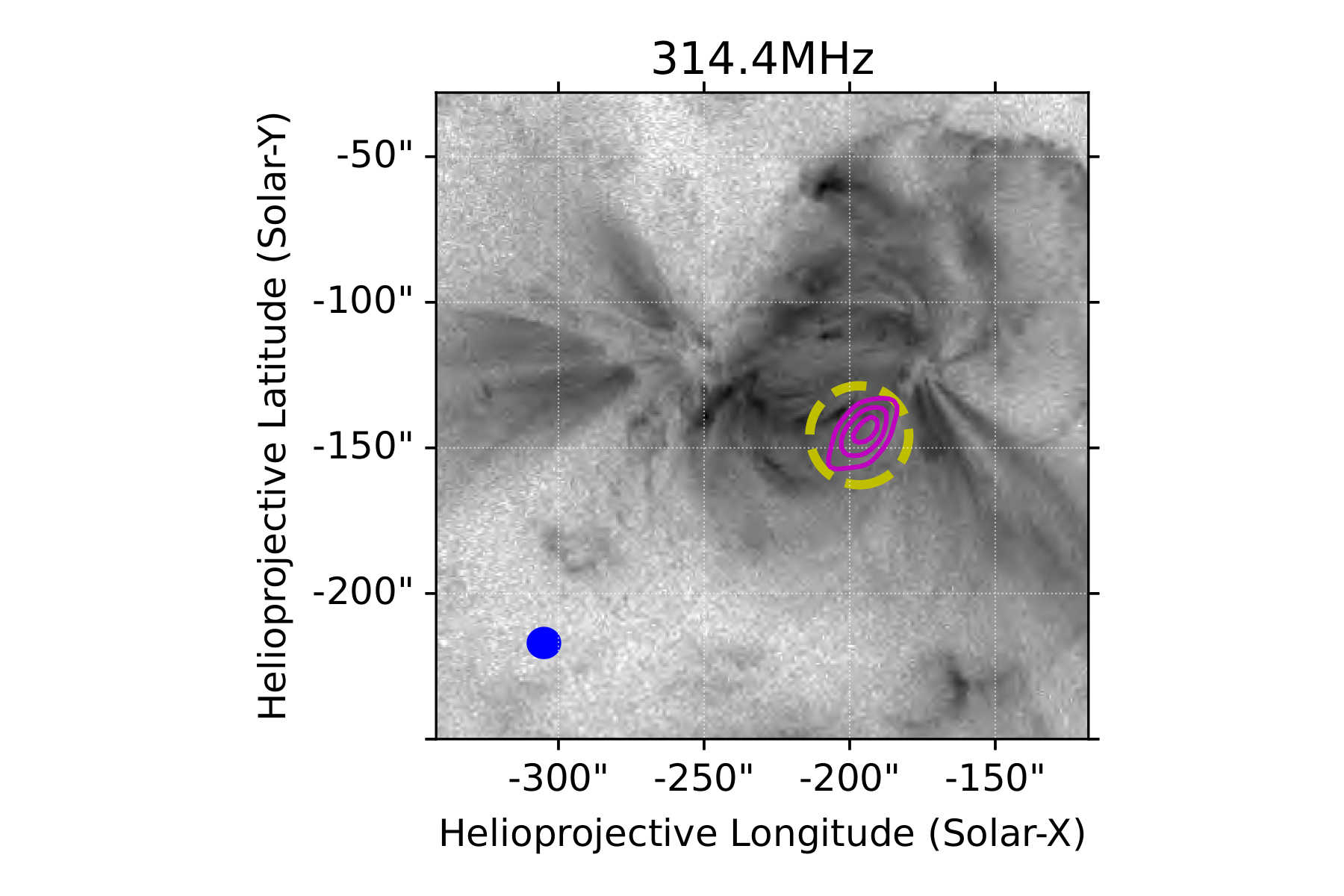
Among the most commonly observed solar radio sources in the metric and decametric wavelengths are the solar noise storms. Powered by a plasma emission mechanism, noise storm sources can become significantly scatter-broadened due to the multi-path propagation caused by refraction from the coronal density inhomogeneities. Scatter-broadening imposes a fundamental limit on the minimum observable source size in the solar corona. While past observational and theoretical works have tried to estimate this limiting size, the limit depends on the details of the coronal turbulence model. As such, pushing the minimum observable source size to smaller values can help constrain the plasma environment of the observed sources as well as the models of coronal turbulence. In this work, Mondal et al. (2025) use data from the upgraded Giant Metrewave Radio Telescope in the 300-500 MHz band to determine, for the first time, multiple instances of structures with length scale of approximately 20\" in noise storms. These sources are much smaller than structures reported earlier in the corona at similar frequencies. These small sources are stable over timescales of 15-30 minutes and are detected over the entire available bandwidth of about 200 MHz. The adjacent figure shows an example of a noise storm source, in the magenta contours. The radio image was generated by integrating 24 MHz and 25 minutes of data. The size of the source was estimated by fitting the region bounded by the yellow dashed circle by a Gaussian, and found to be 30\" x 16\". Such small source sizes are very hard to explain using the currently prevalent coronal turbulence models. To understand the origin of such small sources, Mondal et al. also build an illustrative model. They demonstrate that it is easier to account for the existence of such small sources if they originate in coronal loops, which are much denser than the background coronal plasma.