
Transit Of Venus
The Transit is now over - the lucky ones amongst us saw all of it under clear skies, most of it saw a few minutes of it through monsoon clouds, and some of us didn't see it at all. There was, however, fantastic live coverage on television, so we hope all of you have seen the Transit atleast vicariously !
Transit of Venus
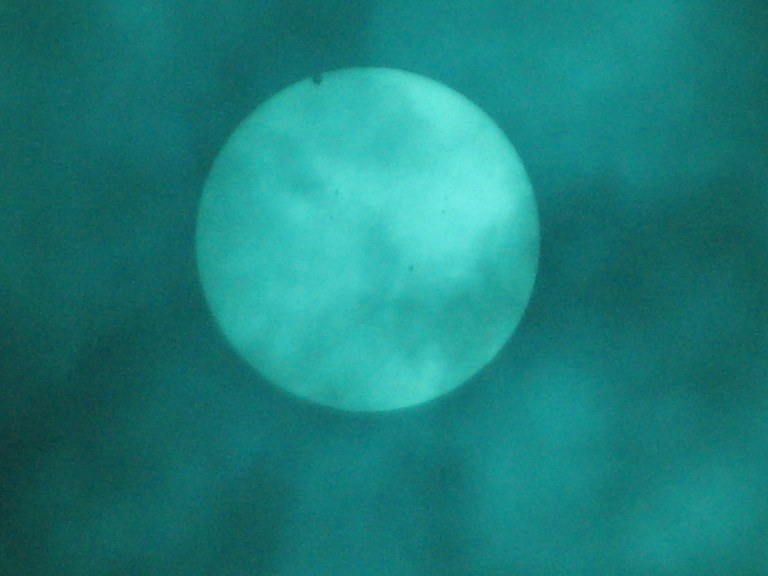
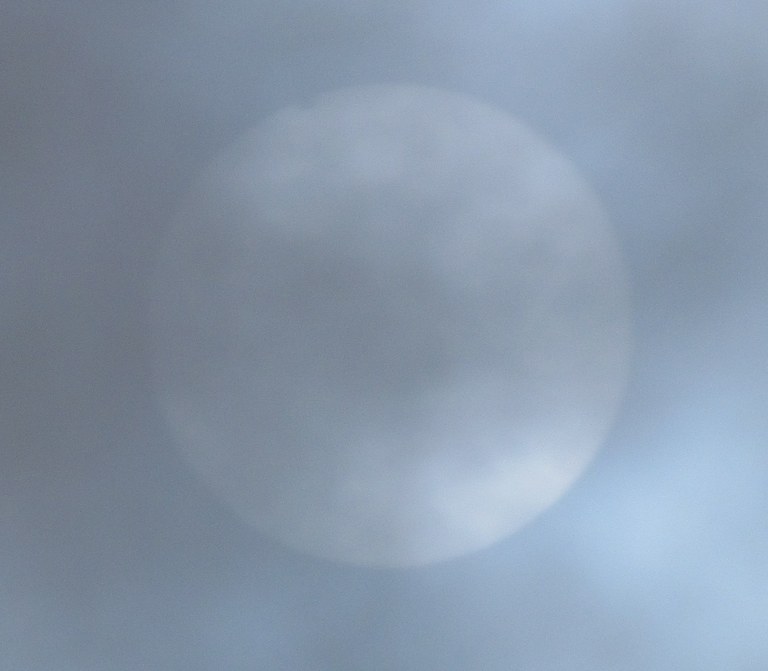
You could well be in a place on Earth from where the Transit of Venus is not visible. Even worse, if you can indeed see the Transit from your country, and have set up your equipment, and called all your friends and family, the Le Gentil effect can strike, and clouds may cover the Sun ! What can you do?
There are many groups which are broadcasting the Transit live on the internet, and on television too. These are some of the links (mainly from this site). If you know of more, please do email us at nirujmohanr@gmail.com.
- Hanle - from the worlds highest observatory - the Himalayan Chandra Telescope
- Rajya Sabha Televsision
- NASA
- NASA TV
- University of Barcelona (from Svalbard)
- NSO
- From Mauna Loa Observatory
- Coca Cola Space Science Center
- Bareket observatory
- Mt. Lemmon Sky Center
- Mt. Wilson, Astronomers Without Borders
- ParsSky, Iran
- University of Colombo
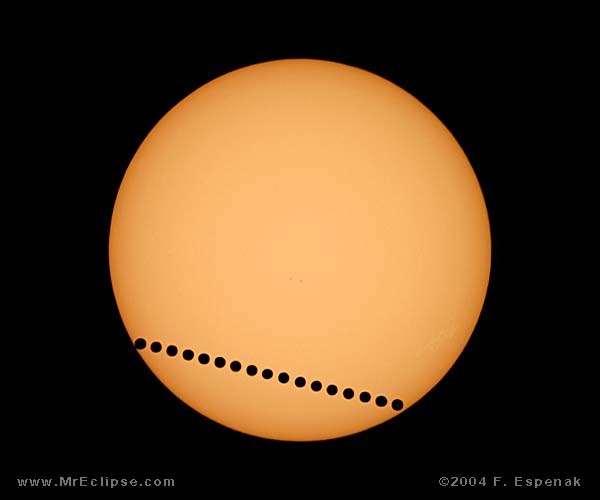
Venus, the second planet from the Sun, sometimes comes exactly in between the Earth and the Sun. This event, called the Transit of Venus, is set to occur on June 6th 2012. This transit will be visible in India from sunrise till 10.30 am and we will see Venus as a black dot, crossing the surface of the Sun. The next transit will occur only after a gap of 105 years.
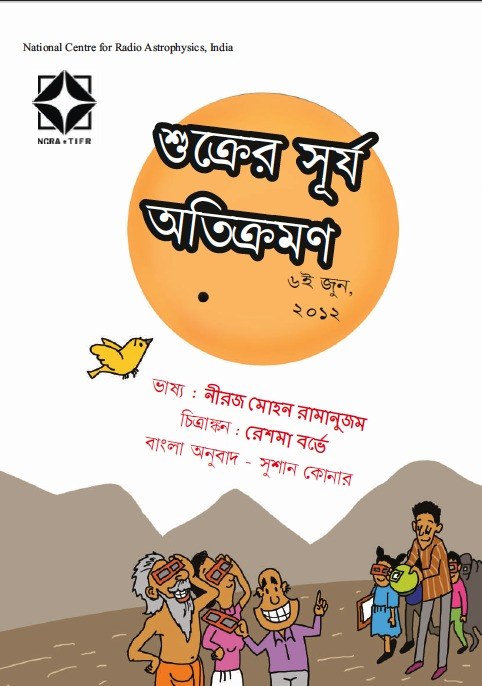
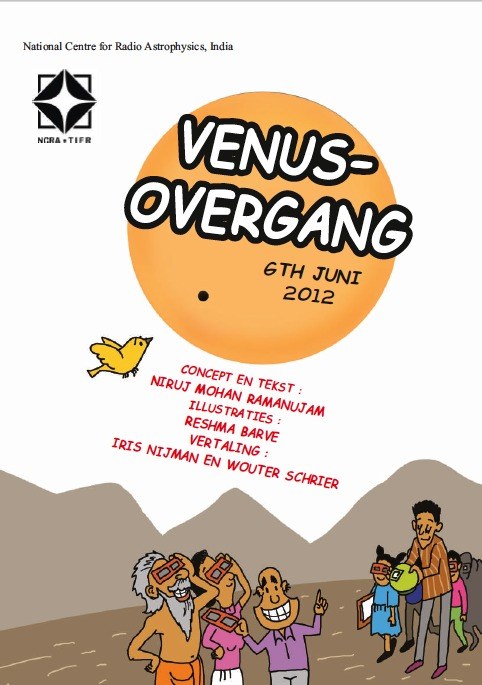
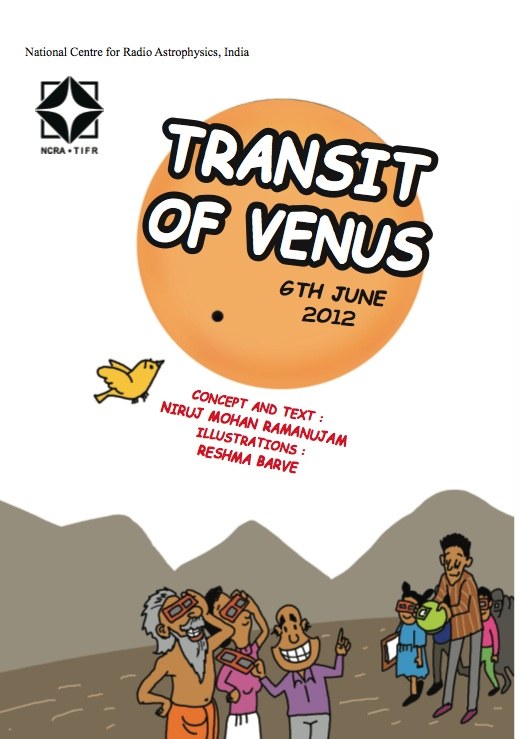
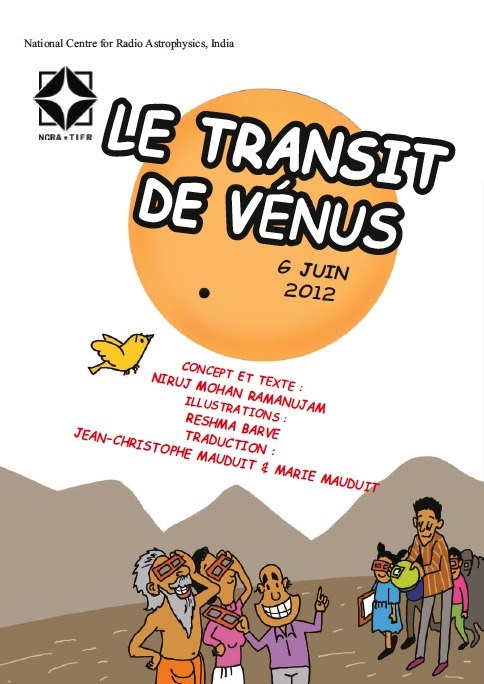
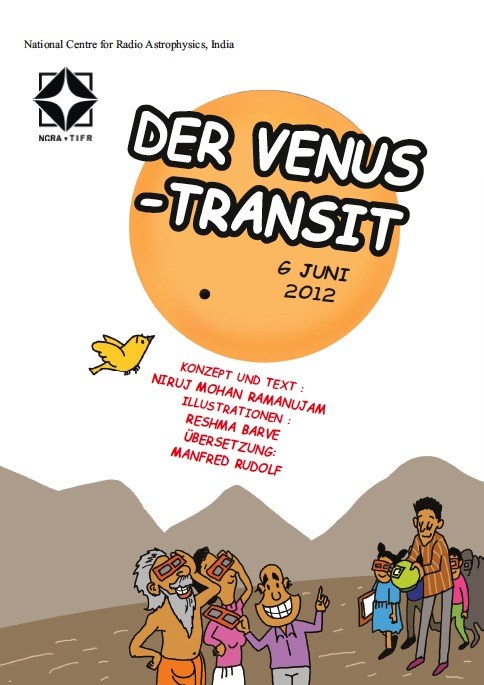
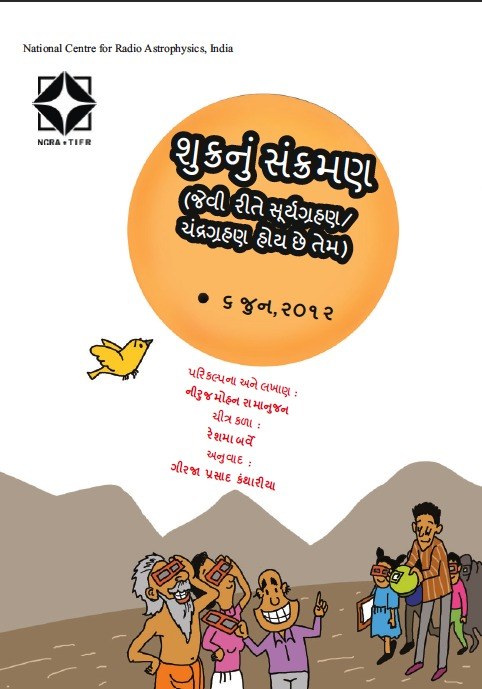
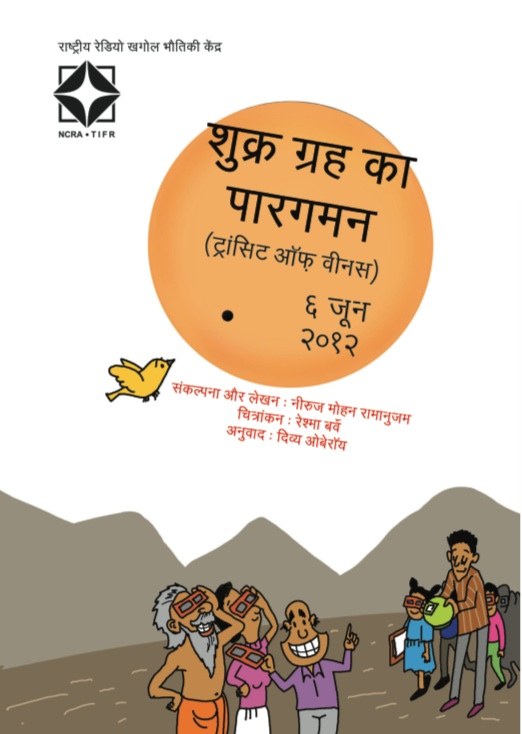
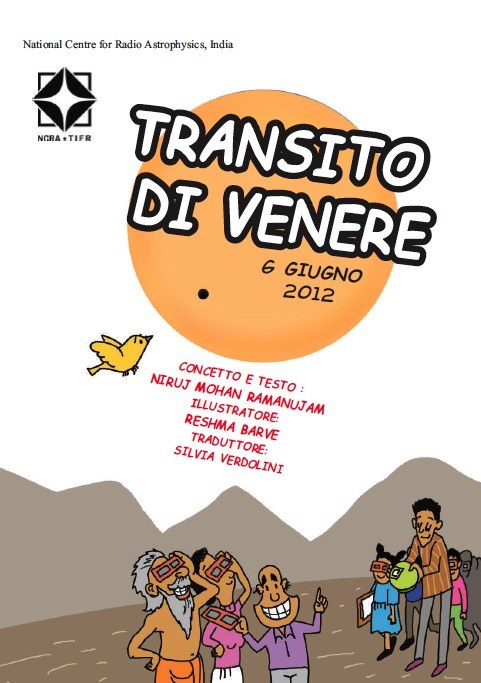
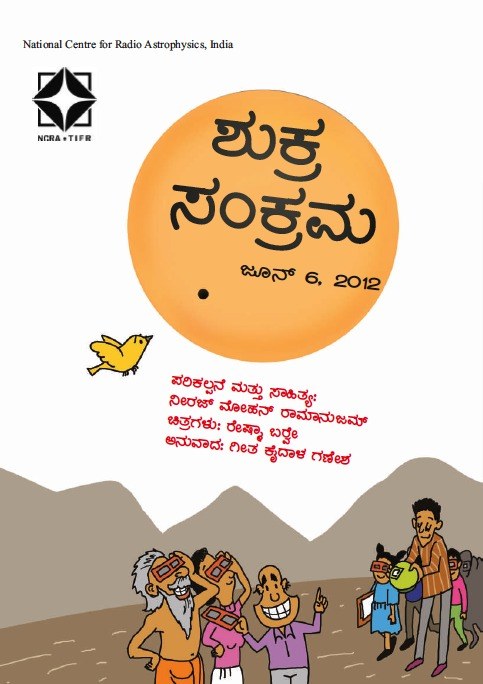
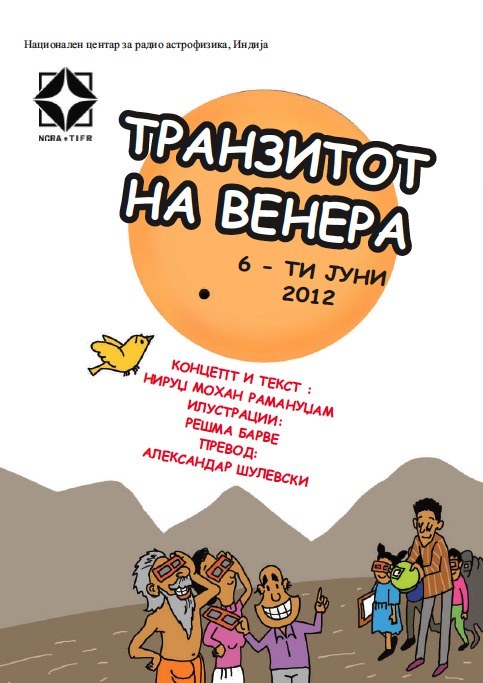
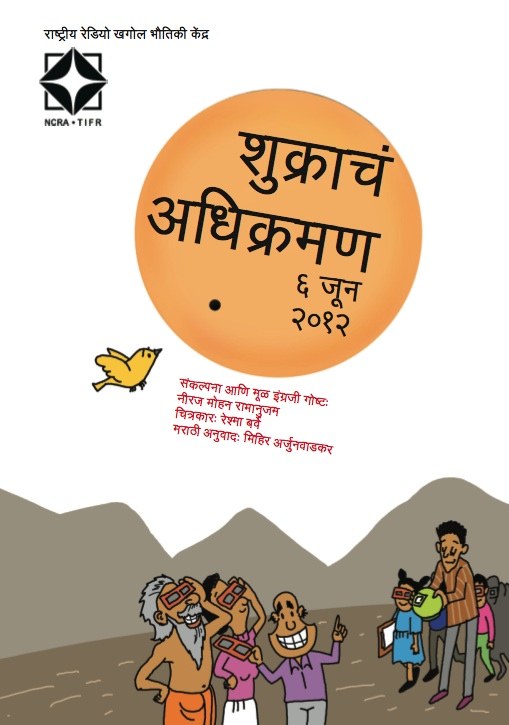
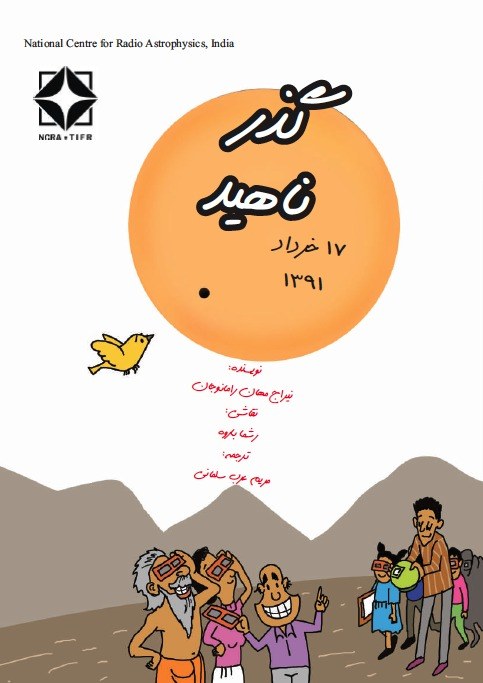
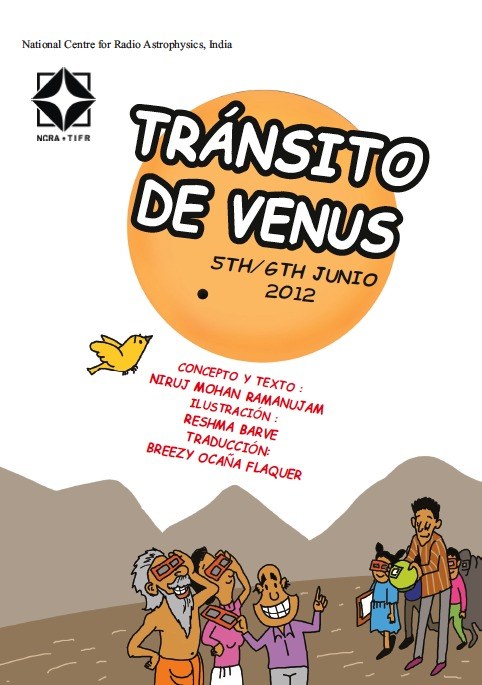
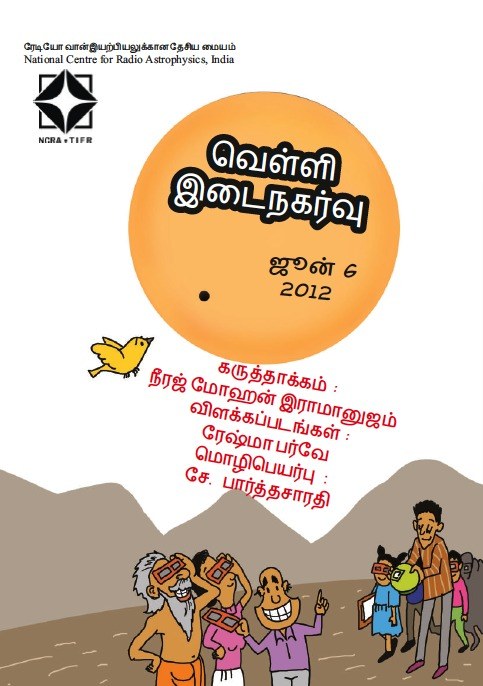
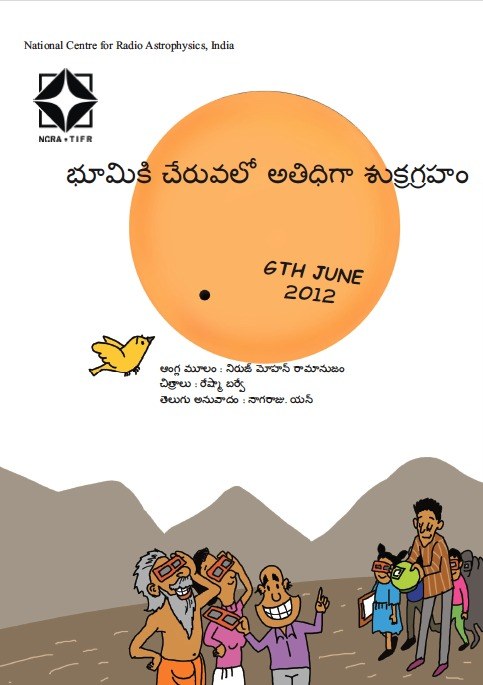
There is a national campaign to get as many people as possible to see this rare celestial event. In order to spread awareness and to mobilize interest, the National Centre for Radio Astrophysics (NCRA, Pune) is publishing a graphic comic about the history and the science associated with the transit of the Venus Transit. The story behind this event has been beautifully and humorously illustrated by Ms. Reshma Barve. This work has been translated into more than 10 Indian and Foreign languages by volunteers. This includes MARATHI, HINDI, TAMIL, GUJARATI, BENGALI, KANNADA, TELUGU, FRENCH, SPANISH, ITALIAN ETC. The
PDF files of these comics are made. A few English and Marathi copies have been printed for distribution among schools. We encourage everyone to download the book, distribute it widely, and print and photocopy it as well.
Since the early 1600s, Astronomers knew the distances between the various planets and the Sun only in terms of the Earth-Sun distance. The most accurate method available to determine the value of the Earth-Sun distance in kilometers was by accurately timing the moment Venus entered or left the disk of the Sun. Astronomers from many countries tried to do so in 1761, 1769, 1874 and 1882 with great difficulty. This comic describes the story through cartoons, and leads up to the 2012 Transit. It explains the current motivation for observing this event and ends with a number of ways for us to safely observe the Transit.
As a prelude to the Transit, NCRA, along with Aksharadhara, is releasing the Marathi version of the comic book at 6:30 pm on Friday, 1st June, by Dr. Anil Awachat and Shri D. Mahajan at AKSHARDHARA BOOK GALLERY, SANAS PLAZA, BAJIRAO RD.
We hope that a large number of us will be able to witness this unique and beautiful celestial eclipse together !
Contact : Niruj Mohan Ramanujam, NCRA, Pune
The comics on the Transit of Venus, published by NCRA in 11 languages, was possible due to a number of people - the illustrator, translators, typographers and so on. A brief bio of the translators follows..
Many Institutes, schools and colleges across the country are organising Venus Transit observations on the morning of the 6th for their communities. Here is a list of events for the public, and free of cost. Please email me any event not listed here at nirujmohanr@gmail.com and I will add it here.
In addition to the following, BGVS is organising public events in many places in almost every state (e.g. 300 schools in Bihar, all districts in Kerala, 200 places in Puducherry, 50 schools in Rajasthan and Punjab each etc). You can contact them here for more info. I will also add specific places here as and when I find out more.
Maharashtra
Pune- On the Bund Garden bridge (Navnirmiti)
- On the Bal Gandharva bridge (Navnirmiti)
- On top of Parvati Hill (Navnirmiti)
- IUCAA, University of Pune (IUCAA)
- Fergusson College (FC and JVP)
- Govt. Polytechnic College, Ganeshkhind (Akashmitra)
Mumbai
- A.B. Goregaonkar school, Goregaon, West Mumbai
- Nehru Planetarium, Worli (site)
- St. Xaviers College, Marine Lines (website)
- Akash Ganga Centre, Badlapur (website)
Nagpur
- Raman Science Centre and Planetarium
Satara district
- Aerodrome (Wimantal), at Phaltan
- Dhalgaon village, Jamner Tahsil (contact: Vikram Patil - 9970225538)
New Delhi
- Jantar Mantar (SPACE - check here)
- Vigyan Prasar office, Noida (website)
Karnataka
Bengaluru- Jawaharlal Nehru Planetarium, next to Raj Bhavan (JNP)
- Nikaya Observatory, near Hosur (website)
Tamilnadu
Chennai- Marina Beach, behind Gandhi Statue (Tamilnadu Science Forum)
Rajasthan
Udaipur- Udaipur Solar Observatory, Badi Road (SPACE)
Goa
Panaji- Public Observatory, Junta House, (website)
- Ravindra Bhavan, Margao and Tarrace Boshan building(website)
Jammu and Kashmir
Leh- Spituk Gompa, Leh (Vigyan Prasar)
if you take any pictures or videos during the Transit, or make drawings or paint a picture, or write a blog, or compose a poem, or even write an article, or interview people while they are seeing the Transit, send us your stuff at nirujmohanr@gmail.com and we will figure out a way to post them online.
If you would like to help archive such material, let us know too!
You should never look at the Sun directly, or through any lens, mirror, telescope, binoculars or any other optics - you can severely damage your eyes or even go blind !
There are many completely safe methods to see the Transit, though - and these can also be used to see a Solar Eclipse too.
Projection through a telescope
If you have a telescope or a pair of binoculars, you can use it to project the Sun on to a piece of paper. It is perfectly safe to look at the paper and hence see the Sun's image. You will be able to see sunspots very clearly as well. Take care not to even accidentally look through the telescope/binoculars while adjusting it. Covering the sheet of paper from the sides to cut out some ambient light will give you a better image.
This method is illustrated (for a solar eclipse) here, here and here.
Eclipse glasses
Ask your nearest planetarium, observatory, astronomy institute or science club for a pair of eclipse glasses. These are not your usual sunglasses ! They are made from special Mylar sheets to cut down the brightness of the Sun by a huge amount. Do not use them if they have holes or seem damaged. You can also use Welders glass #14 or higher if you can get them.
You also get Mylar filters to attach to the front of a telescope, so that you can see through the telescope itself. Unless you can really rely on the quality of your filter, do not use them !
You can ask for them at your Planetarium. If you are in Pune or Mumbai, Navnirmiti stocks quite a few of them.
If you get one, you would look like this, or even as cool as this !
Pin-hole camera
This is the simplest and the most familiar way to see the Sun. However, the size of the Sun's image formed through a pin-hole is roughly 110 times smaller than the distance between the pin-hole and the screen. Hence we need a pin-hole camera atleast 5-8 metres in length ! A 8m long pin hole camera will for a 8 cm sized image of the Sun. Remember, Venus is about 1/30th the size of the Sun. Venus, therefore, will be 2.7 mm big, which can easily be seen.
You may have seen pictures taken during a solar eclipse where the tiny ever-moving pin-holes formed between the leaves of tall trees form very pretty multiple images of the eclipsed Sun, on the ground. Though the image is big enough, the ground needs to be shielded from ambient light. Also, the leaves moving in the breeze will make it a bit difficult to see Venus.
During an eclipse, for example, you would see this or this or even this !
Ball-mirror assembly
The best way to see the Transit is the ball-mirror assembly, a Navnirmiti design. Each one of us can make one, and manage to see Venus extremely well.
Take a plastic ball, say 20-30 cm in diameter. Cut a roughly 1 inch sized hole in it with a knife. Fill more than half of it with sand to make it heavy. Now, close the hole by sticking a piece of paper on it with sticky tape. Get a small flat (plane) mirror from a nearby shop and stick it on the piece of paper. Thinner mirrors will give you better results.
Take another small piece of dark coloured paper and cut a circular hole in its centre, of diameter roughly 2-3 cm. Now stick this on the mirror so that we see only a 2-3 cm wide circle-shaped mirror.
Take this ball outside the house, and place it on a suitable circular stand - this can be the sticky tape ring itself, or even a small vessel from your kitchen. You will notice that you can rotate the ball to make the mirror point in any direction, but friction makes sure that the ball does not rotate on its own. Congratulations - you have now made a ball-mirror mount !
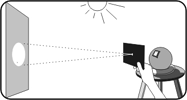
Now use this ball-mirror to project the Sun's image through an open window on to a wall inside your house or school. The distance between the wall and your ball-mirror should be atleast 10 m. If you now darken the room, and make the image of the Sun fall on a white sheet of paper, you can see a beautiful large image of the Sun - you can even make out sunspots, and of course, you will be able to see Venus move slowly across the Sun's disk !
If the image is not sharp enough, cut a 2-4 mm hole in a sheet of paper and hold it in front of the mirror. This pin-hole will then lead to a fainter, but sharper image.
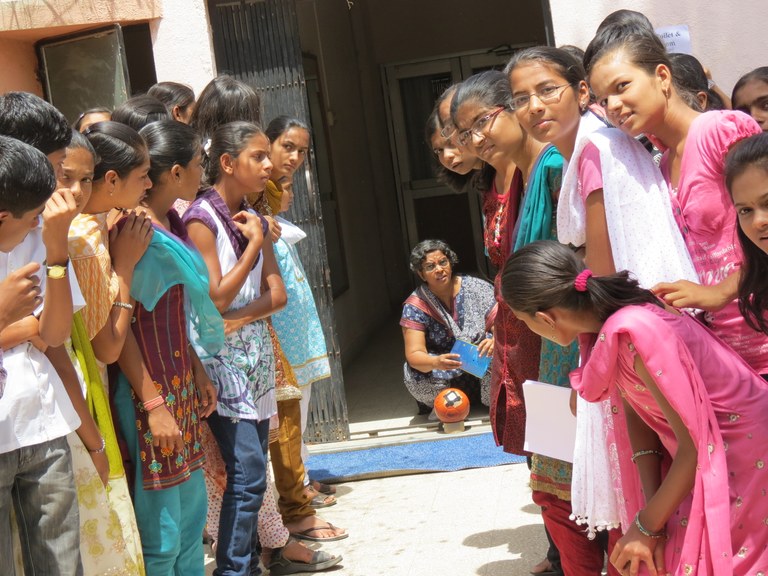
Your assembly will look like this.
'Daytime Astronomy' is a fascinating series of experiments for students, based on the Sun, which can be performed using low-cost easily available material. These have been developed by Navnirmiti and more information on the workshop material can be found here.
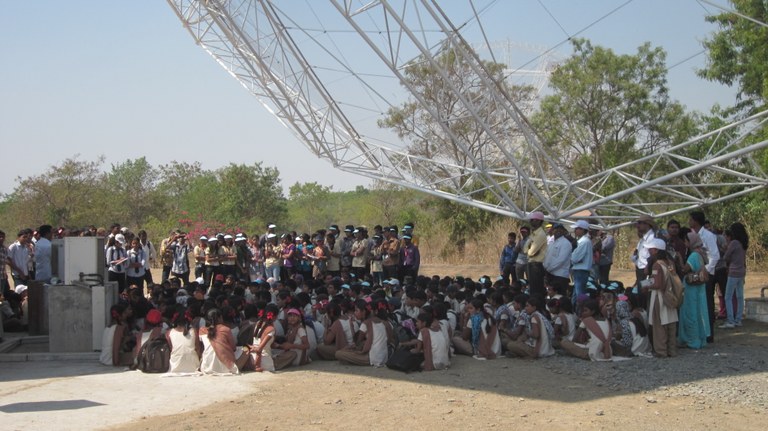
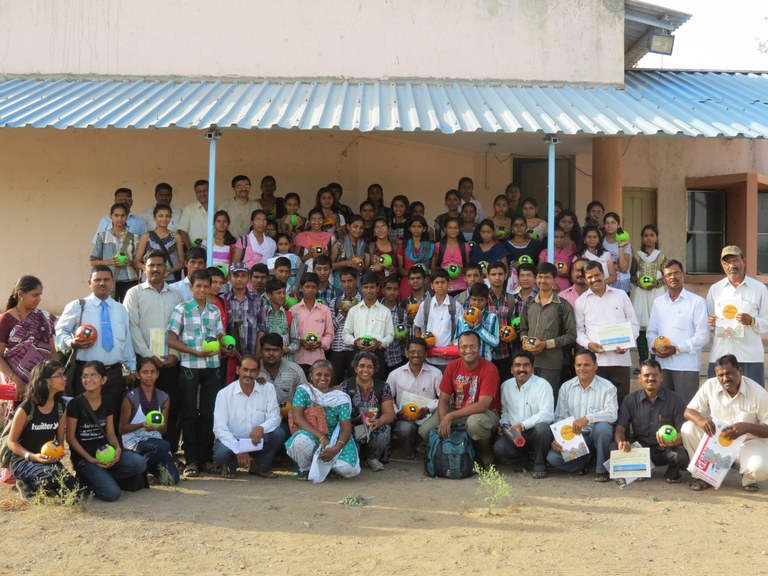
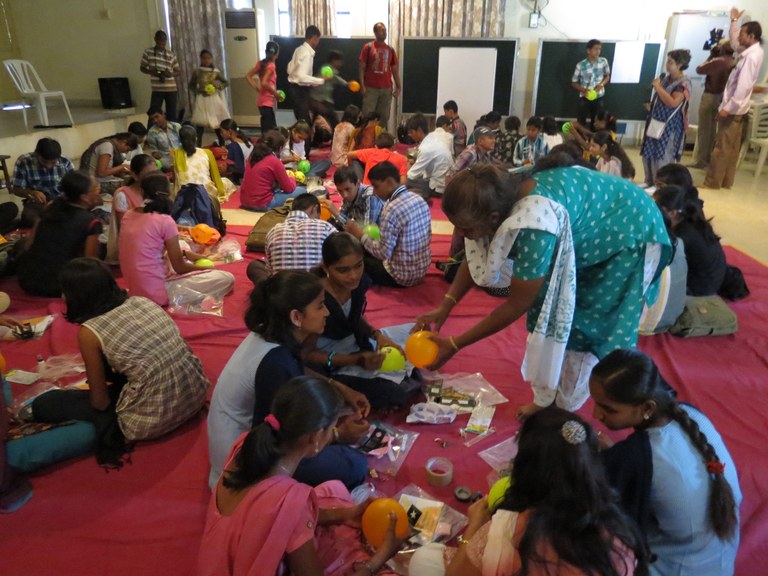
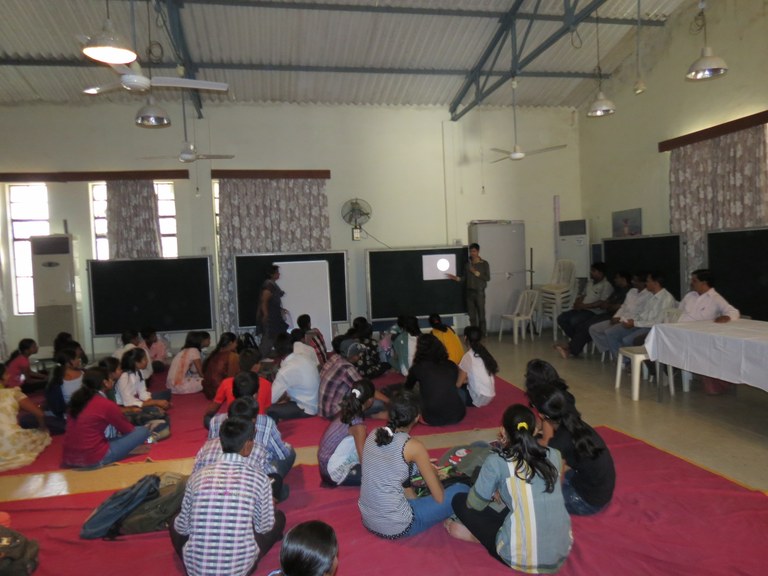
NCRA, along with Navnirmiti, and with help from Kiran, a Fergusson college student, organised a 'Daytime Astronomy' workshop on May 19, at the GMRT campus. 6 students each from 10 schools which are situated close to the GMRT antennas were invited, along with their science teacher, to participate.
The students and the teachers made their own experiments from the Navnirmiti kits and used them to project an image of the Sun inside the recreation hall - we even managed to see 3 huge sunspots. Each school also their own telescope. They even measured the height of a GMRT antenna using nothing more than a needle and graduated piece of paper !
These 60 students will be back on the 6th of June to GMRT with more of their classmates. They will then show them the Transit of Venus through the equipment they made at this workshop.
A Transit of Venus will occur on June 6th 2012 - that is, Venus will come exactly between the Earth and the Sun. We hope you and your friends get to see it - the next transit occurs in 105 years !
We have produced a comic of the story behind the Venus Transit and are translating it in 14 languages. This is for public, free distribution under a Creative Commons license.
Please do download it, email it around, print copies for friends, paste it on your wall, host it on your website, etc.
Available Languages: English, Marathi, Hindi, Tamil, Gujrati, Kannada, Bengali, Telugu, Persian, French, Spanish, Italian, German, Dutch, Macedonian, English(USA times)
You can download these files on astrocast.org as well.
- Text : Niruj Mohan Ramanujam
- Illustration : Reshma Barve
- Marathi translation : Mihir Arjunwadkar
- Hindi translation : Divya Oberoi
- Tamil translation : S. Parthasarathy
- Gujarati translation : Girjaprasad Kantharia
- Bengali translation : Sushan Konar
- Kannada translation : Geetha Kydala Ganesha
- Telugu translation : N. Nagaraju
- Persian translation : Maryam Arabsalmani
- Spanish translation : Breezy Ocaña Flaquer
- French translation : Jean-Christophe Mauduit and Marie Mauduit
- Italian translation : Silvia Verdolini
- German translation : Manfred Rudolf
- Dutch translation : Iris Nijman and Wouter Schrier
- Macedonian translation : Aleksandar Shulevski
Help with producing the pdf files : Reshma Barve, Breezy Ocaña Flaquer, Vishal Gajjar, Sambit Roychoudhuri, Dibyendu Karmakar.
Brief profiles of all the translators can be found here !
Note : the first set of links will open as a google doc. You need to go to 'file' and then download it.