
Science Highlights
Quantifying the weakest non-thermal solar emissions via non-imaging studies
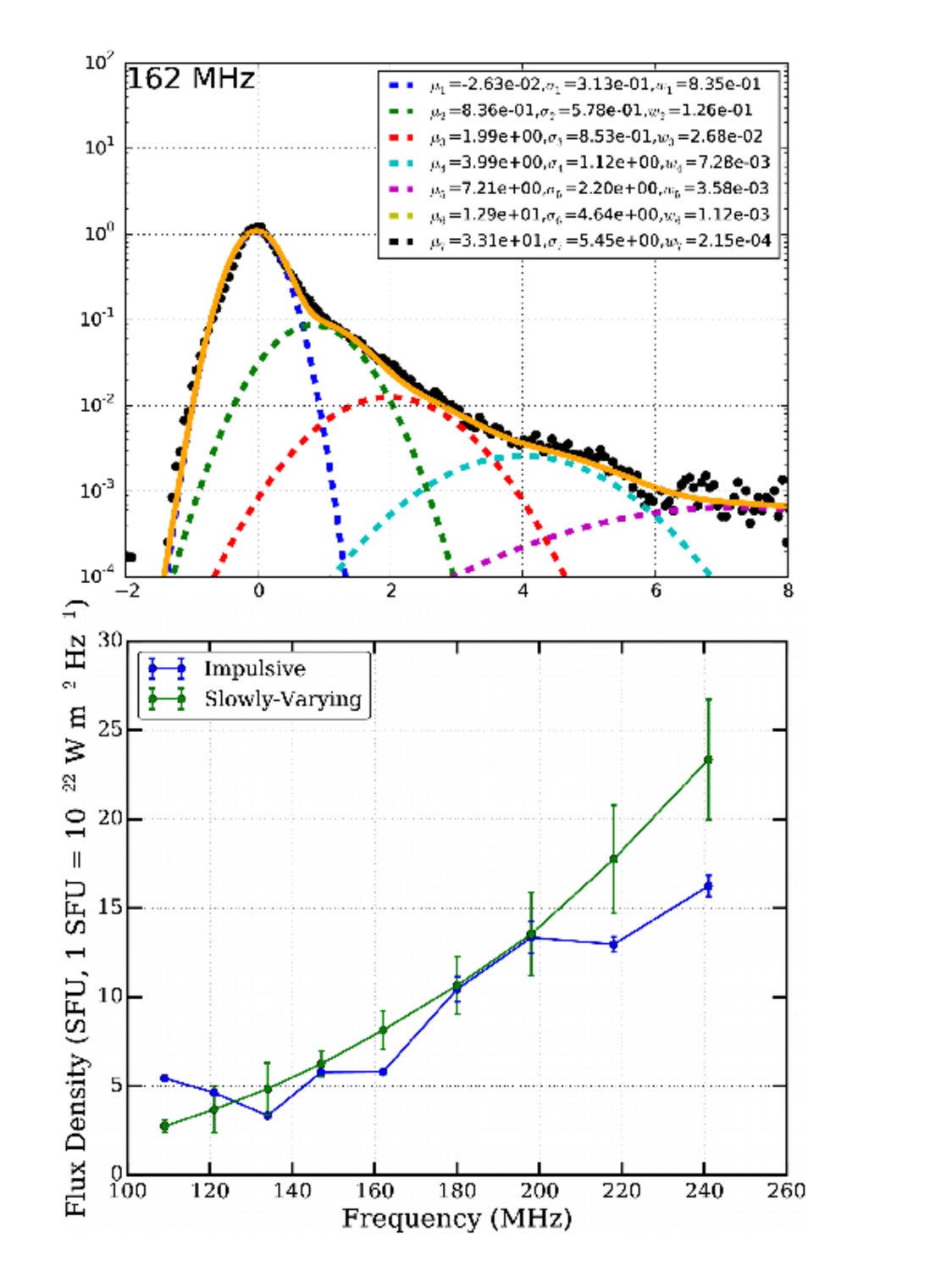
At metre radio wavelengths, the thermal free-free emission from the million K coronal plasma forms the bulk of the solar emission. This broadband emission varies slowly in time and smoothly across frequency. Superposed on this background emission are emissions from a variety of non-thermal mechanisms, which span a large range of strengths, and temporal and spectral scales. Studies with the Murchison Widefield Array (MWA) have recently shown that the weak short-lived narrow-band non-thermal emission features occur much more frequently than had been appreciated earlier. This is exciting because these weak non-thermal emission features may contain clues for solving the longstanding coronal heating problem. Sharma et al. attempt to quantify the weak non-thermal solar emissions using non-imaging techniques, taking advantage of the fine-grained data provided by the MWA to separate out the emission into a slowly varying component, which under moderately quiet solar conditions is expected to be dominated by thermal emission, and an impulsive component, expected to arise from non-thermal processes. They use a method based on a class of statistical data models called Gaussian mixture models (GMMs) to estimate both the strength of the emission components and their time-frequency occupancy. The top panel of the figure shows the observed distribution of the impulsive emission (black dots) superposed on the probability distribution function determined using the GMMs. The dashed and solid lines show, respectively, the individual Gaussian components and the sum of all the Gaussian components; the mean, width and weight of each component are listed on the top right. Surprisingly, Sharma et al. find that even during the moderately quiet solar conditions of the observations, the amount of energy radiated in impulsive non-thermal component is similar to that in the thermal component. Further, they detect evidence for the presence of non-thermal emission in as much as 20-45% of the frequency-time plane. Both of these aspects had not been realised till now. The bottom panel shows slowly varying and impulsive flux densities as a function of observing frequency. The non-thermal emissions studied here are about an order of magnitude weaker than the weakest similar emissions reported in the past. This work establishes the usefulness of the GMM technique for such studies, and gives some tantalising hints, though a lot more needs to be done to assess the role of the weak non-thermal features in coronal heating.
Electron Cyclotron Maser Emission from a radio star
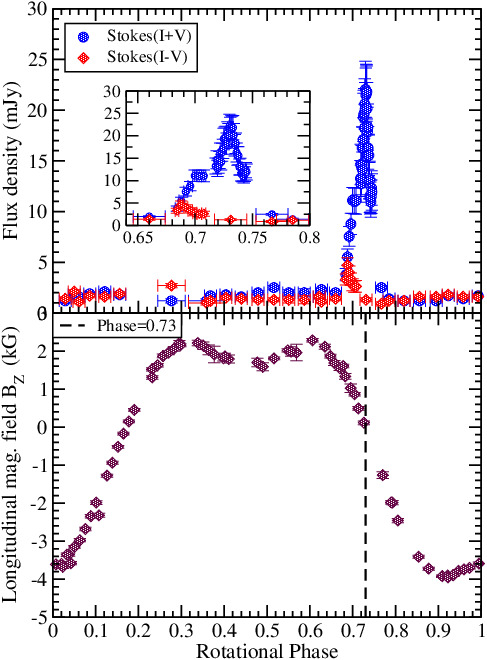
HD133880 is a B-type rapidly-rotating star, with a period less than 1 day, on the main sequence. It is characterised by the presence of an asymmetric dipolar magnetic field of kiloGauss strength. Gyro-synchrotron radio emission has earlier been detected from this star. In 2015, Chandra et al. reported strong enhancement in the star s radio flux (at 610 MHz and 1420 MHz) at certain rotational phases, but the phase coverage was too limited for a detailed study. In the present work, Das, Chandra & Wade aimed to understand the origin of the radio pulses, by using the Giant Metrewave Radio Telescope (GMRT) 610 and 1420 MHz receivers to observe the star over a complete rotation. The GMRT 610 MHz data revealed a dramatic increase (by an order of magnitude) in the star s radio emission at a narrow epoch (phase 0.73) during its rotation, and in the right circular polarization; this can be seen in the upper panel of the attached figure. The observed enhancement is confined to a narrow range of phases and is approximately 100% polarised. Further, the enhancement occurs when the line of sight magnetic field is nearly zero, as can be seen in the lower panel of the figure. Das et al. find that the GMRT data single out Electron Cyclotron Maser Emission as the likely cause of the observed enhanced radiation. This maser process arises, under suitable conditions, due to the interaction of electromagnetic waves with a population of mildly relativistic electrons in a magnetised plasma. Previously, only one magnetic star (CU Vir) was known to host this mechanism, and it was unclear if this is a specific property of CU Vir or a common property of magnetic stars. The discovery of the maser mechanism in a second star rules out the first possibility and, since the maser process is more favourable at low frequencies, emphasizes the importance of more low frequency studies of magnetic stars to further understand the physical conditions that give rise to the maser.
The angular momentum content of gas-rich dwarf galaxies
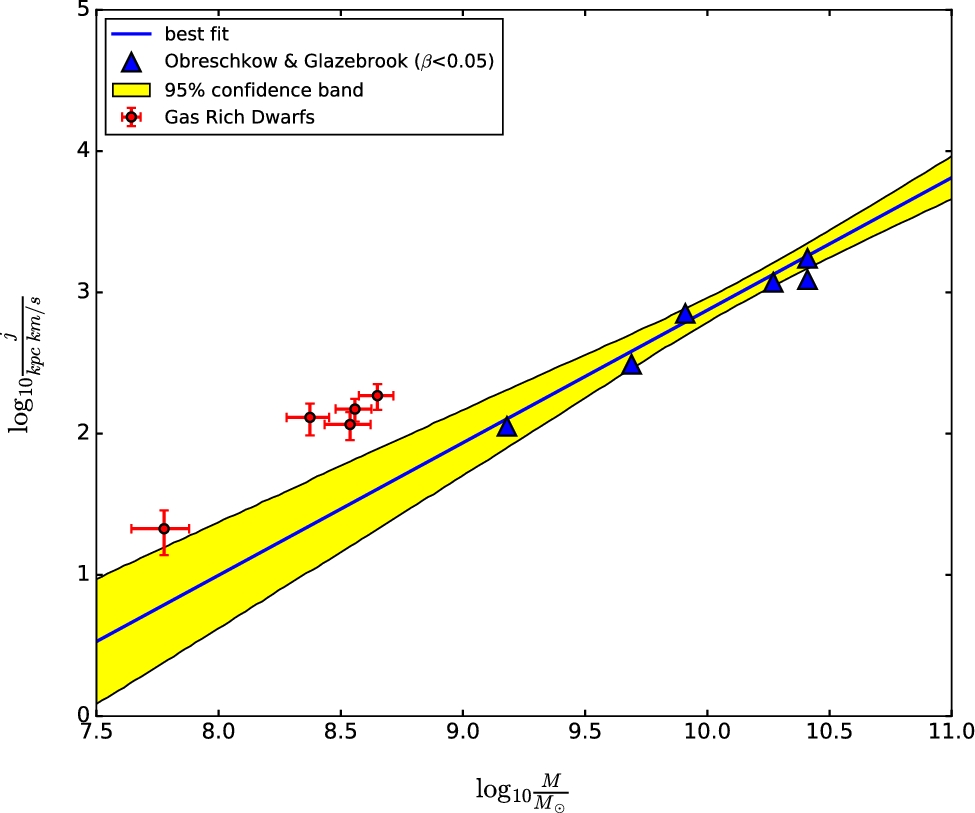
A galaxy s spin is intricately connected to its morphology --- spiral galaxies spin faster and hence are thinner whereas elliptical galaxies have lower specific angular momentum and are puffier. The mass and the angular momentum of a galaxy are related via their evolutionary history. Various researchers in the past have reported a power-law scaling relation between the mass and the specific angular momentum of large spiral galaxies. Chowdhury and Chengalur used archival GMRT, VLA and WSRT HI 21cm data of five gas-rich dwarf galaxies and found that the specific angular momentum in these smaller, less massive, dwarf galaxies is significantly higher than that expected from the earlier studies of spiral disks. The figure shows the location of these dwarf galaxies in the specific angular momentum - mass plane, and compares them with the distribution of spiral galaxies. All the five gas-rich dwarf galaxies lie outside the 95% probability band of the relation for spiral galaxies. The chance probability that the dwarf galaxies belong to the same angular momentum - mass distribution as the spirals is less than one part in a million. The authors suggest two mechanisms through which the dwarfs may acquire their higher specific angular momentum: (i) preferential outflow of low angular momentum gas due to stellar feedback, and (ii) cosmic cold mode accretion, which is known to dominate in less massive galaxies.
A fourth radio arc in Abell 2626
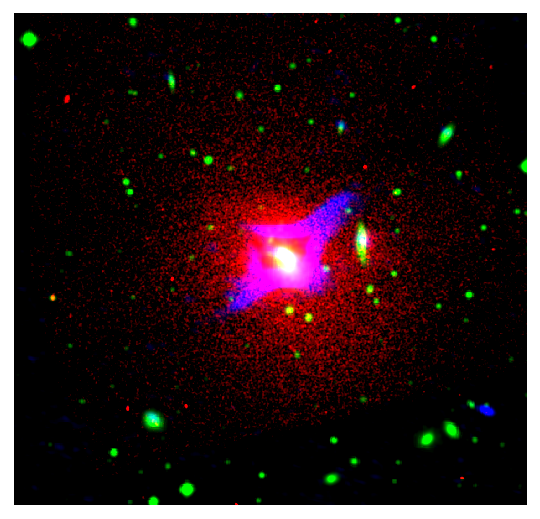
The supermassive black holes at the centres of active galaxies can lead to the formation of spectacular jets that are detectable in deep radio imaging studies. When such black holes are situated close to the centres of galaxy clusters, they experience a dense environment. The radio jets can be affected by the black hole itself and by the environment, leading to complex morphologies. A system of three concave arcs was earlier known towards the galaxy cluster Abell 2626. Kale & Gitti used the 610 MHz receivers of the GMRT to discover a fourth arc in the sytem, that completes an intriguing symmetric structure of four arcs around the central massive galaxy that itself has two active nuclei. The origin of the exotic source is as yet unknown, but may be a rare event of precessing jets from the double nuclei of the central galaxy or a similarly rare configuration of a gravitational lens. The image shows the GMRT radio image in blue, overlaid on X-ray (red) and optical (green) images.
Stringent constraints on fundamental constant evolution over 3 billion years
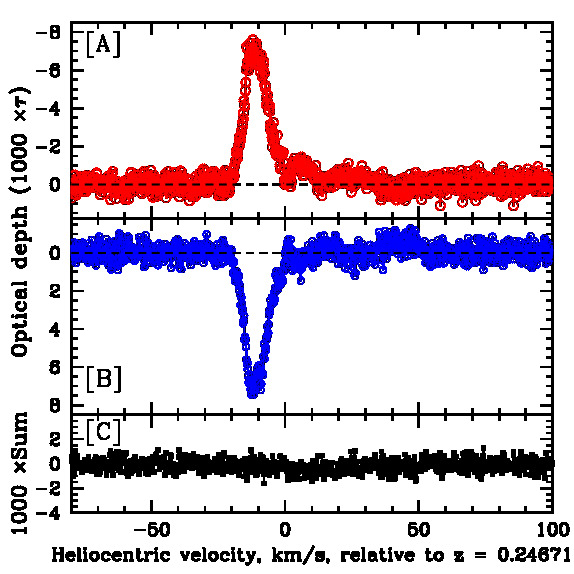
Kanekar, Ghosh and Chengalur used the mighty Arecibo Telescope to carry out one of its deepest-ever observing runs, 125 hours on the hydroxyl (OH) lines from a gas cloud close to the z=0.247 active galactic nucleus PKS1413+135. The satellite OH lines, at rest frequencies of 1720 MHz and 1612 MHz, are "recentResults"conjugate in this system, mirror images of each other, with the 1720 MHz line in emission and the 1612 MHz line in absorption. Since the 1720 and 1612 MHz line frequencies have different dependences on the fine structure constant, alpha, and the ratio of the proton mass to the electron mass, mu, this expected perfect cancellation makes the two lines ideal to probe changes in alpha and mu out to z~0.247, i.e. a lookback time of nearly 3 billion years. If alpha and/or mu change with time, the lines would shift relative to each other, and would not cancel out. Kanekar et al. found that the OH satellite line remain conjugate within the measurement errors, with no evidence for a shift between the two lines. They used this perfect cancellation to place stringent constraints on changes in alpha and mu with cosmological time, limiting fractional changes in the two quantities to less than a few parts in a million. This is the most sensitive constraint on fractional changes in alpha in the literature, and with no known systematic effects. The top two panels of the figure show the two OH satellite lines from PKS1413+135 at z=0.247, with the 1720 MHz in the upper panel and the 1612 MHz line in the middle panel. The bottom panel shows the sum of the two line optical depths. It is clear that this is consistent with Gaussian noise, as expected if the lines are mirror images of each other.
A Giant Radio Galaxy at z ~ 0.57
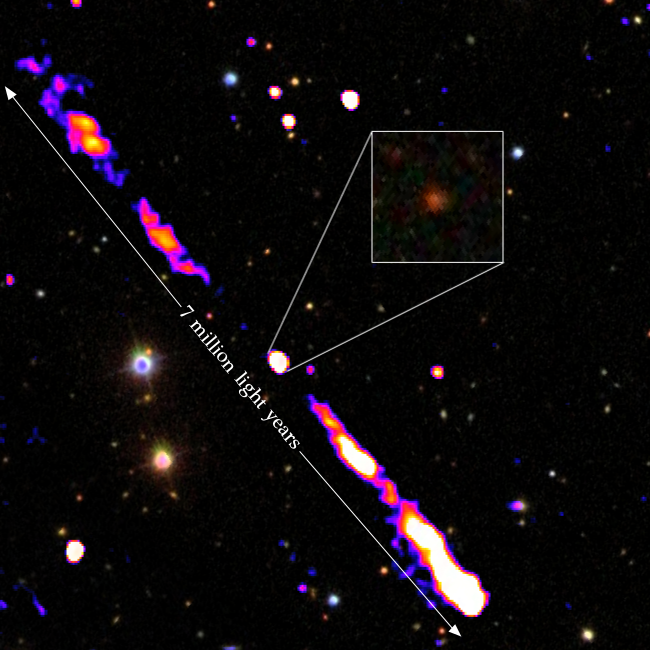
Giant radio galaxies (GRGs) are radio galaxies whose linear extent is more than 1 Mpc. Most of the known GRGs are less than a billion light years away from us. The sharp decline in the number of GRGs at larger distances, i.e. higher redshifts, is a mystery because the number of normal radio sources is actually higher at high redshifts. We recently used the GMRT to carry out a deep 150 MHz study of a small region of the sky in the Lynx constellation, and discovered a large GRG, of size 7 million light years, at a distance of about 5 billion light years, i.e. a redshift of 0.57. We used the GMRT to carry out detailed imaging studies of the GRG, at 325 MHz, 610 MHz and 1420 MHz; the new data suggest that the object is probably a double-double radio galaxy. Further, the radio core of the galaxy shows an unusually steep spectrum, which may imply that there is yet another unresolved pair of lobes within the core, making this GRG a candidate triple-double radio galaxy. Further investigations of the central region of the GRG, to test if it is a re-started radio source, are now under way using the European Very Long Baseline Interferometry Network (EVN), which has the resolution to probe the central region very close to the supermassive black hole. The figure shows the GMRT 610 MHz image of the new GRG, overlaid on the optical SDSS gri-composite image. The optical host galaxy is shown separately in the rectangular box. The double-lobe structure on either side of the central core is clearly visible.
The gas and stellar mass of low-redshift damped Lyman-alpha absorbers
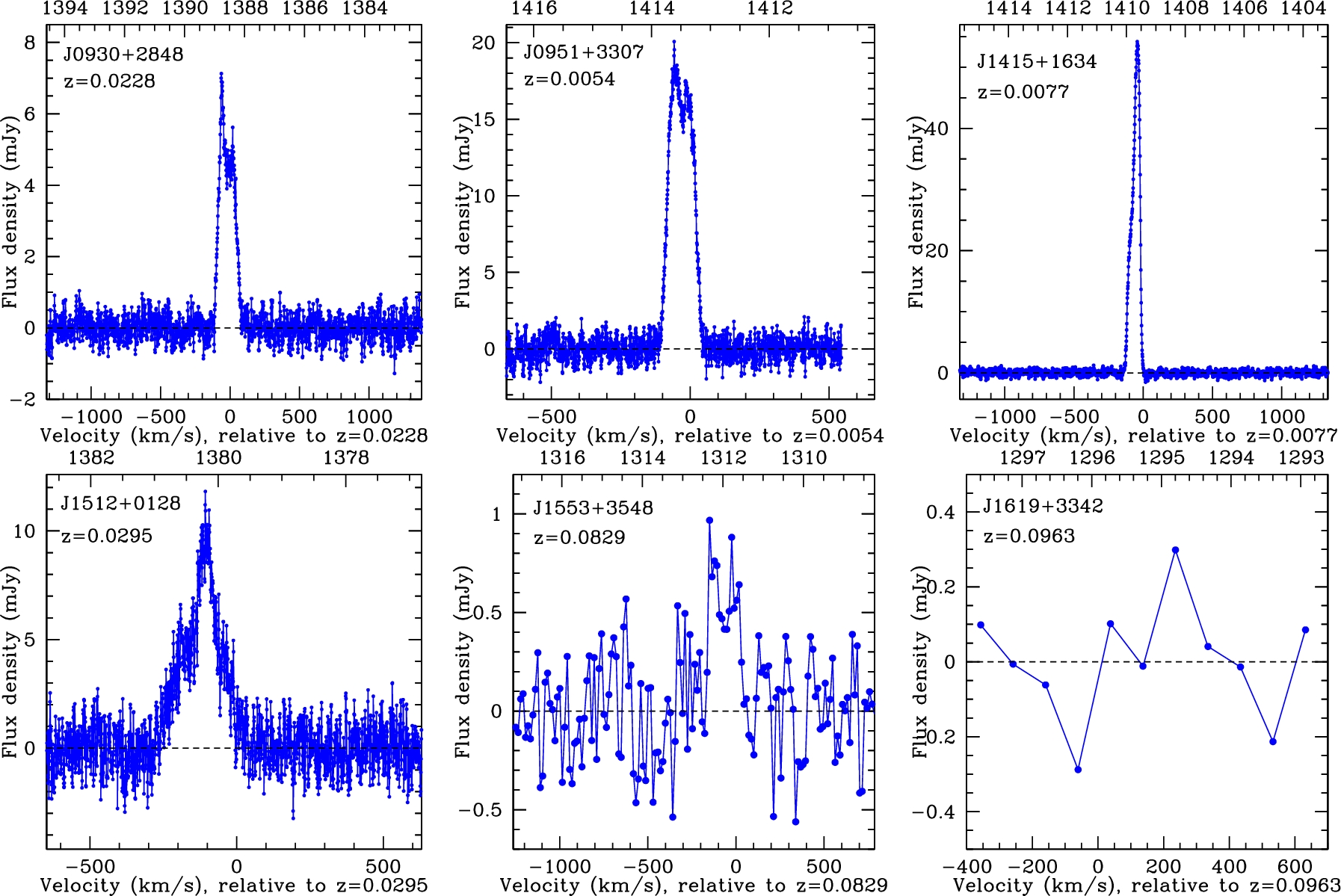
Kanekar et al. report Hubble Space Telescope Cosmic Origins Spectrograph far-ultraviolet and Arecibo Telescope HI 21cm spectroscopy of six damped and sub-damped Lyman-alpha absorbers (DLAs and sub-DLAs, respectively) at z<~0.1, which have yielded estimates of their HI column density, metallicity and atomic gas mass. This significantly increases the number of DLAs with gas mass estimates, allowing the first comparison between the gas masses of DLAs and local galaxies. Including three absorbers from the literature, they obtain HI masses ~(0.24-5.2) billion solar masses, lower than the knee of the local HI mass function. This implies that massive galaxies do not dominate the absorption cross-section for low-z DLAs. Kanekar et al. use Sloan Digital Sky Survey photometry and spectroscopy to identify the likely hosts of four absorbers, obtaining low stellar masses, ~(0.01-0.3) billion solar masses in all cases, consistent with the hosts being dwarf galaxies. They obtain high HI 21cm or CO emission line widths, ~ 100-290 km/s, and high gas fractions, ~5-100, suggesting that the absorber hosts are gas-rich galaxies with low star formation efficiencies. However, the HI 21cm velocity spreads (>~ 100 km/s) appear systematically larger than the velocity spreads in typical dwarf galaxies. The figure shows the Arecibo HI 21cm spectra for the six galaxies of the paper.
The Gas Mass of Star-forming Galaxies at z~1.3
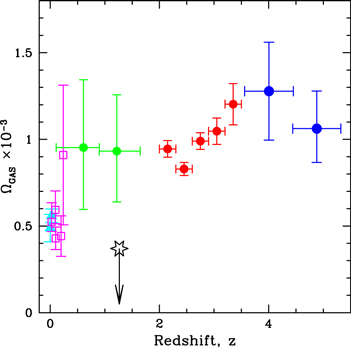
Kanekar et al. used the GMRT 610 MHz receivers to carry out a search for HI 21cm emission from a large sample of massive star-forming galaxies at z~1.18-1.34, lying in sub-fields of the DEEP2 Redshift Survey. The search was carried out by co-adding ("recentResults"stacking ) the HI 21cm emission spectra of 857 galaxies, after shifting each galaxy’s HI 21cm spectrum to its rest frame. The non-detection of a signal in the stacked HI 21cm spectrum yielded a stringent upper limit of 2.5 microJy on the average HI 21cm flux density of the 857 galaxies, at a velocity resolution of 315 km/s. This implies an upper limit of 20 billion solar masses on the average HI mass of the 857 galaxies, the first direct constraint on the atomic gas mass of galaxies at z>0.5. The upper limit to the ratio of the atomic gas mass to the stellar mass, i.e. the gas fraction, is 0.5, comparable to the cold molecular gas fraction in similar galaxies at these redshifts. Kanekar et al. find that the cosmological mass density of neutral atomic gas in massive star-forming galaxies at z~1.3 is significantly lower than the mass density estimates in both galaxies in the local Universe and damped Lyman-alpha absorbers at z>2. This implies that massive blue star-forming galaxies do not dominate the neutral atomic gas content of the Universe at z~1.3. The figure shows the cosmological mass density in neutral gas plotted as a function of redshift. The open star shows the new GMRT result, for blue star-forming galaxies at z~1.3. See the paper for more details.
Discovery of Gamma-ray pulsations from the transitional redback PSR J1227-4853
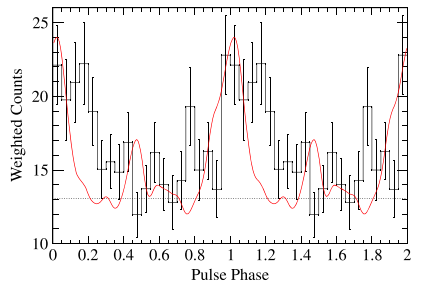
Post-discovery timing studies with the GMRT of the 3rd transitional millisecond pulsar, J1227-4853, have resulted in detection of gamma-ray pulsations after the transition, using data from the Large Area Telescope (LAT) on board the Fermi Gamma-ray Space Telescope. The gamma-ray light curve of PSR J1227-4853 can be fitted by one broad peak, which occurs at nearly the same phase as the main peak in the 1.4 GHz radio profile. The partial alignment of light-curve peaks in different wavebands suggests that at least some of the radio emission may originate at high altitudes in the pulsar magnetosphere, in extended regions co-located with the gamma-ray emission site. Analysis of the gamma-ray flux over the mission suggests an approximate transition time of 2012 November 30. Continued study of the pulsed emission and monitoring of PSR J1227-4853, and other known redback systems, for subsequent flux changes will increase our knowledge of the pulsar emission mechanism and transitioning systems. The figure shows the phase-aligned gamma-ray (black line) and 1.4 GHz radio (red line with Parkes) light curves of PSR J1227−4853, with two rotations shown for clarity. The low-level peak at phase ∼0.5 in the radio light curve is an inter-pulse, which becomes dominant at lower frequencies.
Discovery of PSR J1227-4853: Transitioning from Low-mass X-Ray Binary to Redback Millisecond Pulsar
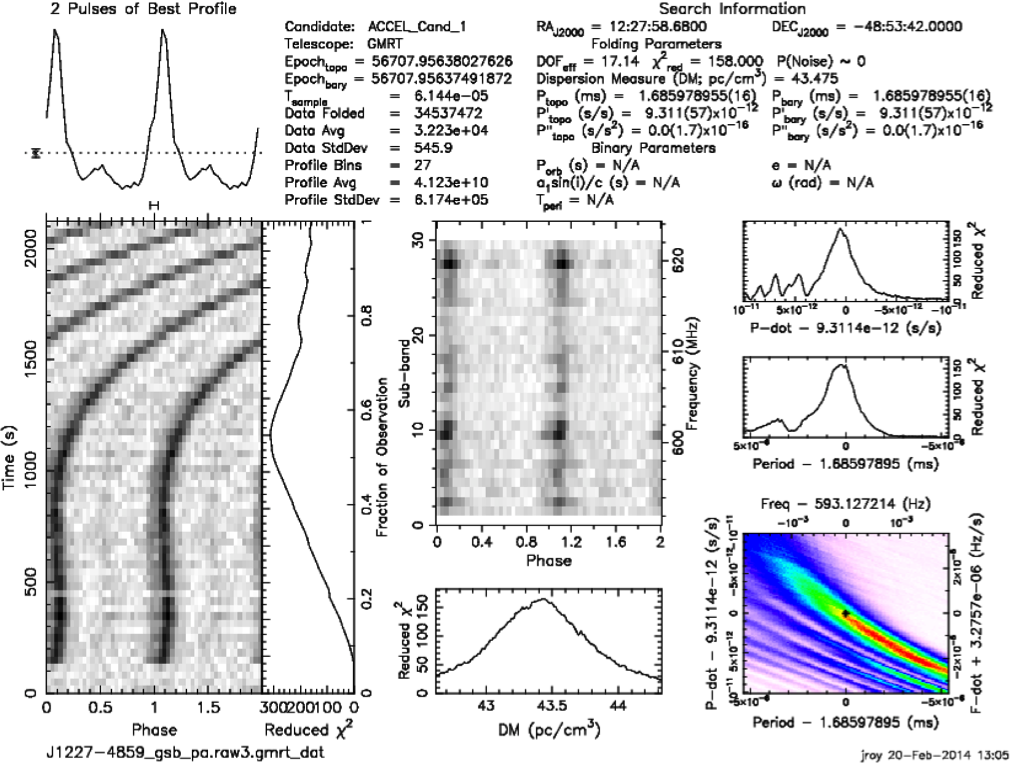
Low-mass X-ray binaries (LMXB s) and radio millisecond pulsars (MSP s) are linked through stellar and binary evolution, where MSP s are the end products of an episode of accretion of matter and angular momentum from the binary companion during the LMXB state. Over the last decade, the discovery of three transitional millisecond pulsars (tMSP s) has allowed a detailed study of the recycling process. Recent studies of PSR J1824−2452I and PSR J1023+0038 have observationally demonstrated the LMXB – MSP evolutionary link. These systems show direct evidence of back-and-forth state switching between radio MSP and accreting X-ray millisecond pulsar regimes and opened a new avenue of research in pulsar astrophysics. The third such tMSP system, J1227-4853, was discovered by us using the GMRT. PSR J1227-4853 is a 1.69 millisecond pulsar at a dispersion measure of 43.4 pc/cm^3. It transited into the active radio-MSP phase associated with a sudden drop of its X-ray and optical luminosity in 2012 December. Extreme orbital perturbations as well as the signature of proper motion are revealed from our GMRT timing campaign. This pulsar, an "recentResults"eclipsing redback , is the only transitioning system currently in an active rotation-powered state. Simultaneous imaging and timing observations with the GMRT were used to directly show that eclipses are caused by absorption rather than dispersion smearing or scattering. A long-term timing study of PSR J1227-4853 is currently under way, which will help to determine whether these transitional systems will eventually be canonical radio MSP s or whether they form a new sub-class of MSP s that continue to transition between the two states. Also, such studies will result in better understanding of the spin evolution of the systems and the dynamics of accretion during the accretion-powered, propeller stage and the rotation-powered stage. The figure shows the pulsar search output for PSR J1227-4853 showing rapid evolution of period and period-derivative in a compact binary system.