

The Milky Way
(Poonam Chandra, Jayaram N. Chengalur, Subhashis Roy, Nissim Kanekar, Former members: A. J. Nayana, Nimisha Kantharia, Swarna Kanti Ghosh, Narendra Nath Patra, Barnali Das, Ayan Biswas)
Understanding the physical conditions in the Milky Way, that stem from the interactions between the stars and the gas is an important area of research in astronomy and at NCRA-TIFR. Radio imaging and spectroscopy offers insights into conditions in the Milky Way that are not available at other wavelengths. An active area of research is the centre of the Milky Way (the ``Galactic Centre'' region), which is believed to be dominated by a compact, supermassive black hole with a mass of about two million solar masses. The Galactic Centre region also contains massive stars and strong star formation activity, as well as large molecular gas clouds and ionized regions, all of which can be studied at radio wavelengths to glean information on local physics.
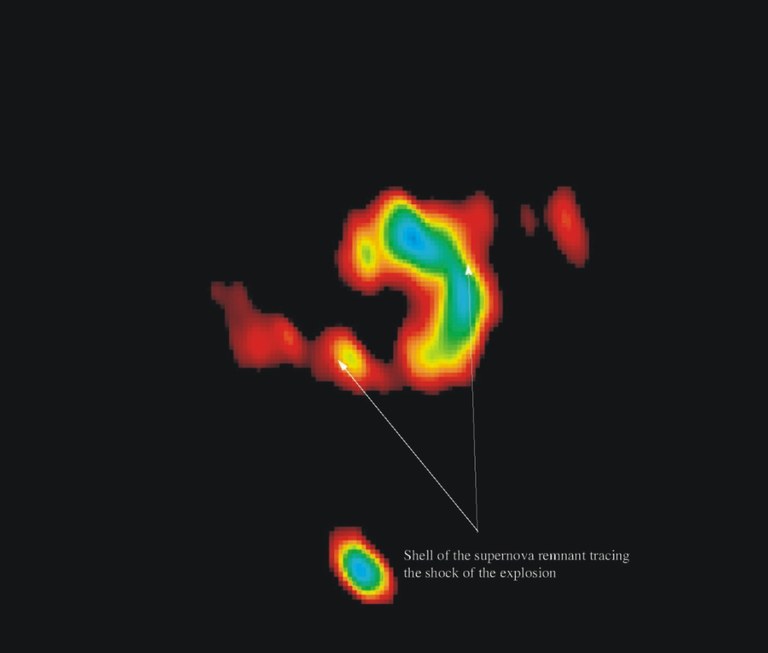
Astronomers at NCRA-TIFR use deep radio continuum imaging studies to trace ionized gas structures arising from supernova remnants and ionized hydrogen regions in the Milky Way, and to derive densities, temperatures, and energetics therein. Low-frequency surveys for supernova remnants have been used to probe the star formation history of the Milky Way. Attempts are also under way to understand acceleration mechanisms in supernova remnants, via a combination of radio and gamma-ray studies. NCRA-TIFR astronomers also carry out research on Galactic objects like novae, which are bright explosions of compact stars, and on the magnetospheres of massive stars. There is also significant interest in black-hole X-ray binary systems, with radio monitoring studies used to probe conditions during the outburst states, when there is increased accretion onto the black hole.
Another important area of research at NCRA-TIFR is the interstellar medium (ISM) of the Milky Way and external galaxies, which consists of various gas phases, neutral atomic, ionized, and molecular gas, at different temperatures, pressures, and densities. The neutral atomic ISM is best probed with the hyperfine spectral line of neutral hydrogen at a rest wavelength of 21.11 cm. NCRA-TIFR astronomers have long used this spectral transition to study physical conditions in the neutral gas in the Milky Way. They have found evidence for a phase transition in the gas above a critical atomic hydrogen column density, as well as for a significant fraction of the neutral gas lying in the thermally unstable phase, and continue to work on the existence and nature of the equilibrium between the different gas phases in the Galaxy.