

The Sun and the Heliosphere
(Divya Oberoi, Puja Majee, Soham Dey, Deepan Patra, Former members: P. K. Manoharan, Rohit Sharma, Atul Mohan, K. Hariharan, Surajit Mondal, Devojyoti Kansabanik)
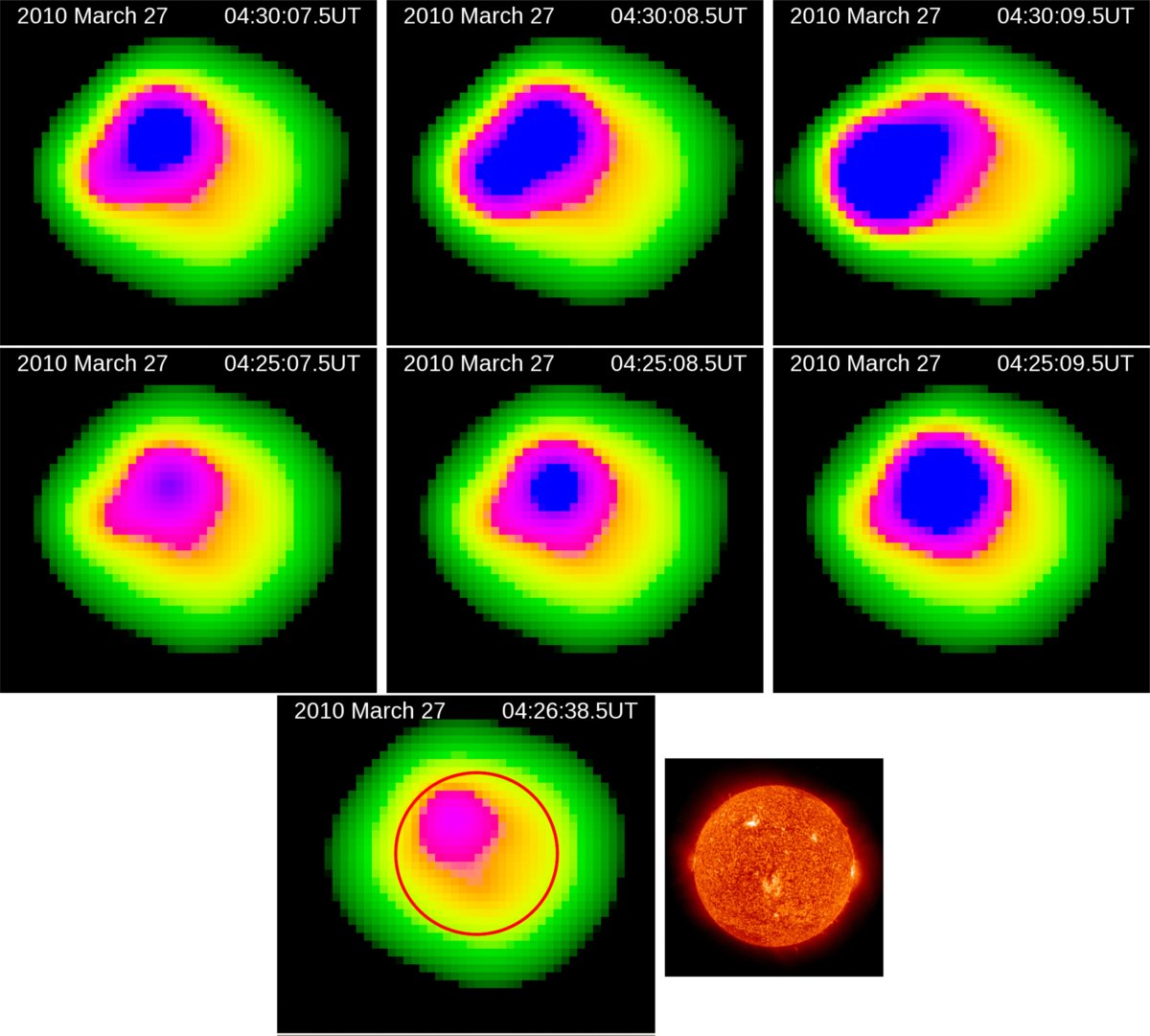
Radio waves provide a view of the Sun that is very different from that at other wavelengths. Low-frequency solar radio emission varies rapidly in time, frequency and spatial location; this variability has long posed a challenge to solar studies. Besides using the GMRT, NCRA-TIFR researchers are involved in mapping the Sun with the Murchison Widefield Array (MWA), a new radio telescope in Australia. The unique high fidelity imaging capability of the MWA over short time intervals and narrow frequency widths allows it to track changes in the solar emission across time, frequency and morphology.
A constant stream of charged and magnetized plasma flows out from the upper solar atmosphere. As radio waves from distant sources traverse this inhomogeneous and turbulent “solar wind”, their wave fronts get distorted. For compact sources, this leads to the phenomenon of Interplanetary Scintillation (IPS), analogous to the optical twinkling of stars. IPS provides an excellent remote sensing probe for the heliosphere, and the ORT has played a pivotal role in the development and application of IPS techniques. IPS monitoring with the ORT is being used to provide insight into solar activity, including solar bursts, coronal mass ejections, and solar-wind driven magnetic storms that affect the near-Earth environment.