

Fundamental Constant Evolution
(Jayaram N. Chengalur, Nissim Kanekar)
Coupling constants like the fine structure constant (alpha), the ratios of particle masses (e.g. the ratio of the proton mass to the electron mass, mu = m_p/m_e), and other dimensionless quantities, are not expected to change with space or time in the standard model of particle physics or General relativity. Tests of temporal variation of such low-energy fundamental constants are thus tests of the basic assumption of the standard model and relativity, similar to tests of violations of the weak equivalence principle, Lorentz invariance, local position invariance, etc. However, besides the above pragmatic view of tests of fundamental constant evolution, a generic prediction of higher-dimensional theories that attempt to unify the standard model and relativity is that low energy fundamental constants like alpha and mu should evolve with time. As such, tests of fundamental constant evolution allow a low-energy probe of such higher-dimensional theories. This is very interesting as most other predictions of these theories lie at very high energies (the unification scale), far beyond our reach in the foreseeable future.
Laboratory studies of fundamental constant evolution, using atomic clocks, provide an excellent approach to probe changes on relatively short timescales, up to a few years. Indeed, such studies have yielded very sensitive constraints on changes in alpha on timescales of a year (e.g. Rosenband et al. 2008, Science). However, such studies are not sensitive to changes in the constants on cosmological timescales. Astronomical studies allow one to probe such evolution on timescales of billions of years, and to thus test the validity of the standard model on cosmological timescales. The most important of these studies are based on a comparison between the redshifts of a galaxy lying along the line of sight to a background quasar, as measured from multiple spectral lines detected in absorption in the quasar spectrum. If the different lines arise from different physical mechanisms (e.g. fine structure, hyperfine structure, rotation, lambda-doubling, inversion, etc.), the line frequencies would have different dependences on quantities like alpha and mu. If alpha and/or mu change with cosmological time, the rest frequency of each line would be different at the galaxy's redshift from the value measured in the laboratory today. However, one uses the laboratory rest wavelength to infer the galaxy's redshift from the observed line in the quasar spectrum, thus making the implicit assumption that the rest wavelength does not change with time. As such, if the constants do change with time, and the line rest wavelengths change as well, the effect is that one would infer an incorrect galaxy redshift. And, if one uses two lines, with different frequency dependences on alpha, mu, etc., one would infer different redshifts for the same galaxy!
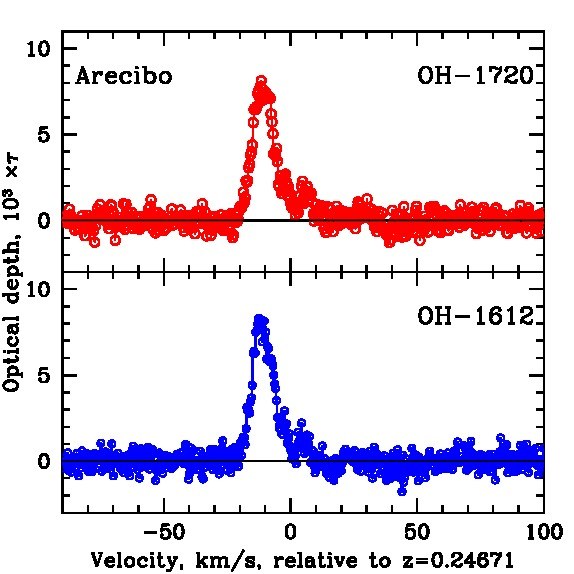
Researchers at NCRA-TIFR have come up with new techniques to probe fundamental constant evolution, based on radio spectral lines. They also use radio telescopes to carry out accurate measurements of the redshifts of atomic and molecular radio spectral lines, including those of neutral hydrogen, hydroxyl, ammonia, methanol, etc, to carry out amongst the most accurate tests of cosmological changes in the fine structure constant and the proton-electron mass ratio.