

Active Galaxies and Clusters
(C. H. Ishwara-Chandra, Dharam Vir Lal, Ruta Kale, Preeti Kharb, Ramananda Santra, Sanna Gulati, janhavi Baghel, Arpan Pal, Salmoli Ghosh, Former members: S. Vaddi, D. J. Saikia, J. N. H. S. Aditya, B. Sebastian, S. Sonkamble, S. Sasikumar)
Active Galactic Nuclei
Active Galactic Nuclei (AGNs) are galaxies where extremely energetic phenomena take place, driven by activity around the super-massive black holes at their centres. These result in the emission of enormous amounts of radiation in various wavebands, including the radio, making them observable out to very large distances in the Universe. The identification and detailed study of Compact Steep Spectrum and Gigahertz Peaked Spectrum sources, which constitute a significant fraction of such bright AGNs but are not well understood, are carried out at NCRA-TIFR. Research is also carried out on studies of giant radio sources, recurrent activity in radio galaxies, the interaction between radio plasma and the inter-cluster and intra-group media, radio halos and relics. Searches are also being carried out for radio galaxies at high redshifts, and efforts are under way to model their gaseous environments, at all redshifts.
Seyfert galaxies were first identified by Carl Seyfert in 1943 as those exhibiting star-like nuclei superimposed on the centers of spiral galaxies, along with peculiar emission line spectra showing the presence of strong narrow and broad emission lines. These are now understood to be a class of AGNs. Sensitive radio observations have detected kiloparsec-scale radio structures (KSRs) or lobes in a large fraction of Seyfert galaxies. The origin of these KSRs is still debated: some studies have suggested them to be driven by starburst superwinds from the nuclei of spiral galaxies, while others have favoured an AGN-driven origin. Several large samples of Seyfert galaxies have been, and are currently being observed at low radio frequencies with the GMRT. Low radio frequency observations are not only detecting radio emission from the spiral galaxy disks themselves, but also "relic" lobe emission from previous AGN activity cycles in some Seyfert galaxies. Radio spectral studies are providing important constraints on the contributions of stellar versus AGN activity. On the one hand, low radio frequencies detect a larger fraction of host galaxy emission in these Seyferts, which contaminates the spectral index values of lobes, the detection of ``relic'' lobe emission strongly favours the AGN-driven origin for KSRs. NCRA-TIFR astronomers are also studying these Seyfert galaxies with Very Long Baseline Interferometry, using telescopes like the Very Long Baseline Array in the USA, and MERLIN in the UK. We are probing parsec-scale AGN jet emission with these studies, in order to finally construct a comprehensive picture of outflows in Seyfert galaxies.
Clusters of Galaxies
Clusters of galaxies are gravitationally bound collections of hundreds to thousands of galaxies. The space between these galaxies is filled with diffuse, hot plasma (~ten million Kelvin), called the intra-cluster medium (ICM). The thousands of galaxies and the gas are held together in the gravitational potential of dark matter which makes about 80-85% of a cluster's total mass. These are the most massive gravitationally-bound physical systems in the Universe.The ICM is a soup of thermal gas, cosmic rays, and magnetic fields. The cosmic rays and magnetic fields are very difficult to detect, and hence the physics of how energy is exchanged between these components and the thermal gas is not well understood. Radio observations (e.g. with the GMRT) provide a unique probe for the relativistic electrons and magnetic fields in the ICM by allowing us to detect the radio emission from them. In the special case of clusters that are undergoing violent mergers with other clusters, the magnetic fields in the ICM are amplified, and shocks and turbulence are driven into the ICM. These shocks and turbulence can accelerate electrons to relativistic energies leading to the formation of sources called radio halos and radio relics. NCRA-TIFR astronomers use the GMRT and other radio and X-ray telscopes to uncover the physical processes that govern these phenomena. Indeed, a large GMRT survey provided the first estimate of the statistical occurrence of such radio sources in merging and non-merging clusters.
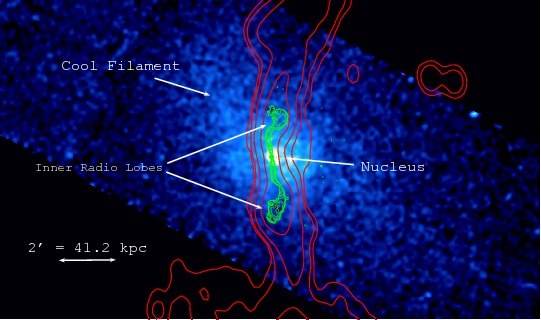
The brightest cluster galaxies (BCGs) that typically reside at the centres of galaxy clusters are the largest and most massive galaxies in the Universe. The BCGs are also known to be spectacular sources of radio emission triggered by the accretion of mass on to their central supermassive black holes (SMBHs). The radio mode feedback from the BCGs is considered to offset the cooling of cluster cores but the delicate balance between the two is still not well understood. NCRA-TIFR astronomers use the GMRT and other telescopes to study the triggering of the radio jets from the SMBHs and their feedback on the ICM.
The active galaxies and radio galaxies in galaxy clusters are of interest as they are responsible for depositing cosmic rays and magnetic fields in the ICM. NCRA-TIFR astronomers have used cluster galaxies to study their dense environments. When the extended radio emission is not being actively fed by the SMBH jets, the radio emission fades rapidly, causing the radio spectrum to steepen, becoming relatively brighter at low frequencies. Such remnants of radio galaxies are of interest in understanding the effects of shock compression and re-acceleration of electrons in the ICM. Radio continuum observations with the wide frequency bands of the upgraded GMRT are now being used to learn the physical phenomena of re-acceleration of electrons in the ICM.