This report is in the Public Domain. You are encouraged to distribute it freely in any form.
See also: 1994 Corbett Report
Report Author
Yogesh Wadadekar
May 1997
Acknowledgements
We gratefully acknowledge the help and cooperation received from Project Tiger authorities at Corbett Tiger Reserve particularly the Field Director, Mr. R. C. Gautam, the Deputy Director, Mr. Rajiv Bhartari, and the DFO, Kalagarh Tiger Reserve Division, Mr. Samir Sinha.
1. Basic Information on Corbett Tiger Reserve
1.1 Geography
1,318.54 km²
Total Area
520.82 km²
Core Area (National Park)
797.72 km²
Buffer Area
Corbett Tiger Reserve is spread over areas of Nainital, Almora, Pauri Garhwal and Bijnore Districts of Uttar Pradesh. The core area forms the Corbett National Park while the buffer contains reserve forests (496.54 km²) as well as the Sonanadi Wildlife Sanctuary (301.18 km²).
The core is bounded to the North by the Kanda Ridge, with a height of 1043 m at its highest point. The entire area falls in the Sivalik and Outer Himalaya geological province. It forms the catchment area of the Ramganga, a tributary of the Ganga, which flows from East to West through landscapes of incredible beauty.
Ramganga Dam Impact
The Ramganga was dammed at Kalagarh at the south-western end in 1974. The reservoir created submerged 40 km² of prime grassland. The area on the western side now constitutes the Sonanadi Wildlife Sanctuary.
1.2 Conservation History
1936
First National Park
Corbett National Park became the first national park of India and the Indian subcontinent on 8 August 1936. Originally called Hailey National Park after Sir Malcolm Hailey, the then governor of the United Provinces.
Major Jim Corbett was largely responsible for delineation of the park boundaries.
Project Tiger Launch Site
Project Tiger, India's ambitious conservation program to save the tiger and its habitat was launched from Corbett in 1973. In 1991 the reserve was enlarged to its present area with a large buffer under direct Field Director control.
1.3 How to Get There
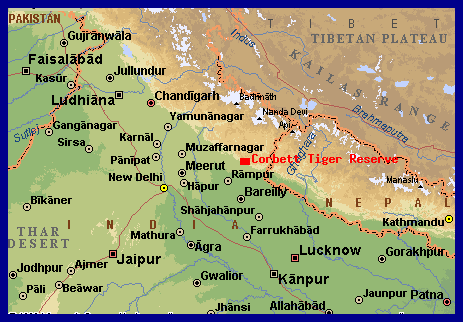
Headquarters: Ramnagar, District Nainital (south-eastern boundary)
By Train:
Departs: Old Delhi Railway Station at 23:00
Arrives: Ramnagar at 04:45
By Road:
Bus services available from Delhi/Moradabad/Kashipur (both private and government services)
Facilities at Ramnagar:
- Hotel accommodation available
- Tourist Lodge adjacent to Project Tiger complex
- Private retreats on Ranikhet road (room, board, transportation, guides)
- STD/ISD telephones, medical and grocery facilities
1.4 Entry Formalities
Day Visitors
Permitted Area: Bijrani sector only
Permits: Issued at Ramnagar office from 08:00
Overnight Visitors
Requirements:
- Entry permit
- Reserved accommodation at Guest Houses
Advance booking strongly advised!
1.5 Where to Stay
24 Rest Houses Available
Locations: Bijrani, Gairal, Sultan, Sarpduli, Khinnanauli, Dhikala, Lohachaur, Halduparao
Dhikala - Must Visit
Largest tourist complex housing a magnificent library. Elephant rides available for viewing wildlife. Reputed to have the highest density of tigers in the world.
Note: Tourist pressures high at Dhikala. Consider other less crowded locations equally rewarding for nature enthusiasts.
1.6 Flora of the Reserve
Mind Boggling Diversity
In association with bhabar: 110 tree species, 51 shrub species, 27 climbers, 33 bamboo and grass species
Dominant Species: Sal (Shorea robusta) found over 75% of total area. Pure stands found in some areas.
Common Trees:
- Haldu (Adina cardifolia)
- Pipal (Ficus religiosa)
- Rohini (Mallotus philipensis)
- Mango (Mangifera indica)
- Sheesham (Dalbergia sissoo) - along Ramganga river
1.7 Fauna of the Reserve
582
Bird Species
50
Mammal Species
26
Reptile Species
7
Amphibian Species
Our Observations
Big Cats
Leopard: Chance spotting at Halduparao
Tiger: Pugmarks, scat, and parts of a sambar kill found near Halduparao
Deer Family - Many Sightings
Barking Deer: Lohachaur, Gairal, Halduparao
Sambar: Lohachaur, Kanda, Halduparao
Chital: Spotted all over the Reserve
Other Notable Observations
Wild Pig: Lohachaur, Gairal, Halduparao. Corbett's wild pigs are huge (boars can tip scales at 100 kg) due to abundant food supply.
Langurs: Troops frequently spotted at Lohachaur around Mandal river. Seen everywhere in reserve.
Rhesus Macaques: Spotted at Lohachaur region. Not very common.
Gharial: Seen at Crocodile Bank near Gairal
Jackals: Near Halduparao Guest House
Elephants: Always lone tuskers at Halduparao and Hathikund
Appendix A: Species Lists
Only species observed by us have been listed. The complete Checklist is much bigger and may be found in references.
Note: Only the birdlist is fairly complete. Butterfly and plant lists are sketchy due to our preoccupation with birds.
A.1 Birds (100+ Species)
Location & Frequency Key
Locations:
L = Lohachaur
R = Rathuadhab (includes birds on way to Kanda)
H = Halduparao (includes birds at Hathikund)
Frequency:
1 = Extremely Common (almost every outing)
2 = Common (~5 times/day)
3 = Seen more than once but not common
4 = Seen only once
Numbers preceding bird names refer to species/subspecies numbers in Dillon Ripley's A synopsis of the birds of India and Pakistan
| # | Common Name | Scientific Name | Location |
|---|---|---|---|
| 29 | Darter | Anhinga rufa | H4 |
| 38 | Little Green Heron | Ardeola striatus | R3 |
| 42 | Pond Heron | Ardeota grayii | R1 H2 |
| 161 | Crested Hawk Eagle | Spizaetus cirrhatus | H4 |
| 164 | Booted Hawk Eagle | Hieraaetus pennatus | H4 |
| 174 | Pallas Fishing Eagle | Haliaeetus albicilla | H3 |
| 177 | Himalayan Greyheaded Fishing Eagle | Ichthyophaga nana | H4 |
| 186 | White Eyed Buzzard | Butastur teesa | R3 |
| 190 | Common Buzzard | Buteo buteo | R3 |
| 203 | Changeable Hawk Eagle | Spizaetus cirrhatus | R4 H3 |
| 225 | Shaheen Falcon | Falco peregrinus | L4 |
| 290 | Redwattled Lapwing | Vanellus indicus | L2 R2 H1 |
| 352 | Rock Dove | Columba livia | L1 R1 |
| 371 | Spotted Dove | Streptopelia chinensis | L1 R1 |
| 427 | Rose Ringed Parakeet | Psittacula krameri | L1 R2 H1 |
| 431 | Slaty Headed Parakeet | Psittacula himalayana | L3 R2 H2 |
| 539 | House Swift | Apus affinis | L3 R3 |
| 561 | Crested Tree Swift | Hemiprocne longipennis | L4 R4 H3 |
| 570 | Pied Kingfisher | Ceryle rudis | H2 |
| 572 | Lesser Pied Kingfisher | Ceryle lugubris | R3 |
| 575 | Stork Billed Kingfisher | Pelargopsis capensis | L4 |
| 577 | White Breasted Kingfisher | Halcyon smyrnensis | L2 R2 H2 |
| 588 | Little Green Bee Eater | Merops orientalis | L2 R1 H1 |
| 593 | Blue Tailed Bee Eater | Merops superciliosus | R3 |
| 595 | Indian Roller | Coracias benghalensis | L2 R1 H1 |
| 601 | Common Hoopoe | Upupa epops | L2 R2 H2 |
| 610 | Great Pied Hornbill | Buceros bicornis | L3 R3 H3 |
| 617 | Brown Headed Barbet | Megalaima zeylanica | L3 R2 H2 |
| 620 | Coppersmith | Megalaima haemacephala | L3 R2 H2 |
| 667 | Lesser Golden Backed Woodpecker | Dinopium benghalense | L2 R2 H2 |
| 669 | Greater Golden Backed Woodpecker | Chrysocolaptes lucidus | R4 H3 |
| 753 | Ashy Drongo | Dicrurus leucophaeus | R4 |
| 756 | Black Drongo | Dicrurus adsimilis | L1 R1 H1 |
| 762 | Lesser Racket Tailed Drongo | Dicrurus remifer | L3 R3 H3 |
| 763 | Greater Racket Tailed Drongo | Dicrurus paradiseus | L2 R2 H2 |
| 769 | Golden Oriole | Oriolus oriolus | L3 R3 H2 |
| 772 | Black Hooded Oriole | Oriolus xanthornus | L2 R2 H2 |
| 784 | Rufous Treepie | Dendrocitta vagabunda | L1 R1 H1 |
| 786 | Himalayan Tree Pie | Dendrocitta formosae | R3 |
| 792 | House Crow | Corvus splendens | L1 R1 |
| 793 | Jungle Crow | Corvus macrorhynchos | L1 R1 H1 |
| 809 | Scarlet Minivet | Pericrocotus flammeus | L2 R2 H2 |
| 818 | Large Cuckoo Shrike | Coracina novaehollandiae | R3 H3 |
| 843 | Red Vented Bulbul | Pycnonotus cafer | L1 R1 H1 |
| 844 | White Cheeked Bulbul | Pycnonotus leucogenys | L1 R1 |
| 851 | Red Whiskered Bulbul | Pycnonotus jocosus | L1 R2 H1 |
| 890 | Large Grey Babbler | Turdoides malcolmi | L3 R2 H2 |
| 893 | Jungle Babbler | Turdoides striatus | L1 R1 H1 |
| 920 | White Crested Laughing Thrush | Garrulax leucolophus | R3 H2 |
| 1031 | Oriental White Eye | Zosterops palpebrosus | L3 R3 H3 |
| 1076 | Tickells Warbler | Phylloscopus affinis | L3 R2 H2 |
| 1090 | Common Tailorbird | Orthotomus sutorius | L2 R2 H2 |
| 1160 | Black Redstart | Phoenicurus ochruros | R3 H3 |
| 1165 | Plumbeous Redstart | Rhyacornis fuliginosus | R2 H2 |
| 1182 | Shama | Copsychus malabaricus | L3 R2 H3 |
| 1183 | Magpie Robin | Copsychus saularis | L1 R1 H1 |
| 1193 | Common Stone Chat | Saxicola torquata | R2 H2 |
| 1227 | Himalayan Whistling Thrush | Myiophonus caeruleus | R2 H3 |
| 1265 | Grey Tit | Parus major | L2 R2 H2 |
| 1324 | Common Myna | Acridotheres tristis | L1 R1 |
| 1326 | Bank Myna | Acridotheres ginginianus | L1 R1 |
| 1329 | Hill Myna | Gracula religiosa | L2 R3 H2 |
| 1343 | House Sparrow | Passer domesticus | L1 R1 |
| 1371 | Red Avadavat | Amandava amandava | R3 |
| 1390 | White Rumped Munia | Lonchura striata | L3 R2 H2 |
| 1417 | Grey Wagtail | Motacilla cinerea | R2 H2 |
| 1422 | Large Pied Wagtail | Motacilla maderaspatensis | R2 H2 |
| 1444 | Paddyfield Pipit | Anthus rufulus | L2 R2 H2 |
Table shows representative species. Full list contains 100+ documented species.
A.2 Mammals (10 species)
- Chital Axis axis
- Elephant Elephas maximus
- Wild pig Sus scrofa
- Barking Deer Muntiacus muntjak
- Sambar Cervus unicolor
- Tiger (heard) Panthera tigris
- Common Langur Presbytis entellus
- Rhesus Macaque Macaca mulatta
- Jackal Canis aureus
- Leopard Panthera pardus
A.3 Reptiles (3)
- Gharial Gavialis gangeticus
- Common Skink Mabuya carinata
- Monitor Lizard Varanus bengalensis
A.4 Butterflies (8)
- Common Crow
- Plain Tiger
- Blue Tiger
- Common Sailor
- Yellow Sailor
- Common Bluebottle
- Blue Pansy
- Lemon Pansy
A.5 Plants (13)
- Sal Shorea robusta
- Haldu Adina cardifolia
- Pipal Ficus religiosa
- Kadipatta Murraya koenigii
- Mango Mangifera indica
- Mahua
- Tendu Diospyros melanoxylon
- Awala
- Lantana
- Sheesham Dalbergia sissoo
- Banyan Ficus benghalensis
- Teak Tectona grandis
- Rohini Mallotus philipensis
Note: The list presented above is merely a fraction of Corbett's rich natural heritage that we were able to sample with limited time and knowledge. More bird species were seen than identified due to wary birds, low light conditions, and thick vegetation.
Useful Addresses
Field Director
Project Tiger, Corbett Tiger Reserve
Ramnagar, Nainital District
Uttar Pradesh 244715
Tel: (05946) 85489, Res: 85376
Fax: (05946) 85376
Corbett Birdwatching Programme
Corbett Tiger Reserve
Ramnagar, Nainital District
Uttar Pradesh 244715
Fax: (05946) 85376
Oriental Bird Club
101/4 Kaushalya Park, Hauz Khas
New Delhi 110016
Tel: 011 660607/6961520
Fax: 011 6864614
Bombay Natural History Society
Hornbill House, Dr. Salim Ali Chowk
Mumbai 400023
Tel: (022) 243421, 243869, 244085
References
- Nature Reserves of the Himalaya and the mountains of Central Asia, IUCN 1993, pp 170-176. Extremely Useful Article
- Bedi R., Corbett National Park, Clarion Books, Delhi, 1984.
- Dillon Ripley S and Ali S., Pictorial Guide to the Birds of the Indian Subcontinent, BNHS, 1995.
- Dr. Kumar, Girish, Land of Roar and Trumpet, Sanctuary, Sept.-Oct. 1994.
- Corbett National Park: A Golden Jubilee Celebration 1936-1986, Corbett Tiger Reserve, 1986.
- Sinclair et al, Insight Guide to Indian Wildlife, Insight guides, 1990.
- Corbett Jim, Man Eaters of Kumaon, Oxford University Press.
- Brochure, Corbett National Park: Rest Houses and Facilities
- Brochure, Corbett Tiger Reserve: Rate List 1996-97
- Grewal and Sahgal, Birds of Corbett Tiger Reserve, Oriental Bird Club, 1996.