Trip Report
Yogesh Wadadekar
December 2000
This is a report of a short trip that I undertook with S. Sridhar and Sharadini Rath in December 2000. We visited Thattekad from 26-28 December.
Acknowledgments
This trip would not have been the success it was without the presence of Elthose whose encyclopedic knowledge of local birdlife and his unflagging and contagious enthusiasm made birding seem like a new experience to us. We thank Mr. Pramod Krishnan (IFS) for taking special efforts to make arrangements for our visit - most of all for putting us in touch with Elthose. We also wish to thank Mr. Thomas and Mr. P. K. Uttaman for their wonderful company. We thank the Assistant Wildlife Warden at the Sanctuary for helping us with food and accommodation arrangements, which allowed us to concentrate on the birdwatching.
1. Basic Information
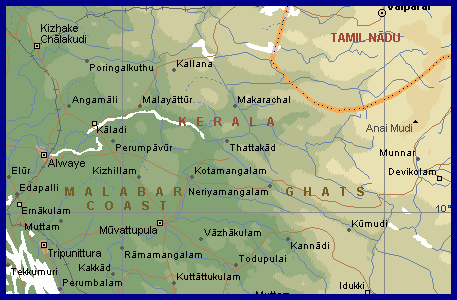
The Salim Ali Bird Sanctuary (also commonly known as the Thattekad Sanctuary) is located in the Kothamangalam Taluk of Ernakulam district on the northern bank of the Periyar river. The sanctuary was notified in 1983 based on a recommendation made by Dr. Salim Ali many years previously. Ali described Thattekad in the 1930's as the richest bird habitat in peninsular India, comparable only with the eastern Himalayas. Since then much of the forest has been diverted to cultivation and teak and mahogany plantation but what survives gives a glimpse of the phenomenal bird diversity of the once widespread lowland forests of Kerala.
| Latitude | 76° 40' - 76° 45' N |
|---|---|
| Longitude | 10° 7' - 11° E |
| Altitude | 35- 523 m (Njayapilli peak) |
| Area | 25.16 sq. km |
| Rainfall | 2500 mm annually |
| Forest type | Tropical semi-evergreen and tropical deciduous |
| Mammals | Elephant, Leopard, Sloth Bear, Porcupine |
| Bird species | > 250 |
2. How to Get There
The sanctuary is 13 km north-east of Kothamangalam along the Pooyamkutti road. The nearest railway station is Aluva at a distance of 48 km. Kochi, the nearest airport is 71 km away. The new airport at Nedumbassery is probably closer.
Kothamangalam is well connected by privately operated buses to Ernakulam via Muvattupuzha or Perumpavur. There are frequent buses from Kothamangalam to Thattekad. Currently the bus needs to cross the Periyar river by ferry. Construction on a bridge across the river has started.
3. Where to Stay
Accommodation Options:
- Three storied watch tower inside the Sanctuary with two beds, a toilet and a kitchen. No electricity but solar powered lamps available.
- Forest department inspection bungalow called Hornbill near the sanctuary entrance.
- Dormitory just inside the sanctuary ideal for large groups.
- PWD rest house near the Bhoothathankett Dam.
- Lodges in Kothamangalam.
For Further Information and Booking:
-
The Chief Conservator of Forests (Wildlife)
Thiruvanthapuram Kerala 695014 -
The Wildlife Warden
Idukki Wildlife Division
Vellappara, Painavu P.O.
Idukki District 685603
Phone: 0486 232271 -
The Assistant Wildlife Warden
Thattekad Bird Sanctuary
Njayapilli P.O., Kothamangalam
Kerala
Phone: 0485 588302
4. The Bird List
Only species observed by us have been listed. We have no information if an exhaustive checklist is available for the Sanctuary. Nomenclature used follows Birds of the Indian Subcontinent (1998). The pocket edition of this book was used for field identification. Subspecies have not been mentioned unless unambiguous identification was made (eg. ruby-throated subspecies of the Black-crested Bulbul).
- Collocalia unicolor Indian Swiftlet
- Ocyceros griseus Malabar Grey-Hornbill
- Spizaetus cirrhatus Changeable Hawk-Eagle
- Anhinga melanogaster Oriental Darter
- Ardea cinerea Grey Heron
- Ardeola grayii Indian Pond-Heron
- Bubulcus ibis Cattle Egret
- Egretta garzetta Little Egret
- Mesophoyx intermedia Intermediate Egret
- Vanellus indicus Red-wattled Lapwing
- Metopidius indicus Bronze-winged Jacana
- Chlidonias hybridus Whiskered Tern
- Phalacrocorax niger Little Cormorant
- Snipe: species unidentified
- Columba livia Rock Pigeon
- Alcedo atthis Common Kingfisher
- Ceryle rudis Pied Kingfisher
- Eurystomus orientalis Dollarbird
- Halcyon smyrnensis White-throated Kingfisher
- Pelargopsis capensis Stork-billed Kingfisher
- Merops leschenaulti Chestnut-headed Bee-eater
- Centropus sinensis Greater Coucal
- Eudynamys scolopacea Asian Koel
- Gallus sonneratii Grey Junglefowl
- Amaurornis phoenicurus White-breasted Waterhen
- Aegithina tiphia Common Iora
- Artamus fuscus Ashy Wood-swallow
- Corvus macrorhynchos Large-billed Crow
- Dendrocitta formosae Grey Treepie
- Dicrurus aeneus Bronzed Drongo
- Dicrurus leucophaeus Ashy Drongo
- Dicrurus macrocercus Black Drongo
- Dicrurus paradiseus Greater Racket-tailed Drongo
- Oriolus chinensis Black-naped Oriole
- Oriolus oriolus Eurasian Golden-Oriole
- Oriolus xanthornus Black-hooded Oriole
- Pericrocotus cinnamomeus Small Minivet
- Hirundo daurica Red-rumped Swallow
- Hirundo tahitica Pacific Swallow
- Chloropsis aurifrons Golden-fronted Leafbird
- Irena puella Asian Fairy-bluebird
- Copsychus malabaricus White-rumped Shama
- Copsychus saularis Oriental Magpie-Robin
- Cyornis pallipes White-bellied Blue-Flycatcher
- Eumyias albicaudata Nilgiri Flycatcher
- Luscinia brunnea Indian Blue Robin
- Myiophonus horsfieldii Malabar Whistling-Thrush
- Turdus merula Eurasian Blackbird
- Arachnothera longirostra Little Spiderhunter
- Parus rufonuchalis Dark-grey Tit
- Lonchura kelaarti Black-throated Munia
- Motacilla madaraspatensis White-browed Wagtail
- Pitta brachyura Indian Pitta
- Iole indica Yellow-browed Bulbul
- Pycnonotus cafer Red-vented Bulbul
- Pycnonotus jocosus Red-whiskered Bulbul
- Pycnonotus melanicterus gularis Black-crested Bulbul (ruby-throated subspecies)
- Pycnonotus priocephalus Grey-headed Bulbul
- Acridotheres tristis Common Myna
- Gracula religiosa Hill Myna
- Sturnus malabaricus blythi Chestnut-tailed Starling
- Acrocephalus arundinaceus Great Reed-Warbler
- Pellorneum ruficeps Puff-throated Babbler
- Phylloscopus trochiloides Greenish Warbler
- Rhopocichla atriceps Dark-fronted Babbler
- Turdoides striatus Jungle Babbler
- Megalaima haemacephala Coppersmith Barbet
- Megalaima viridis White-cheeked Barbet
- Celeus brachyurus Rufous Woodpecker
- Chrysocolaptes lucidus Greater Flameback
- Dinopium benghalense Black-rumped Flameback
- Hemicircus canente Heart-spotted Woodpecker
- Picus chlorolophus Lesser Yellownape
- Loriculus vernalis Vernal Hanging-Parrot
- Psittacula columboides Malabar Parakeet
- Psittacula cyanocephala Plum-headed Parakeet
- Batrachostomus moniliger Ceylon Frogmouth
- Eurostopodus macrotis Great Eared-Nightjar
- Bubo bubo Eurasian Eagle-Owl
- Glaucidium radiatum Jungle Owlet
- Otus bakkamoena Collared Scops-Owl
- Harpactes fasciatus Malabar Trogon
Notable Observations
5. Internet Resources
-
Birds of Thattekad: Report and checklist from two visits to the sanctuary by Radhika Vatsan.
www.imsc.ernet.in/~radhika/birds/thattekad.html
References
- Grimmett, R., Inskipp, C. and Inskipp, T. (1998) Birds of the Indian subcontinent Christopher Helm, London.
Contact
Comments and corrections to this report will be greatly appreciated. Please send comments to:
Yogesh WadadekarI-1 Rajat
968/20 S. Bapat Rd.
Pune 411016
India
Email: yogeshw@iitbombay.org