For the team
Actual dates for DR5 images:
26 September 2012 - Sandeep makes primary beam corrected images available to
the group for checking.
28 September 2012 - Ishwar sends a summary of his quick check of the pbc images. NGK
busy with scheduling and cannot look at them.
18 OCtober 2012 - Sandeep sends across a list of files he is unable to check +
tgss_dr5_list.txt which is used for co-adding.
25 October 2012 - Sandeep puts up a pdf containing primary beam, astrometry corrected
TGSS overlays on NVSS and plans to start coadding on 26 Oct.
27 October 2012 - NGK sends back the file tgss_dr5_list.txt after her quick
check of the images.
6 November 2012 - SS puts up 715 coadded images on tgss065. These have incorporated his
checks and NGK checks
7 November 2012 - SS puts up 715 catalogues on tgss065. The team needs to decide on the
release date.
Nov 8- Nov 16 - Diwali week - work is slow.
Nov19 - started data quality checks. Sidharam has also put up the plots on the
everest bookkeeping tool - these are for rms, source count.
Nov 20 - TGSS team meet at 5.30pm. New date for release: on or before November 30. We
need to inform Swarna about the same now that we have a concrete date.
Some of the data quality check files are here - these are for 715 fields and includes
a few northern fields which will not be released:
New Release dates:
21 September 2012 - SS, ICH, NGK. Delay in making primary beam corrected images:
24 September 2012 - primary beam corrected images will be ready
26 September 2012 - start coadding/cataloguing images
28 September 2012 - coadded images + catalogues will be available
29 September 2012 onwards - data quality checks
31 October 2012 - release
30 September to 15 December 2012 - SS will be going to Brazil. Release will happen in
this period.
GMRT proposal to observe ultrasteep spectrum sources has been granted 80 hours by GTAC.
Observations can start around 15 January 2012. If possible schedule 6h slots at 325 MHz on
one night per week to allow the raw voltage data recording and subsequent copying.
~ 350 GB per antenna per stokes in 6 hours will be the rough data volume.
To schedule 6-7 hour slots preferably 11pm to 6am.
Sidharam is willing to come to continue with the bookkeeping work. Call him for the interview.
Give a link to the tgss job advert from TGSS news.
Targetting the steepest spectrum sources in Cycle 23 for followup.
Ewan's email.
3 September 2012 - SS, ICH, NGK
Total number of images which are being processed in the new pipeline are
960 - these are all less than or around 0d declination. These also include
the data from 7, 25, 26 June 2010 which was found to haev severe artifacts
in the earlier analysis. How many of the total 960 images will be released will
depend on their quality after the images are ready.
Last run of Imaging started from 27, 28, 29 August 2012 - these take about
9-10 days to run so the images will be ready on 4,5,6 September 2012 resp.
908 images will be made by 6 September and the last (52-5)=47 images will
start being made from 7 September and assuming they take about 10 days to make
will be ready by 17 September. So by 17 September, about (960-130) field images will be ready.
Per day there are 5 calibrator fields which are not images currently but will be
later. So if 36 fields are observed per day - there are also 5 calibrator fields
on that day. So roughly the new field images will be about 960 - (26*5):
(960 (total fields)/ 36 (per day fields) ~ 26 days of data is being imaged).
need to update Swarna. Also ask about project assistant.
Dates:
17 September 2012 - all images will be ready ~ 830 images
17-23 Sep 2012 - Checking primary beam corrected images for any artifacts etc
24 Sep- 4 Oct 2012 - coadding + cataloguing images
5 Oct 2012 onwards - data quality checks
31 October 2012 - DR5
Include in policy document:
1. Pdf/student/short-term student - the work done working on TGSS data with TGSS team
should be be published in some form: e.g. JAA, BASI, astroph. Depending on
the volume and quality of work; the place where it is to be published can be
decided. In decreasing order of preference: international refereed journal - Indian
journal - astroph. This helps both the person working with the team and the team.
2. Codes/programmes developed by any of the above can be taken by the team.
Appropriate documentation + GUI should be encouraged for future modifications.
TGSS Project Assistant
There is clearly a need for having a projet assistant on the TGSS project.
Thsi person can help with the bookkeeping + running tests + other regular jobs.
This person can be taken through the contractor. One possibility is the
student who developed the book-keeping software for TGSS - Sidharam Teli.
He can help transfer the software to a common machine (currently on everest)
+ load DR5 images and data + include other data quality check routines.
Contacting Jasjeet Bagla regarding our TGSS proposal
Should we ? Swarna had suggested sending him an email explaining.
Ishwar thinks not necessary; SS thinks we should send an email before the meeting;
NGK is fine either way; GK (asked later) thinks writing an email is useful.
So TGSS team should write an email.
21 August 2012 - SS, ICH, NGK
A large number of the primary beam corrected images will be ready
by August 22 but not all the ones to be released in DR5 - Sandeep mentioned.
Met Breezy to discuss her work. She will be giving a seminar on the work
she has done before she leaves. She has done two main pieces of work -
on the angular correlation function for TGSS fields and on nearest neighbour distribution.
13 August 2012 - SS, ICH, NGK, GK
SS, GK went to SA to attend an Indo-SA workshop.
They summarised the meeting - overall ok. Visited KAT-7, SALT sites. Also met with
SALT extragalactic contact person.
Raju's review got over. His talk was better than last time.
He is told to work on the 6DF correlation + sidelobe detection algorithms and then
find a class of sources he can work on.
Breezy - seminar/science cake before she leaves - on the angular correlation function
+ nearest neighbour work. She can talk to SS, ICH, NGK in a week's time and
then we can determine it. One possible date is 21st Augst. GK will be back on 25th so
we can meet on 27th.
TGSS DR5: 491 + 110 (new) images for DR5.
All field images will be ready by 22 August. 23 August: primary beam images for
visual inspection. 3 September: coadded images + catalogues for data quality
checks. Aim at 17 September 2012 monday for DR5.
Ad for pdf: include in DR5 release.
26 July 2012 - SS, ICH, NGK
TGSS computers crashed
Problem with DG at NCRA on 22 July 2012 Saturday -> MSEB was not coming through the campus ->
caused TGSS UPS to crash at 6am on 23 July 2012 bringing down the 100 computers -> the
entire system was restarted on 24 July monday and was being restored -> power failed for a few minutes
on 25 July tuesday -> UPS failed in these few minutes bringing down the TGSS computers ->
reason was one battery was dead which caused the circuit to be open and the system crashed.
-> two new batteries were bought as cash purchase- totally 20 batteries in the UPS; one had gone bad earlier
and one failed now - so now there are 20 batteries on 26 July 2012 thursday- the system was brought
up on 26 July 2012 thursday. One disk seems to have been affected by this power failures.
TGSS DR5: Will be delayed because of the above problem due to which the last set of
images are not made yet. The quantum of delay will become clear when the analysis begins
again.
Mukul Mhaskey 1. MPhil/PhD - SS, ICH, NGK no time.
2. Project assistant - should help with TGSS work. Not for science - thats why first round,
we took him as a project student.
28 June 2012 - TGSS core group meeting
Dwaraka's proposal: TGSS data on clusters from all possible catalogues - a list has been
sent to Sandeep - the final goal for this is unclear - he wants images of clusters and also
uvtapered images of a list of clusters - some are in DR4 and others are not. We need to frame
some rules for collaborative projects asking for TGSS data. Ishwar will make the rough list of
rules. We should look at cluster images.
TGSS DR5 - 20 August 2012 - Sandeep says that about 3 days of data is left to be reanalysed - images should
be ready by 28 July 2012 and images and catalogues are done parallely and takes 7 days
to complete so by 6 August 2012 , the coadded images and catalogues should be ready.
We aim at DR5 on 20 August 2012 .
GMRT Observing Cycle 23: 1. ultra-steep spectrum sources at 325 MHz (~400 hrs), 1280 Mhz (~100 hrs) -
rule out pulsar candidates 2. ULIRGs proposal - Arti 3. Few clusters in observing cycle. 4. star
forming galaxies. 5. flat spectrum/inverted spectrum sources ~ 6 sources - total ~ 10 hours.
Mukul Mhaskey: (1) Register for PhD in Pune University - explore (2) Project assistant.
December 2012 - Current Science paper and main paper. Tsky calibration - takes four months
- will start after July 15.
Will meet pdfs on monday ie 2 July 2012.
31 May 2012 - TGSS extended team meeting (ICH, NGK, Breezy, Arti)
Arti: ULIRG spectra - importance of study and important low frequency contribution
from TGSS data.
1. Control sample from a small region in WENSS and NVSS to check the flux scale of WENSS and
WISH. Take spectral index and find median value. Ishwar has found some 15% error in WENSS scale.
2. ULIRG sample - use WENSS/WISH and NVSS for the entire sample.
Breezy: Nearest neighbour distribution was estimated for each field and then combined
to get the distribution for the entire region. Three peaks are seen in your
distribution. Not clear what they mean.
1. Plot the nearest neightbour using the combined catalogue and compare with the plot
generated using individual field catalgoues.
2. Angular correlation function.
17 May 2012 - TGSS extended team meeting
Raju: DR4 - 2497 unique TGSS sources which have multiple NVSS counterparts ( greater than 2) associated
with one TGSS source. 'Extended' in Raju's terminology.
He finds that several sources seen in the TGSS image but which were not catalogued in DR2 are now
catalogued in DR4.
Breezy: she has plotted the nearest neighbour histogram for the 11 fields individually and then
combined for all sources with S/N greater than 5.
Arti: Talked briefly of ULIRG galaxies in TGSS.
Noone really had much but all had made progress. Good.
10 May 2012 - TGSS extended team meeting
median flux of sources in a typical 150 MHz field ?
Raju Baddi: is now using TGSS DR4 - finding NVSS counterparts.
Mentioned something about contacting AJ (!?).
He has done this for DR2 and is not doing DR4.
DR2: 1461 extended sources in TGSS - single TGSS; multiple NVSS.
Two categories are excluded: extended: single TGSS, single NVSS and multiple TGSS and
single NVSS. sample definition is not clear.
Raju will be writing up a short summary of his selection procedure - a flow chart.
Other thing he has to do is generate small images/coordinates of the sources not catalogued in TGSS.
Arti - summarised her star forming GMRT proposal - wants comments.
looking for extended emission around GPS sources in TGSS - DR3: 20 (
includes GPS which turnover at 150 MHz and also the ones which continue increasing
beyond) known GPS
are found - some of them show extended emission which looks like halo which with
higher resolution is believed to resolve into two lobes. Arti uses at least four
frequencies.
GPS sources in FIRST? Can add to her work.
Breezy
Nearest neighbours and 2-point angular correlation function has been estimated
for 11 fields - alternate fields in declination were taken.
The nearest neighbour histogram shows a drop around 7'. Why?
To examine this, plot nearest neighbours for sources greater than 200 mJy.
8 May 2012 - TGSS core meet
few points for discussion: (a) Yashwant had indicated to SS, NGK about possible
collaboration in following up the pulsar candidates. All members feel that we should go
ahead and follow up the steep spectrum candidates to rule out pulsars. We plan to
resubmit an observing proposal in cycle 23 (both at 90cm and 20cm) and depending on the
outcome we can have further discussion. (b) Sykes email on a possible BASI paper.
The big TGSS paper will also be ready in some more time so the team felt that it
might be too late to have a BASI paper. Swarna had suggested Current Science as an option.
SS thinks the paper can be divided into two parts - one general part can go to Current
Science and the other to ApJ/MNRAS....anyway this is for later. Also Sykes wants
it by mid-May which is very soon (c) Raju, Breezy, Arti, Mukul - all are doing something with
TGSS - they will give ~ 10m prsentation on their work this thursday - 8 May 2012.
(d) TGSS DR5. New images/ old images
TGSS DR4 was on 20 April 2012
17 April 2012 - TGSS core team meet for DR4
Team discused the results of the modified pipeline and it seemed to be doing similar
to the older version in terms of rms noise, but better in terms of sensitivty to
extended structure.
Team converged on 19 April 2012 for DR4
Jobs to be done: (1) Field centres for release - NGK (2) Aitoff projection of
fields to be released - NGK (3) Header change for FITS files - SS (4) Generating
table of FITS files for webpage - SS (5) DR4 release notes - NGK (6) final changes
on TGSS website - SS, NGK
Need to inform Swarna
13 April 2012 - statistics on the 128 fields generated using modified pipeline:
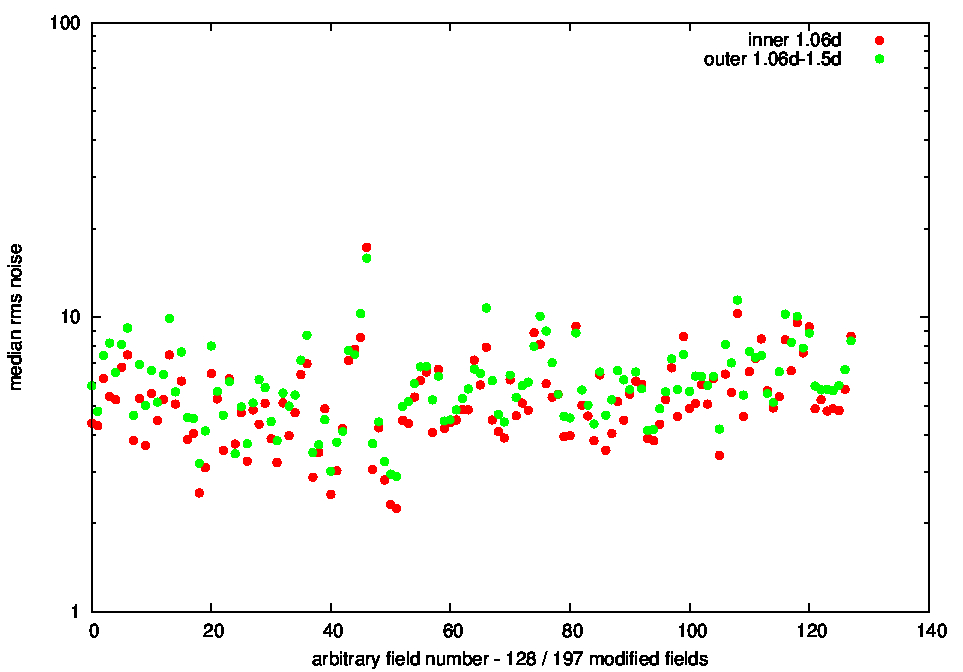
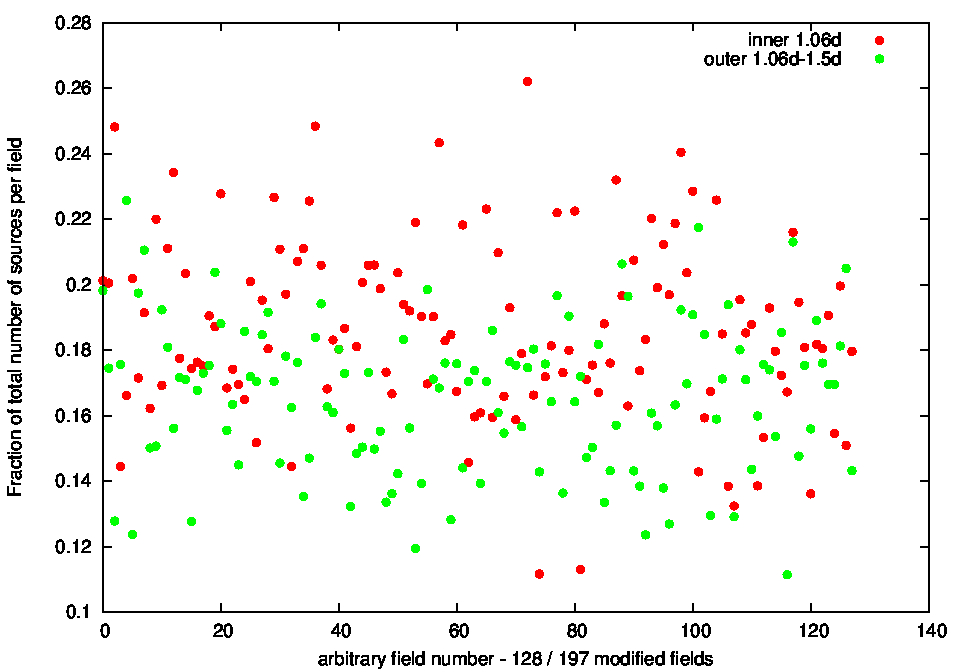
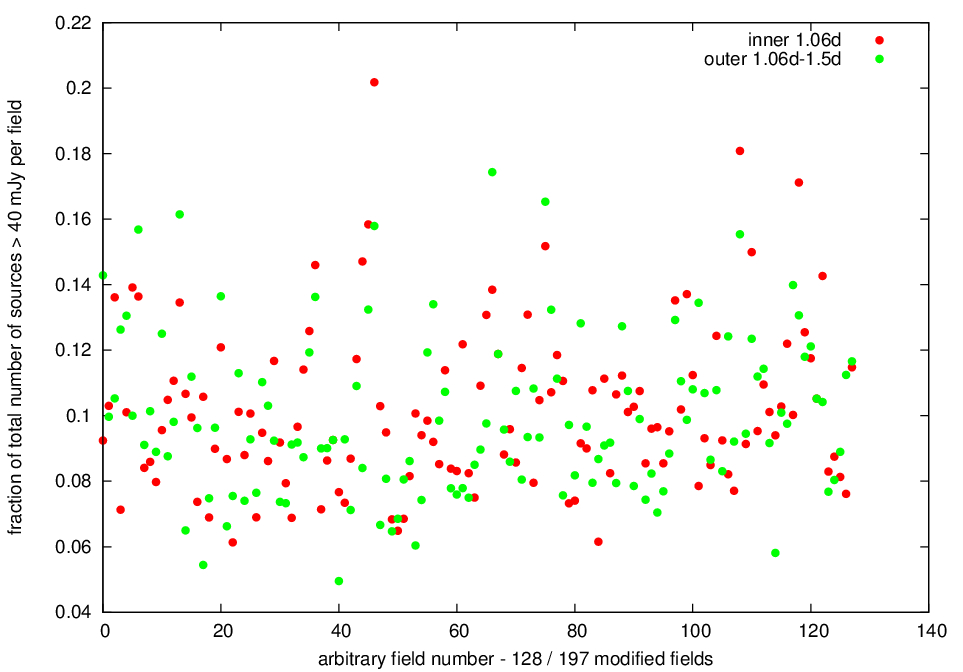
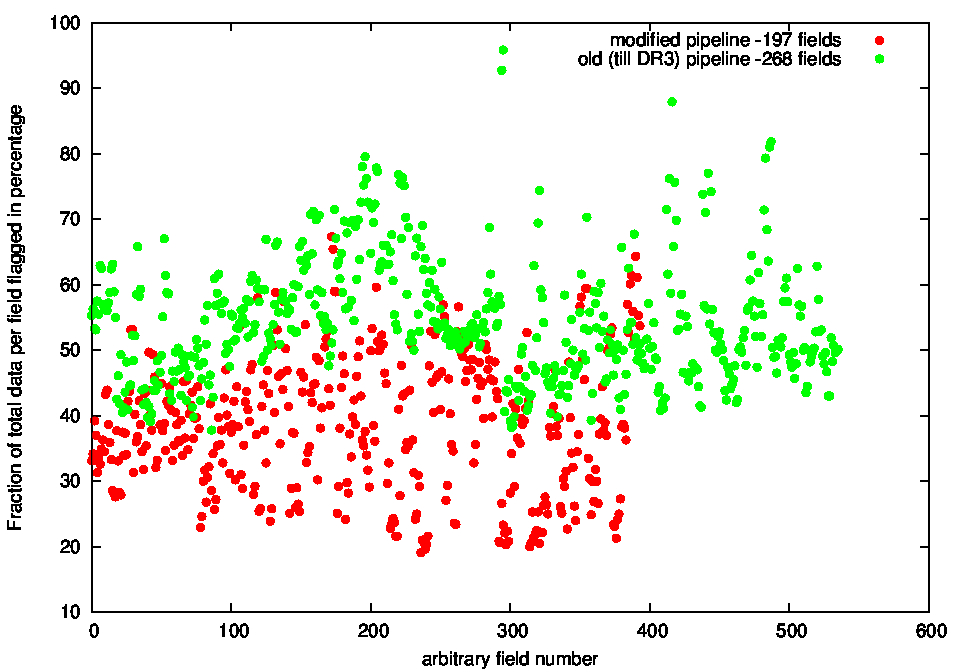
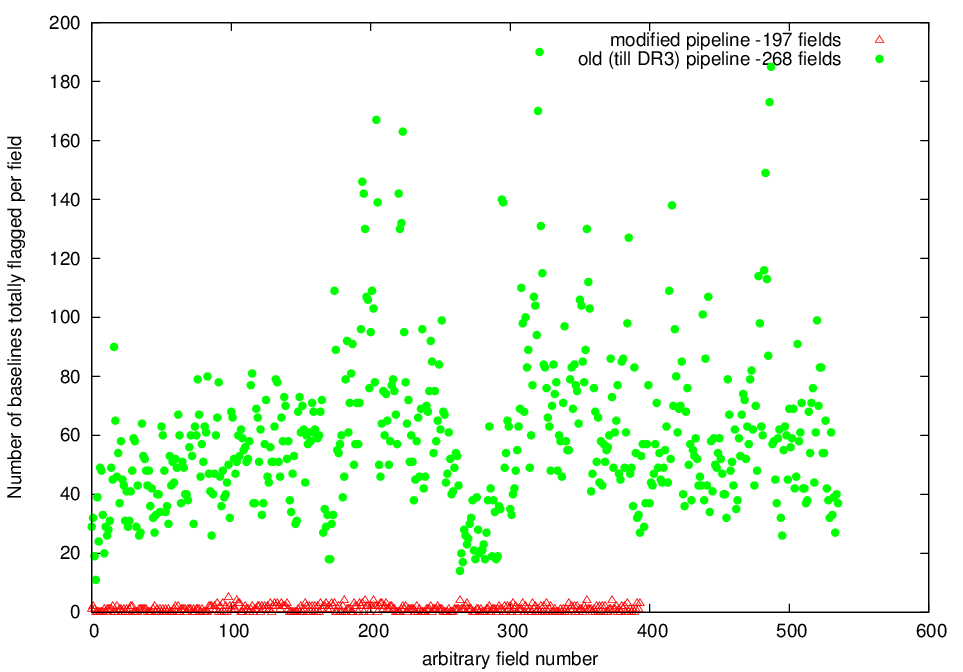
13 April 2012 - plots comparing flagging statistics for the old and modified pipeline
The figures compare the flagging fraction with the old pipeline and the modified pipeline.
The left panel shows the total data flagged in percentage and the rightside shows the
total number of baselines in the data that have been flagged. Both figures show considerable
improvement with the modified pipeline - fraction of data flagged has gone down and total
number of baselines which are entirely flagged has come down drastically.
Sandeep also lists the antennas which are entirely flagged - with the modified pipeline, there
are maximum two antennas which are entirely flagged - curiously these are 5 and 11 whereas with
the old pipeline, the number varies from two to five. The modified pipeline is definitely doing better in terms of
retaining data quantum.
7 April 2012
Plots similar to the ones displayed in November 2011 are shown here for the 495 images that we
are releasing as part of DR4.
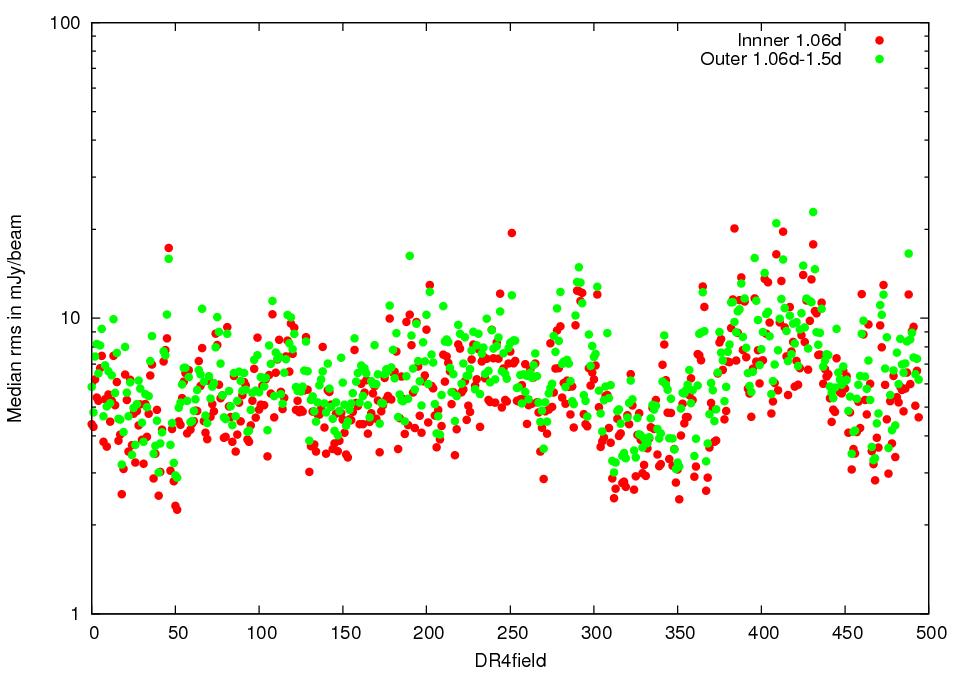
Plots for TGSS website showing some statistical results for the 344 fields released in DR3:
1. Median rms in inner and outer parts of beam. Median rms in the inner beam is 5.3 mJy/beam.
and in the outer beam is 6.14 mJy/beam - about 15% higher in the outer beam but within
the range specified for our survey. Postscript file is
here
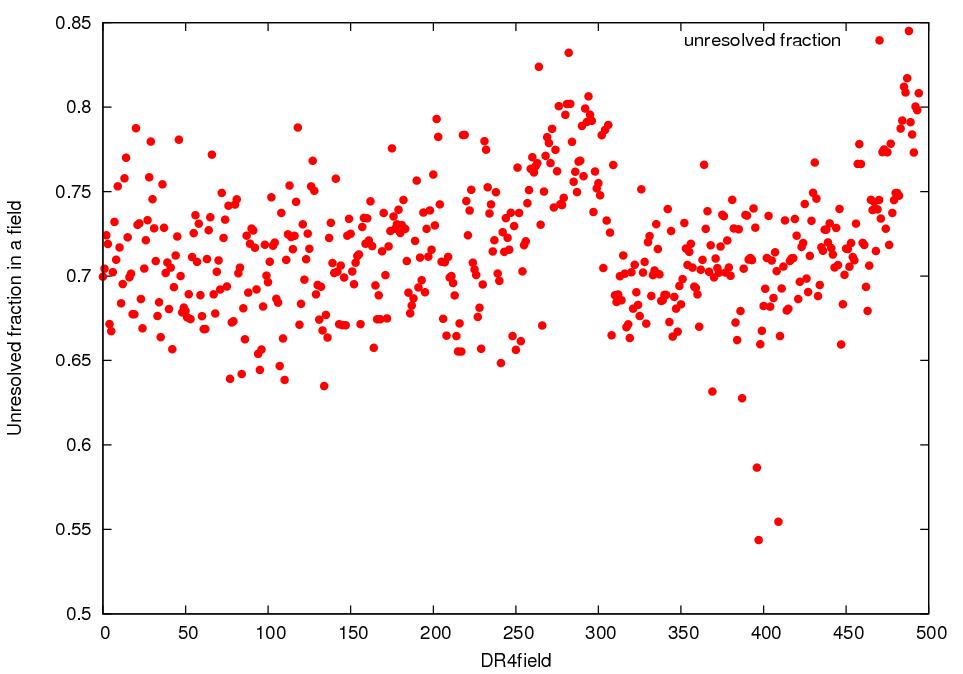
2. Unresolved source fraction: Postscript file is
here
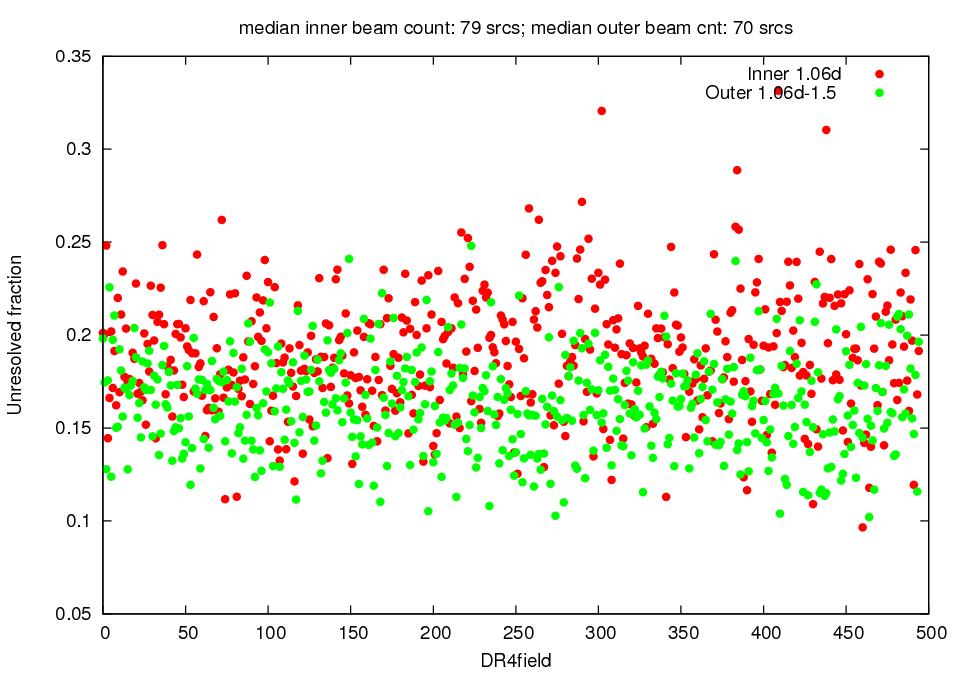
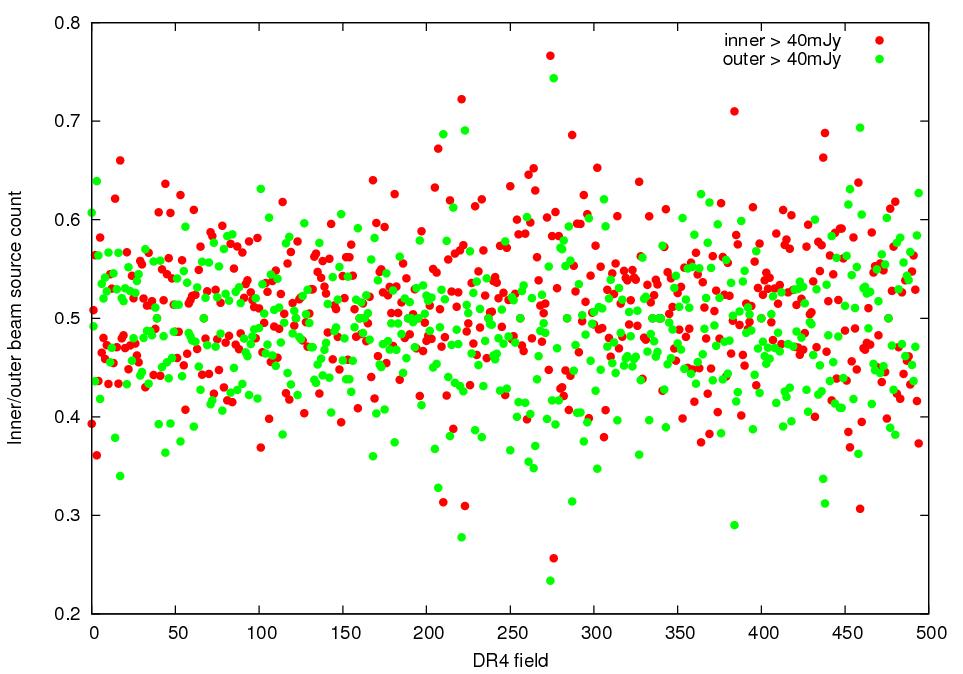
3. Unresolved fraction of sources in the inner and outer half of the 150 Mhz 3d beam.
The median source count (includes all sources) in the inner 1.06d beam is 79
while in the outer 1.06d to 1.5d beam it is 70
ie about 13% more sources are in the inner part of the beam - possibiy also a result of the
higher rms noise in the outer parts of the beam.
Postscript file is here
If only sources greater than 40 mJy are included then the plot shown on the right is obtained.
The distribution of sources in the inner and outer beam is similar as expected - so the
difference seen when all sources are included is indeed an effect of the slight difference
in the rms noise characteristics but all within the quoted numbers.
Postscript file is here
5 April 2012
The plots showing data quality checks on the coadded field catalogues are available
here. . Both ps and png files are kept under two separate directories
for 495 fields.
3 April 2012
Some comparison between the old pipeline and the modified pipeline can be found
here . Left side images are primary beam corrected
images using the modified pipeline and the right side images are the coadded images
using the old pipeline.
27 March 2012 5.45pm
ICH, GK, NGK in Pune; SS in Brazil:
26 March 2012 - all the coadded images have been put on tgss065 by SS. 564 images -
this includes DR1, DR2 and DR3 images - ~ 344 images. These are old images - only
coadded again and catalogued again. 22 images are new (using old pipeline)
north of -15d contiguous to DR2 regions. Around 198 images are new in the sense that
the modified pipeline has been used to make these.
Delay due to large number of fields being coadded.
Comparison images on 28 March 2012 evening IST.
Data from 29, 30 April 2010 includes Galactic centre.
Delay due to queing - ~ 10 days per image.
data checks - at least 10 days.
So DR4 goes to April 2012.
13 March 2012 5pm
ICH, NGK in Pune; SS joined in Brazil:
comparison images just started due to some problem with the internet link from Brazil
for SS - started today - so will take a week. Expected date: 22 March 2012.
183 new images have been generated - 79 fields contiguous to DR3 and below declination
-15d.
coadding, cataloguing of the 79 images can start now. 21 March 2012 - SS will give the coadded images.
21 March 2012 - start examining the coadded images + catalogues
DR4 - 79 images + 36 images - all below -15d ; this with DR3 will be 1 steradian.
This will leave out 183-79-36=68 images for next releases to avoid too many patches.
If 79+36 images are usable then its 1 steradian mapped - in this case we relased
only the fields below -15d. If we fall short then we release fields upto 0d.
Blue - new images images which can be released in DR4; Green- DR3; red - all observed TGSS positions.
 catalogues for sources > 6.5 sigma for other users.
Flagging percentage is reduced with new pipeline; median seems to be 30% and
median for old pipeline images was 50%.
DR4 -> 31 March 2012 .
catalogues for sources > 6.5 sigma for other users.
Flagging percentage is reduced with new pipeline; median seems to be 30% and
median for old pipeline images was 50%.
DR4 -> 31 March 2012 .
6 March 2012 4.30pm:
ICH, GK, NGK at NCRA - Sandeep is to join us from Brazil:
Today's meeting to discuss Swarna's inputs.
Sandeep could not join in.
2 March 2012 12.30pm:
ICH, GK, NGK met CD around noon (Sandeep is in Brazil - and these need to be
discussed with him in a team meeting - one possible time is tuesday 4.30pm IST):
TGSS team conveyed two main points to CD:
1. CD/Observatory can decide the raw data release policy for TGSS.
2. DR4 will be delayed to April 2012 due to (a) changed pipeline results
need to be quantified after comparing with old pipeline results.
Discussion with CD: Main points:
(a) On DR4 delay - CD said that we should try to release as soon as possible for
several reasons (1) before LOFAR results come out (2) for people to use the survey,
large regions need to be imaged and released.
(b) On sky to be released in future releases:
There was discussion on releasing northern sky first after the current
-30 to 0d declination strip has been released. LOFAR has started observations
for its sky surveys and at some point in future will be releasing their
images of the northern sky. TGSS can be used widely before that.
(c) On completion of TGSS - the phase 1 release:
If the currently modified pipeline is found to be giving better results then
it should be frozen and the entire sky should be imaged with it. R&D can
be done after the TGSS phase 1 release is over.
CD wanted to know if we can release all the images within a year - we would like
to. He also inquired if we should augment the existing computing facility
However when Ishwar and I estimated the number of images that we can make
in a year - we find that if 70 computers are dedicated to imaging TGSS data; then
in a month we can generate 200 images - and in a year this would be about 2400 images.
Considering that totally more than 5000 fields need to be imaged - it appears that
we need to double the computing facility to be able to release in a year.
Is this feasible - in terms of control + operation + optimisation ? Can
we employ someone who can help with some of the tasks with these computers?
(d) CD suggested that we should discuss a long term strategy for TGSS -
which sky regions to be released etc based on the issues important to the group
+ wide circulation of TGSS results.
(e) Release DR4 by end-March.
1 March 2012 4.30pm:
ICH, GK, NGK in Pune. Agenda points:
(1) raw data release
(2) DR4
(3) NGC 5903 paper.
Three of us discussed the raw data policy to follow for the TGSS
data since Sandeep had not joined us from Brazil. Three of us converge on the following:
(1) TGSS team has nothing to do with the raw data release - it should be handled by NCRA as per existing
norms/policy ie 18 months. (2) We stand by our statement in the proposal '
Observatory specific data release policy for large projects will be followed'
(3) in general, there should be some rethinking on the raw data policy for large projects.
DR4:
10+-1day March 12 - comparison images of both pipelines for a few fields.
6 March 12 - 60 more images - 100 fields are already there. This is scattered into three
different parts of the sky - release will be for only the continguous part.
15 March 2012 - primary beam corrected images.
end-March 2012: data quality on primary beam images
April first two weeks: coadding and catalogue making.
DR4: second week of April 2012
Next data release can be all the images through the new pipeline + extra images if possible.
However this will crucially depend on the improvement on the image quality with the new
pipeline. And realistic dates.
NGC 5903 paper:
rms noise - 5 to 7 mJy/beam for the noise on the images outside the Galactic plane.
(include on website) - GK will resubmit the paper on monday - 5 March 2012.
20 February 2012:
Three of us (ICH, GK, NGK) at Pune and SS joined in over google chat from Brazil.
Several topics were discussed - there has been a request for raw data from a user to the CD.
3 November 2011:
Core + extended TGSS group meeting at 3.30pm :
SS gave news about TGSS DR3 + pdf reviews every year + Ishwar being awway for a month.
Raju described his work + some rare problems which will happen in the catalogue such as the
same extended source being catalgoued with different coordinates in two different catalogues.
He has manually looked at 154 images of DR2-DR1 and will redo that once. He was also asked
to write a summary of what he has done so that that can be discussed and feedback, if any,
given. Arti had plotted beams to see the constancy of rms across the beam instead of the
general increase due to the primary beam gain. Breezy discussed the plot she has generated
which plots the number of neighbours within some angular separation for different annuli
of 2' radial size.
3 November 2011:
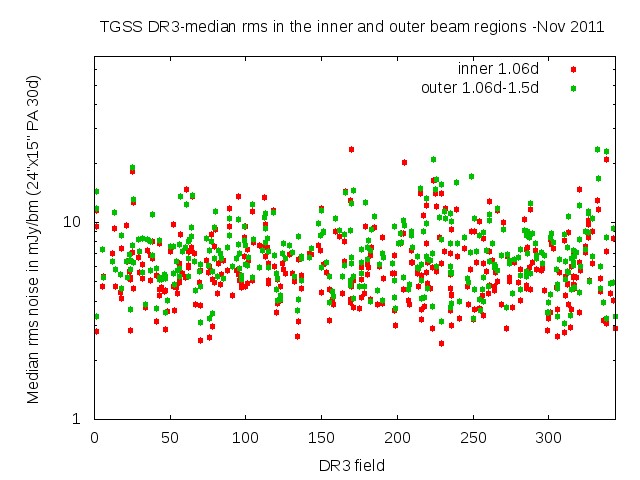
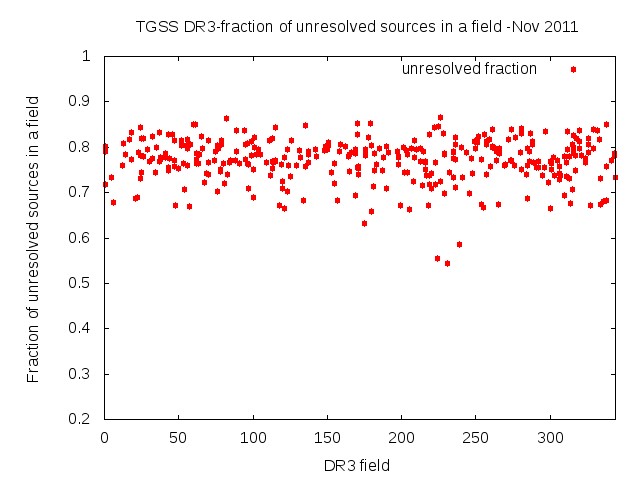
Plots for TGSS website showing some statistical resutls for the 344 fields released in DR3:
In these plots the x-axis has a randomised field number.
1. Median rms in inner and outer parts of beam and
2. resolved source fraction:
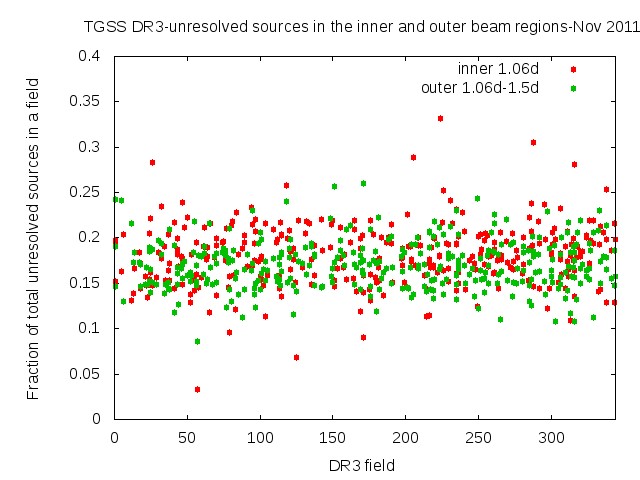
3. Fraction of sources in the inner and outer half of the 150 Mhz 3d beam.
2 November 2011:
DR1: 134 fields
DR2: 154 additional fields
DR3: 56 additional fields
Total in DR3: 344
DR2 - total fields available were: 353; problems in images from 25, 26 June - removed
43 images. Rest 310 images were coadded. We excluded another 22 images from 7 June from
the release which were by mistake not excluded from mosaicing. Thus totally 288 images
were released in DR2.
DR3 - total fields available were: 288 + 68 = 356 out of which 68 new fields. Excluded 12 out of
68 fields since the images showed some problems, so totally 344 images were released.
The images in DR2 were not mosaiced/catalgoued again in this release. They are the
same as in DR2.
1 November 2011: core team meet:
(0) TGSS DR3 release on 31 October 2011
(1) Whether to have a DR3b or DR4 ? Team think should be DR4 - GK thinks we should release
1 steradian - for this extra 110 images are required - 344 images are released in
DR3; SS says that all the images released in DR3 will be reanalysed by the improved
pipeline. So the next release will be after four months ~ 15 February +- 15d.
(2) focus on pdf projects.
status on 27oct11 evening from SS Common resolution images are almost ready.
By morning of 28oct11, the shifted/coadded images should be ready.
25 October 2011
Core team met in the morning to discuss the DR3 release date.
Since SS has made changes in the algorithm etc : (1) excluding central
square baselines during self-calibration (2) included 35 computers in
the computing lab - he has restarted the analysis on 18 October.
Hence none of the 90 images are ready today. Since at least 8 days
are taken by each computer to deliver an image - the first 50 images
or so might be ready around 26th and the second round of the remainaing
40 images will take another 8 days. Realistically, the earliest
all the images will be ready is 10 November. Coadding+cataloging
will be earliest by 15 November. Keeping two weeks for data quality
checks, the earliest all the images can be released is end-November.
Evening of 25 Oct 2011: Met CD. CD strongly suggested that we should
release whatever images are ready on 31st October. Hence the 56 images
which are ok - totally 68 images are new and out of these - some
12 imags are corrupted.
So these will be released without waiting for
the 90 images. It can be an incremental release - Diwali special.
SS said that the coadded + catalogues should be ready
by morning of 27 Oct. So that the data quality tests can be carried out
on these.
15Oct11 3pm: core team + extended team. Extended team giving updates on what they are
doing. Raju's pdf details not yet sorted out. Raju is working on DR2 now for the cross-matching.
Noone has big results to discuss - discussion on resolving small queries.
15Oct11 2.30pm: SS,ICH,GK,NGK - DR3 - 24Oct11 - coadded images - tests will start then.
DR3 aim for 31 Oct 2011.
Out of the new 68 images that have been checked - some 24 images have artifacts problem.
In the pipeline, some changes are made now - not using the central square baselines while
self-calibrating - this will improve the model and will probably lead to reduced artifacts.
Thus a smaller fraction of the 90 images will be bad and will need to be removed. Thus we can
aim at about 44 + 90 ~ 134 new images in DR3.
Tests: rms as function of radial distance from centre of image; unresolved and resolved sources;
inner half and outer half; how to present results on the webpage.
30sep11: Observed bandwidth = 140 to 156 MHz - central freq is 148 MHz ie
wavelength lambda= 2.027. For a circular aperture of diametre D= 45m, HPBW ~ 1.02 * lambda/D
= 2.5822 degrees. Full beam width between first nulls is 2.439 lambda/D = 6.2979 degrees.
For a radius of 1.2911d of the circle with diametre
2.5822 degrees; the area is pi*radius^2 ie 5.23 square degrees.
If HPBW = 180' as given on the GMRT primary beam correction webpage then that implies that
the diametre of the circular aperture which is being used at 150 MHz is 38.73m (instead of
45m). Can we confirm this? In this case, the sky area covered by the beam till the HPBW point
(r=1.5 degrees) is 7.065 square degrees.
For TGSS (SS):
TGSS pointings separated by 173.8331 arcmins (2.89722 degrees) and arranged on a hexagon. So the sky area
observed by each pointing will be pi*r^2 of the sky + the region between pointings.
Sky area for 173.8331 arcmins of beam diametre ~ 6.589 square degrees per pointing.
Area of an hexagon is 3*sqrt(3)/2 * d^2.
The area of a hexagon which connects the pointing centers of the
six outer pointings in the hexagon (side d = 173.8331 arcmin) = 21.8079 square degrees.
Now the areas of the outer pointings + central pointing area have to be removed to
get the sky covered in the gaps. The area of six pointing within this hexagon
is and the six pointings whose centres are connected have a total approximate sky
area 3/4 * d^2. The area of central pointing is pi/4 * d^2. The net area in the
gaps is (3*sqrt(3)/2 - 1/4 - pi/2) * d^2 = 6.5311 square degrees. (check with SS)
This is then divided into the seven pointings ie 0.93301 square degrees per pointing.
Thus each pointing covers 6.589 + 0.9330 square degrees ~ 7.522 square degrees.
29sep2011 -
90 images by 15 October 2011 - discuss if the remaining 109 in slightly
separate region of the sky should be released - SS, ICH, NGK think not.
(Getting an image of one pointing takes ~ 8 days)
Coadded images and catalogues after a week - 24 October 2011. Checks etc on these images - 30 October.
3rd Data Release - 31 October.
Here is the status on 29 September 2011 - blue is DR2 and the pink are the new regions that have been
analysed/are being analysed subsequent to it. The contigous part of the pink can be the regions that
are released in DR3 - to discuss. The parts near RA=8h correspond to the days 22,23,24 January 2011
and 20, 27 December 2010

-30 to -15d - 42 days of data have to be analysed - 42*36 ie ~1400 fields. However only about 720 of
these will be in the range -30 to -15d - rest will be at other declinations.
29 Sep 2011 - we have shifted the weekly TGSS meeting to every thursday since monday tends
to get busy with the colloquium etc.
TGSS extended group meet (including Arti, Breezy, Raju):
Breezy is trying to estimate the number of nearby members for each catalogue entry. Exercise
similar to Proctor paper. Discussion on which is the best way to do this. Either do the
nearest neighbour exercise or find all the neighbours at different angular separation between
a source and in different concentric circles around it.
Arti - described her work on the star forming galaxies sample that Raju had made from DR1.
She finds three categories when she superposes the TGSS on DSS: (1) strong evidence
for counterparts (2) offsets (3) suspicious as counterparts.
She has found luminosity of these objects - all as expected have L(150MHz) > 10^22 W/Hz.
TGSS core group meet (SS, ICH, NGK):
Expected angular region for DR3 ~ 4000 square degrees - analysis should be completed by 15 October 2011.
image quality checks - timeline
Each pointing - 7.5 square degrees.
Some information on other surveys:
| Survey | FreqMHz | dec_range | Tot_hrs | Strt_obs | DR1 | DR2 |
| NVSS | 1420 | -40d to 90d | 2400h? | 1993 | DR1? | ? |
| FIRST | 1420 | 10d to 90d | ~1800h | 4/1993 | DR1 ? - 1995/1996 | ? |
| VLSS | 74 | -30d to 90d | 900h | 2001-02 | ? | 5/2006 |
| GALFA-HI | HI | 0d to 36d | 3046h | 2005 | 2009 | 2011 |
| SUMSS | 843 | -90d to -30d(b>10d) | ? | 1998 | 2002(catalogue) | |
| WENSS | 325 | 28.5 to 90d | ? | 1991 | ? | DRn-2010? |
| TGSS | 150 | -50d to 90d | ~1700h | 4/2010 | 10/2010 | 6/2011 |
relevant websites:
FIRST: http://sundog.stsci.edu/first/whatsnew.html
19 Sep 2011 core team - 2.30pm
Largest reliable structures in TGSS - typically 7' to 8' above the surface brightness sensitivity which
is about local 3*sigma. Include on TGSS website. This is because shorter spacings
are not available - the largest structure if all baselines are present would be about 60'.
325 Mhz DDT time - 5 more hours in Cycle 21.
BASI paper - only one more week left before final deadline. DRP ?
Arti, Breezy, Raju joined the group at 3pm:
Raju gave an update on his work:
TGSS DR1: 134 fields of 4.5dx4.5d; NGSS-TGSS: 20013 sources; TGSS-6DF: 447 sources
TGSS only: 3227
About 80% of TGSS sources have a NVSS counterpart; ~200 sources per field are detected in TGSS.
TGSS DR2-DR1: 154 fields; 590 sources - TGSS,6DF- using Raju's codes; manually corrected: 604;
26674 TGSS-NVSS - out of these sources some 100 have a problem since they are close to the edge
of the beam. So 26580 are TGSS-NVSS only.
53113 TGSS only sources. Removal of duplicate sources leaves 43013 sources; removal of
beam artifacts which Baddi uses an algorithm of perimetre circle around strong TGSS-only sources
leaves 28996 sources whcih are TGSS only in TGSS DR2-DR1. Baddi should plot different
quantities for these sources. Baddi also finds that genuine sources in TGSS images
are not catalogued in the source catalogues.
TGSS DR2 - 288 fields were released.
Baddi should try to examine the resolved and unresolved populations.
Breezy: Proctor et al - cataloguing FIRST galaxies based on morphology.
12 Sep 2011
22, 23, 24 January 2011 data to be analysed to extend to 9h RA and between -33d and -15d.
Some possible items to discuss: 1. regions of sky to release in DR3 - 5000 square
degrees. 2. Discuss with Breezy if she is done with her admin-related work.
3. TGSS papers - DRP, BASI papers. 4. SF galaxes with TGSS.
SS, ICH, GK, NGK - 3pm
(1)
DDT observations at 325 MHz of a few TGSS fields was carried out a few days ago - 16 fields
were observed - one field had 6 known pulsars in a globular cluster. These fields
have been observed in the interferometric mode, phased array and incoherent modes.
Sandeep has analysed the pulsar data for two of the known
pulsars (1823-3021A 1823-3021B) and detects both of them.
The software has been developed by him.
Now for searching other pulsars - some kind of search algorithm will have to be written
which goes through several combinations of DM and folding.
(2) 15 known GPS in DR2. (Arti, GK)
(3) Check images - all of September can be used to analyse data - so about 150 images will
be ready by first week of October. NGK will figure out the regions that can be analysed for
contiguous coverage. So this will add upto about 120+120+100+150 ~ 490 fields ~ 3430 sq degrees.
for DR3.
(4) Breezy's project - Breezy and Raju joined the group ~ 3.30pm.
Breezy'r project would be similar to what Proctor (2011) has done using the FIRST data.
Something similar can be done for TGSS which she can do.
5 September 2011: SS, ICH, NGK, GK
Breezy came by and talked with ICH, NGK - she has been completing paperwork related to
her joining NCRA. She arrived end of August. She'll come meet the group when she is done.
Group is meeting Raju today. He has submitted another thesis paper and is working on the last
paper from his thesis. He will talk to the group on his TGSS work on 26 September or
first week of October.
TGSS Papers:
DRPC paper, BASI paper, HYDRA paper, 6dF-NVSS-TGSS paper, GPS Sources,
Star Forming Galaxies with 6 dF, Source with Halo, field galaxies in Hydra
Tsky calibration work at 150 MHz has started. About 12hours of the sky has already
been observed - the technique being used is similar to what Sandeep did at 240 MHz.
29 August 2011: SS, ICH, GK, NGK
Arti's project with TGSS: 1. Star forming galaxies ~ 20% of galaxies in TGSS DR1 are
star forming galaxies. or 2. continue on project with NGK 3. another project?
Arti gave a short presentation of the brightness sensitivity of the TGSS 20" survey.
She finds that TGSS will detect galaxies more luminous than 10^23 ergs/sec.
Baddi's project - luminosity function of all the classes of sources + identification.
17 June 2011: entire team met - Sandeep called the meeting to discuss following
points:
1. press release. GK has drafted a release. SS and I drafted another much shorter
tighter version. However GK suggested we send both these to CD and Deans. We
agreed to send only the GK version since in bigger issues the team has presented
a united front and this is a trivial thing.
2. Raju Baddi - his case has to be argued in the faculty meeting on June 21 for a pdf
position. He has submitted his thesis and worked well with the TGSS group in the
last six months.
3. Catalogue requests from two Dutch students - two students have requested the entire
catalogue listing of sources in the images released in DR2. The group discussed this
and felt that it is premature to rlease the entire catalgoues for two reasons : (1)
it is Galactic centre region and the flux scale is wrong with the median
spectral index being around -1. (2) Tsys correction will happen in a year's time and
the catalgoues can be released then.
4. The space adjacent to the TGSS lab is to be requested for TGSS project. More
pdf are joining + students will be there and it can be used as a discussion room.
5. Meeting with Dipankar to discuss the issues raised by GTAC and CD.
8, 9 June 2011:
(SS, ICH, GK, NGK)
Last steps leading to data release were done. These included:
1. preparing pointings figures, aitoff projection.
2. Listing of FITS files
3. Activating catalogues/image servers for DR2.
4. Change in explanations etc.
1 June 2011: (SS, ICH, NGK)
SS to release catalogues today - 5pm.
52 hours to generate 310 catalogues. Generally ecah catalogue generation takes on
average 4 to 5 hours but some catalogues take longer - maximum 15 hours or so
for images which show large beam artifacts (sidelobes).
Coadding of images: for DR2 - 34 images were coadded by each computer in 12 hours.
9 computers were doing the job for a total of 310 images.
Realistic dates of data release within the group - erring on the higher side should
be kept.
DR3 - if less than 10% images are bad; those will be removed and the release will go ahead
- delay should be less than a month. If a large fraction of data is bad ie 40% and more;
then the release should be stopped and the problems investigated. And appropriate people
kept informed - CD, GTAC chair.
30 May 2011: (SS, GK, NGK)
3 June 2011: Friday - DR2. Final date.
NGK: aitoff projection of DR2, archive DR1 page, new DR2 page, images, catalogue check,
updates news page.
SS: FITS file list, FITS header, sky covered in DR2, catalgoues and check
Release: email to the mailing list.
2 May 2011:
1. DR2 will happen by 5 May 2011, thursday. 3 May 2011 - the team will have access
to good images + diagnostics
2. Meeting Dipankar on 6 May 2011 afternoon.
3. Reply to Prof. Ghosh's email - overseer committee - last week of May.
4. DR3 - sky in declination range -15d to -35d ie 16% of sky to be eventually
mapped by TGSS north -35 degrees. Few fields might be left over
if computing facilities are not increased. - end July - internal release.
-30d to 30d is half the total area of the sky.
First week of September - DR3 for all.
The time between end July to early September - Science!
5. TGSS team will meet every monday 3pm
2 May 2011: DR2 is pending. TGSS team is meeting today at 3pm to discuss DR2 and
probably can discuss the following also:
1. meeting Prof. Bhattacharya
2. reply to Prof. Ghosh's email
3. parts of the sky to be analysed for release in next releases.
21 March 2011:
We wrote to GTAC on March 15 informing them of the delay in the TGSS DR2 release and that it will happen
around 21 March. However, Sandeep tells me that the coadded images will be available only around
March 23 since he had forgotted to include a few images so the release will have to be next week after
some basic checks on the images have been implemented.
The group briefly met on friday March 18 to discuss a few items: (1) reply to GTAC - GTAC has awarded
280 hours of observing to complete the 150 MHz survey. The 100 hours that the group asked for
at 325 Mhz have not been awarded in this cycle. The need for this to check the flux scale is
after the entire tsky correction is implemented by recording total power across the sky. We
plan to start this exercise from this cycle. (2) Uniform resolution across the sky versus
varying resolution with declination strips. NGK thinks that we should release common
resolution images across the sky - say 25" for the sky north of -35d and think of naturally
weighted images to uniformly weighted images. SS, GK seem to think that
we should release different resolutions for every 20d declination strips. The discussion has
to continue from here.
Here is the source count from TGSS DR1 which was included in the observing proposal for
requesting time in Cycle 20- plot by Sandeep - 90% completion is between 30 and 40 mJy.

4 March 2011:
intranet login: coreg
passwd: coreg-321
OR
http://coreg:coreg-321@www.ncra.tifr.res.in/~ngk/intranet
4 March 2011:
Here is our current status. About 353 fields below 0d declination were to be released
in DR2 - about 2500 square degrees of sky. However some 72 fields were found to have
some problem in the image warranting a relook so only 281 can be released.
This image
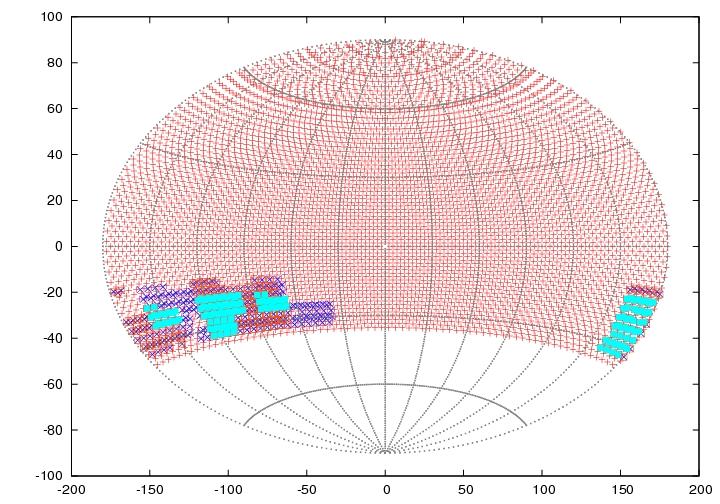 shows the status. All the pointings are in
red, light blue shows the regions which were released in DR1, dark blue shows the
353 fields which we were aiming at releasing in DR2 and dark red which includes
the light blue fields shows the
281 fields which we will be able to release in DR2 if it is scheduled immediately.
Maybe we should explore delaying the release till a proper contiguous piece
of sky is ready for release. Some of this delay is also caused by the discussion with
GTAC wherein it was suggested that we release images four months after they are
observed. We overlooked the fact that if the maps are released as above, they will
not always correpond to a contiguous piece of sky.
SS finds that coadding each computer takes about 7-8 hours to generate a catalogue
for one field. Thus with 65 computers grinding away, we can catalogue 65 fields
in 7 to 8 hours and 195 fields in one day.
Thus it took about two days to catalogue all the 353 fields. As the number of fields
increase, this time will increase and will have to be taken in to consideration.
Moreover coadding also takes time - get the numbers from SS.
shows the status. All the pointings are in
red, light blue shows the regions which were released in DR1, dark blue shows the
353 fields which we were aiming at releasing in DR2 and dark red which includes
the light blue fields shows the
281 fields which we will be able to release in DR2 if it is scheduled immediately.
Maybe we should explore delaying the release till a proper contiguous piece
of sky is ready for release. Some of this delay is also caused by the discussion with
GTAC wherein it was suggested that we release images four months after they are
observed. We overlooked the fact that if the maps are released as above, they will
not always correpond to a contiguous piece of sky.
SS finds that coadding each computer takes about 7-8 hours to generate a catalogue
for one field. Thus with 65 computers grinding away, we can catalogue 65 fields
in 7 to 8 hours and 195 fields in one day.
Thus it took about two days to catalogue all the 353 fields. As the number of fields
increase, this time will increase and will have to be taken in to consideration.
Moreover coadding also takes time - get the numbers from SS.
Some of the points which need to be discussed in the group:
Which parts of the sky to release in subsequent data releases.
How to go about doing the above - for example if a large part of the sky has been
coadded and catalogued and no regions within a few fields have been observed, then those
need not be coadded and catalogued again. Can we quantify this ?
Data checks mechanism - I think once an image is primary beam corrected, it should
be available in a common area for data quality checks to be done. So at least
image problems will be identified early on.
We need to discuss the angular resolution that we can use for all the images - one
common resolution ? It can be dependent on the worst resolution at -30d declination
but we just stick to this for the releases presently and not vary it.
Problems faced and likely to face in future.
21 February 2011:
We're running late. All the primary beam-corrected shift-corrected
coadded images were ready today instead of Feb 14 - ie late by one week.
The delay was caused by several small things. The catalogs are being
prepared now. Apparently it takes about 7-8 hours on one computer
to prepare the catalogue of one pointing. The shift estimation takes
about .... hours per field. FOr this, the catalogues are generated
in the primary beam corrected images and then compared to NVSS to
estimate the shifts. In some cases, the shifts are larger than
40' mainly since the phase calibrator is far away and phase self-cal
loses position information.
We have 353 fields this time ie for about 7 sq degs. per field converts
to about 2500 square degrees of the sky.
This includes the Galactic centre region.
The tentative date fixed for the TGSS DR2 is 28 February 2011 ie
next monday. The data quality checks have to be effected before that.
3 February 2011:
25th June 2010 data is being analysed - will get over on 4th February. Write to
Dipankar with a N->S plot for TGSS DR2 pbcorred images. Then the co-adding
+ catalogue generation will happen - get over around 11 Feb - certainly 14 Feb.
15 Feb - NVSS counterpart - generate spectral indices - data quality checks -
select steep spectrum sources. 16 Feb night - DDT at 325 MHz. 19 Feb - TGSS DR 2.
27 January 2011:
To log into the intranet page use the following
login: TGSS; passwd:GTAC-member or
http://TGSS:GTAC-member@www.ncra.tifr.res.in/~ngk/intranet
27 January 2011:
Immense progress since the last entry. TGSS first data release was on 19 October 2010;
images covering about 1000 square degrees of the sky were released; more computers were
installed in the computing lab taking the total number of computers to 65; observations
of the sky required for TGSS in cycle 19 are going on; analysis is in progress;
observing proposal for Cycle 20 was prepared and submitted on 15 January 2011 - a comprehensive status
summary was submitted with the proposal which requests 380 hours of GMRT time to
(1) complete all the observations of sky north of -30d (2) extend the observations to
cover the region between -30 and -50d (3) followup observations at 325 MHz for about
100 fields.
The status of observations (in light blue), DR1 release (in dark blue), analysed fields (in
pink), the sky remaining to be observed (in green) and the entire sky observable
with GMRT (in red) is shown in the figure in aitoff projection of equatorial coordinates:
TGSS as of 12 January 2011
4 Sep 2010: median and least squared mean spectral index
of the 36 fields (three of the fields had some problem and I couldn't
get the numbers - anyway the rest are here).
1. least squares mean spectral index
2. least squares mean spectral index
2 September 2010: In 36 fields, the TGSS catalogue gives the following numbers:
total number of sources: 10446;
number of unresolved 'U' sources are 6297 ie 60% of
all sources are unresolved. (GTAC query 6 in second part).
1 September 2010:
A source count plot is available
here (Arti)
29 August 2010:
The FITS files of primary beam corrected images for about 100 pointings are available
here for download and checks.
29 August 2010:
Click here
to look at the data checks that we have been doing and what we understand
about our maps/data. Please send comments/corrections to NGK very soon since the prsentation for tomorrow
will be prepared based on this.
28 August 2010:
Find the plots which show (1) spectral index (156, 1400 MHz) distribution
(2) spectral index versus TGSS flux density (3) spectral index versus NVSS flux
density (4) angular distance from phase centre versus difference between TGSS
and NVSS coordinates (all within 30"). Tsys correction has been applied to the fields
where required (extrapolated from Haslam et al. 408 MHz map).
Plots
Also find the plot showing the
best fit spectral index to all the ~ 200 sources in each of the field
here.
Also find the plot showing the
mean difference in the TGSS source coordinates and NVSS source coordinates.
here.
27 August 2010:
Click on the field name:
R41D15
R43D17
R44D17
R44D17
R56D17
R56D17
R58D17
R58D17
to view the comparision of the images of extended sources - sources whose angular extent
in the TGSS catalogue is listed to be larger than 30" - in images obtained from the hardware
correlator data, the software correlator data and the combined hardware and software correlator
data. The field R56D17 is close to the Galactic plane and the images have been scaled by the
Tsys correction estimated from the Haslam et al. 408 MHz map.
Some of the problems areas:
1. offsets between GSB and GHB source positions and also with NVSS. Seen in more than
one field - some of the fields in the above list that show some level of problem:
R43D17, R58D17.
2. Double natured sources are seen in some of the fields.
25 August 2010:
The TGSS Image server and catalogue browser are ready for testing says Sandeep. Click
here to visit and test it. Send comments to Sandeep.
Update from July 2010:
To view the images released for GTAC; click
here .
22 August 2010:
TGSS image server is getting ready - Sandeep is working on it.
Here are plots showing the N->S for the 36 images listed for GTAC:
source count plots .
Update from 20 August 2010:
Click on the field name:
1. R41D15
2. R56D17
to view the comparision of the images of extended sources - sources whose angular extent
in the TGSS catalogue is listed to be larger than 30" - in images obtained from the hardware
correlator data, the software correlator data and the combined hardware and software correlator
data. The field R56D17 is close to the Galactic plane and the images have been scaled by the
Tsys correction estimated from the Haslam et al. 408 MHz map.
Update from August 13 2010:
Click here for the system temperature
correction factors for the images kept at the above URL. Note that
the numbers listed in the column with the heading C-3C48 have to be applied to
the image units in the above URL. The verb in AIPS to use is 'rescale' and
the adverb which has the correction factor is 'factor'.
Click here for the sky temperature
values at 150 MHz derived from the Haslam et al. map at 408 MHz using a spectral index of -2.55 after convolving
it to the 150 MHz beam ie 173 arcmins.
Update from 21 July 2010: SKS, GK, Arti, NGK
Checks on data:
1. source count - N -> S: a) for all sources b) for sources detected
at 150 MHz and not in NVSS and vice versa.
2. GSB data versus GHB data
Update from 6 July 2010: SKS, ICH, NGK
Points for the proposal:Status summary
1. Sky area covered till 7 July - include the figure showing the pointings - the observed
pointings should be in blue. About 1000 pointings have been observed
in the (RA,dec) range of 10h40m to 21h00m, -30d to +27d.
2. TGSS computing lab has been set up now. We give the progress chart below:
21 May 2010 - 44 desktop computers with Intel I5 processors arrive at NCRA
22 May 2010 - 23 June 2010 - disk/CPU quality checked,
operating systems installed, Centos 5.5 (equivalent to
Fedora Core 4), compatible AIPS++ version installed and
tested and verified AIPS++ perfomance on all computers, the data
analysis pipeline was checked by running on few of the pointings
observed in Cycle 16 (the same fields which were given to GTAC members
in Cycle 18 proposal).
28 June 2010 - Primary beam corrected images of the pointings from Cycle 16
were ready. The images match with the ones generated earlier and so
all is well.
28 June 2010 - 2 July 2010 - production mode images generated for
36 pointings from the observation on 6 June - co-added images.
5 July 2010 - source catalogues were generated from the co-added images.
We note that for subsequent data analysis all the above steps will not
be repeated and only the pipeline will run in the production mode and
generate images - 1 day's data will be processed in 3.5 days in the
TGSS computing lab. This will match the rate of observation once we
have cleared the backlog which will be possible in the one month downtime.
7 July 2010 - We will release about 230 square degrees for GTAC on 7 July.
And a larger data release is planned for September 2010.
Update from 5 July 2010: SKS, ICH, NGK
1. 36 images (one day's data) in two regions of the sky have been analysed. Coadded images
are available on 2 July.
2. Catalogues of all the fields are available. 5 July 2010.
Update from 28 June 2010: SKS,ICH,NGK
1. 32 images will be ready on 30 June 2010 - the time required for the cross-calibration
had not been included in the estimate earlier
2. We should aim at releasing ~ 2500 sq deg. by September 2010 - before the GTAC
meeting which will allocate time for Cycle 19.
Update from 22 June 2010: SKS,ICH,NGK,GK,AG
1. AIPS++ installed and running on all 44 machines
2. The analysis pipeline is being run on 12 machines and old data being analysed
to check for the optimum configuration.
3. New dataset from Cycle 18 will be analysed - 32 pointings will be analysed.
25 June: Images of 32 pointings will be ready as written in the 21 June update.
4. Gopal thinks we need to compare peaks with Speak > 100 mJy/bm with NVSS - both for images convolved
to NVSS resolution and the full resolution 150 MHz images. Arti is implementing this.
Update on 21 June 2010: SKS,ICH,NGK
Running late by 7 days
22 June 2010: one day's data will be passed through the pipeline
25 June 2010: 32 fields will be imaged
28 June 2010: coadded images, catalogues, logN-logS, spectral index distribution in annuli plots
Rest as under.
Meet on 5 Jun 2010 - SKS, ICH, GK, NGK: Important points:
7 June - at least few computers will be running the pipeline - even if the
performance is not maximum.
18 June - one day's data (far from plane)
from Cycle 18 will be analysed and imaged ~ 32 fields.
21 June - coadding, catalogues
24 June -logN - logS, spectral index distribution in annuli plots.
5 July - Data quality checks: logN - logS, spectral index (150, 1420), convolve to NVSS
and morphology check , comparison of pt source in overlapping parts of pointings for flux
fidelity, position fidelity; comparision of position of pt sources wrt NVSS - especially
sources in the triangular patch where sources from three pointings are included.
7 July - Data Release for GTAC - 200 sq deg
October 2010 - Before next observing cycle starts: Data Release for 5000 sq deg. with
all checks done
|
 The image of a part of the sky at 45" resolution.
